

"It's like constructing buildings. The paper offers space for many possibilities," he says.
Yuan Yunfu, a professor at the Academy of Arts & Design at Tsinghua University, says: "Chinese ink paintings and calligraphy share the same origin.
"In Wang's work, a gist of calligraphy is extracted, transformed and exaggerated to find a connection between the content and the platform, and a balance is struck between something concrete and abstract."
However, Wang prefers to call himself a practitioner of modern art.
"As modern lifestyles are different from life in ancient times, it is not necessary to follow traditions," says Wang.
So, he wants hanshu to make traditional Chinese art forms accessible to the East and West.
"The spirit of traditional art must be retained, but new approaches are also needed," he says.
"Chinese-style modern art is not only about Western methods to explain Chinese themes. We need Chinese platforms."
His views are echoed by US artist Joan Schulze, who says: "It's a dilemma for all artists-how to honor traditions and move them forward so that art remains a live and growing medium.
"Wang has done this: Each work is uniquely his and contributes a fresh approach to the long tradition of Chinese calligraphy.
"Paper and ink become one with this artist-say more with less."
 |
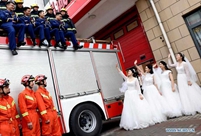 Fire brigade in Shanghai holds group wedding
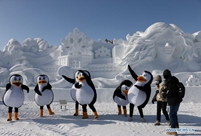 Tourists enjoy ice sculptures in Datan Town, north China
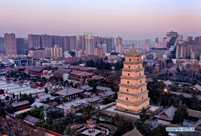 Sunset scenery of Dayan Pagoda in Xi'an
 Tourists have fun at scenic spot in Nanlong Town, NW China
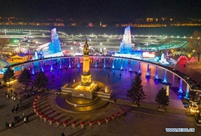 Harbin attracts tourists by making best use of ice in winter
 In pics: FIS Alpine Ski Women's World Cup Slalom
 Black-necked cranes rest at reservoir in Lhunzhub County, Lhasa
 China's FAST telescope will be available to foreign scientists in April
 "She power" plays indispensable role in poverty alleviation
 Top 10 world news events of People's Daily in 2020
 Top 10 China news events of People's Daily in 2020
 Top 10 media buzzwords of 2020
 Year-ender:10 major tourism stories of 2020
 No interference in Venezuelan issues
 Biz prepares for trade spat
 Broadcasting Continent
 Australia wins Chinese CEOs as US loses