

The Chinese government will devote more effort in 2017 to implementing assessment measures that focus more on the environment than economic growth, according to China's top economic planner.
Under the new measures, officials' performances will be judged based on environment-related indicators, including resources utilization, environment quality, ecological protection, green lifestyle and public satisfaction, said Zhao Chenxin, spokesperson for the National Development and Reform Commission (NDRC).
This is the first time in the history of the People's Republic of China that environment protection has carried more weight than economic development in the assessment of officials.
According to the Green Development Index System, which is a part of the mechanism released last December, the economic growth category carries a weighted value of 9.2 percent--much less than the value of environmental categories.
As early as 2011, many places in northwestern Xinjiang Uygher Autonomous Region had consciously started giving higher priority to environmental protection, while also reducing the emphasis on economic growth.
In 2011, the Bortala Mongol Autonomous Prefecture ordered Wenquan County to stop using GDP as an indicator when assessing officials. The county then integrated and restructured its nonferrous metal industry, shut down ineligible plants and banned unrestricted mining.
While weakening and in some cases even eliminating the economic growth indicator, Xinjiang has also carried out a pilot project to lower economic growth targets in impoverished counties. In 2010, the GDP target of Yumin, a poor county, was proactively lowered to pave way for environmental protection and and a "green economy." That year, the industrial added value of Yumin dropped from 100 million RMB ($14.5 million ) to 60 million RMB ($8.72 million).
To further promote anti-pollution efforts, the Ministry of Water Resources recently established a system cataloging the performance evaluations of officials. The ministry will supervise and investigate implementation of the system later this year and into 2018.
Since 2016, the Ministry of Environment has been interviewing government heads about poor air quality. Last April, it interviewed officials from Changzhi in Shanxi province, Anqing in Anhui province, Jining in Shandong province, Shangqiu in Henan province and Xianyang in Shaanxi province over rising levels of pollutants and violations of environmental laws.
Data released by the ministry shows that as of Dec. 5, 2016, a total of 295 companies had been registered and disciplined for environmental offenses. Eighteen people were detained and 275 people were interviewed.
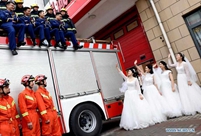 Fire brigade in Shanghai holds group wedding
 Tourists enjoy ice sculptures in Datan Town, north China
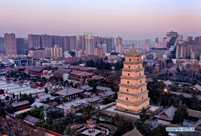 Sunset scenery of Dayan Pagoda in Xi'an
 Tourists have fun at scenic spot in Nanlong Town, NW China
 Harbin attracts tourists by making best use of ice in winter
 In pics: FIS Alpine Ski Women's World Cup Slalom
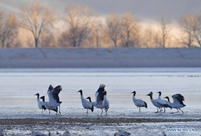 Black-necked cranes rest at reservoir in Lhunzhub County, Lhasa
 China's FAST telescope will be available to foreign scientists in April
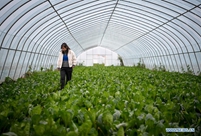 "She power" plays indispensable role in poverty alleviation
 Top 10 world news events of People's Daily in 2020
 Top 10 China news events of People's Daily in 2020
 Top 10 media buzzwords of 2020
 Year-ender:10 major tourism stories of 2020
 No interference in Venezuelan issues
 Biz prepares for trade spat
 Broadcasting Continent
 Australia wins Chinese CEOs as US loses