

 |
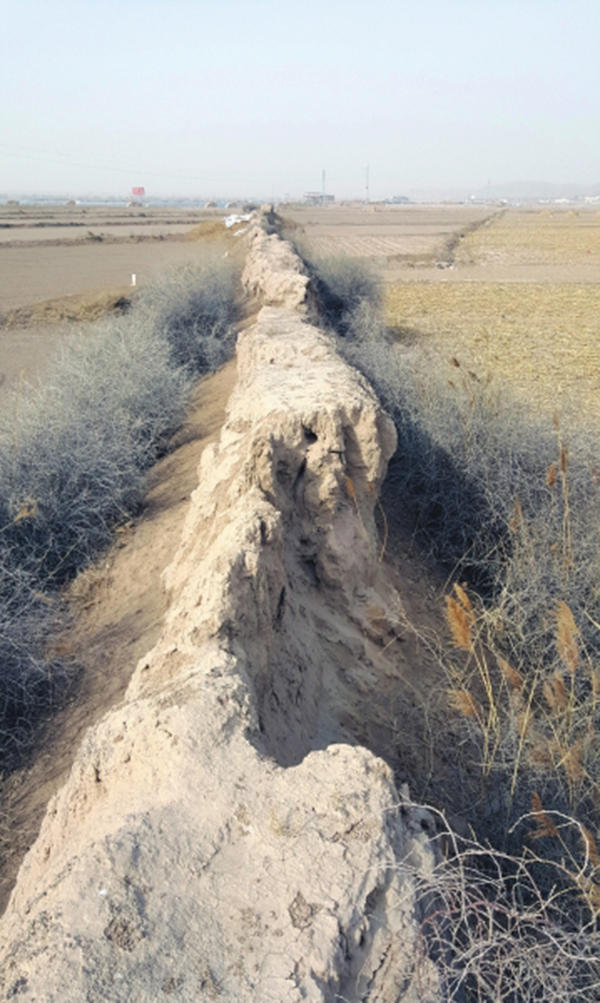
Stretching over about 90 kilometers, the Jingtai area of the Great Wall, built in the Ming Dynasty in 1599, is now at risk of being swallowed by farmland.
Unlike eastern parts of the Great Wall in Beijing and Hebei, which were mostly constructed using stones and brick, sections in Gansu were largely built using soil and earth. After centuries of erosion from wind and sandstorms, they have become extremely fragile.
Some parts of the wall were reduced to soil ridges due to large-scale farming, and some were used as part of a courtyard to fence in livestock and cultivate dried grass. In addition, the wall has sprouted grass in some places that see little human activity.
The wall was severely damaged in the 1970s and '80s, when farmland was expanded excessively, locals explained. Protection and renovation of the wall restarted when people began paying more attention to historical and cultural sites. In 2006, the wall was put under state protection. In 2015, Gansu established a protection zone spreading 20 meters across both sides of the wall.
 Fire brigade in Shanghai holds group wedding
 Tourists enjoy ice sculptures in Datan Town, north China
 Sunset scenery of Dayan Pagoda in Xi'an
 Tourists have fun at scenic spot in Nanlong Town, NW China
 Harbin attracts tourists by making best use of ice in winter
 In pics: FIS Alpine Ski Women's World Cup Slalom
 Black-necked cranes rest at reservoir in Lhunzhub County, Lhasa
 China's FAST telescope will be available to foreign scientists in April
 "She power" plays indispensable role in poverty alleviation
 Top 10 world news events of People's Daily in 2020
 Top 10 China news events of People's Daily in 2020
 Top 10 media buzzwords of 2020
 Year-ender:10 major tourism stories of 2020
 No interference in Venezuelan issues
 Biz prepares for trade spat
 Broadcasting Continent
 Australia wins Chinese CEOs as US loses