

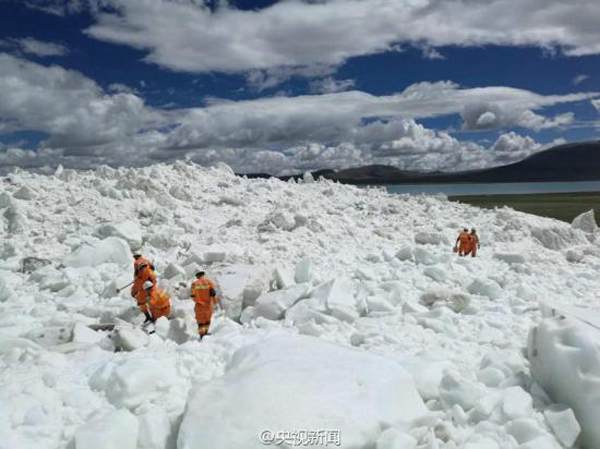
Another large-scale glacier avalanche occurred in Ngari Prefecture, Tibet Autonomous Region in September, two months after the last big one. In a research paper published by the Journal of Glaciology, which is jointly run by the Institute of Tibetan Plateau Research under the Chinese Academy of Sciences and the Byrd Polar and Climate Research Center at Ohio State University, scientists argue that the increasing frequency of avalanches may be caused by rising temperatures brought about by climate change. If this is true, the two big avalanches may be just the beginning.
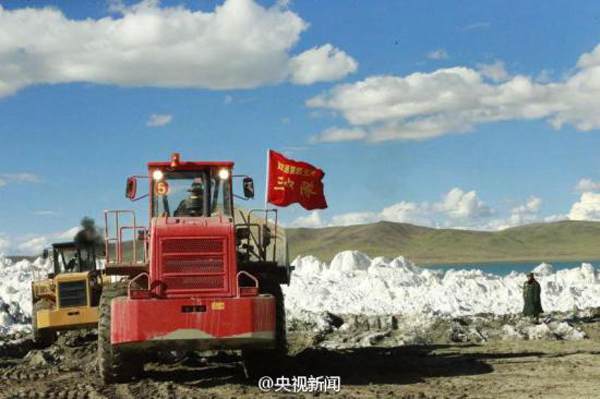
On July 17, a major glacier avalanche occurred in Ngari Prefecture, Tibet. Though over 100 rescuers rushed to the disaster-stricken area, the death toll was still nine, with more than 100 yaks gone.
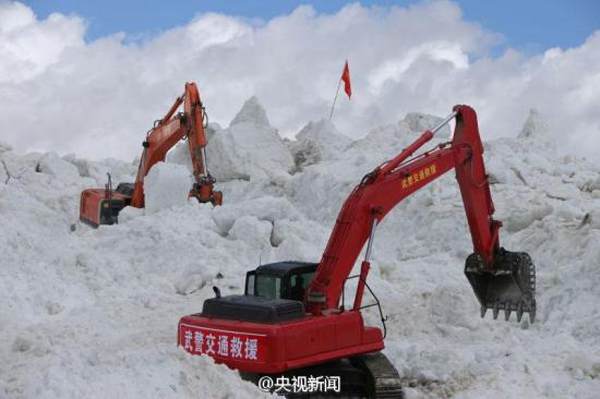
There are 5,862 glaciers in the region, covering 4,900 square kilometers. These glaciers provide stable water resources, but also pose great risks. Previous monitoring showed that the glaciers in the region are stable, meaning that the two disasters triggered extra concern, with data showing that temperatures have risen.
Satellite images show that the glacier in question first began to form from a snowmelt in September 2015. The surface of the collapse resulting from the glacier avalanche was over 10 square kilometers, equal in size to 1,400 football fields. Some experts believe this disaster is the result of local temperature increases and heightened precipitation, in turn caused by climate change. If this is the case, then still-higher temperatures may lead to a series of glacier avalanches in the future. Others think the disaster was caused by the normal cyclical movement of glaciers.
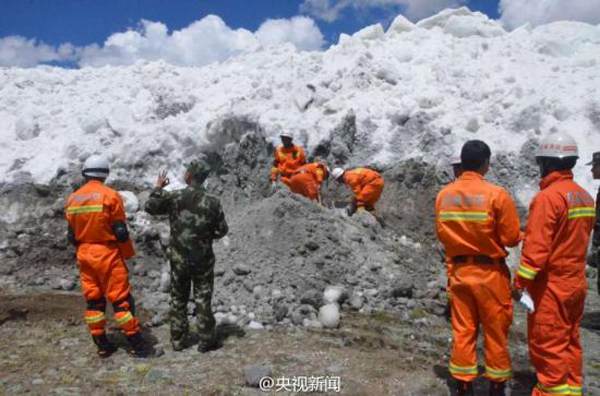
It is neither easy nor cost-efficient to conduct continuous monitoring over such a vast region. What's more, certain meteorological phenomena restrict the emergency alert system.
This disaster underscores the insufficient progress human beings have made to stop climate change. However, it could serve to urge scientists and local government that now is the time for new solutions, suggested Tian Lide, a glacier expert with the Institute of Tibetan Plateau Research under the Chinese Academy of Sciences.
 Fire brigade in Shanghai holds group wedding
 Tourists enjoy ice sculptures in Datan Town, north China
 Sunset scenery of Dayan Pagoda in Xi'an
 Tourists have fun at scenic spot in Nanlong Town, NW China
 Harbin attracts tourists by making best use of ice in winter
 In pics: FIS Alpine Ski Women's World Cup Slalom
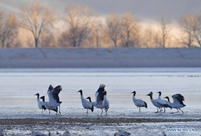 Black-necked cranes rest at reservoir in Lhunzhub County, Lhasa
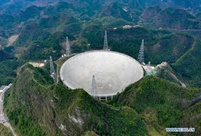 China's FAST telescope will be available to foreign scientists in April
 "She power" plays indispensable role in poverty alleviation
 Top 10 world news events of People's Daily in 2020
 Top 10 China news events of People's Daily in 2020
 Top 10 media buzzwords of 2020
 Year-ender:10 major tourism stories of 2020
 No interference in Venezuelan issues
 Biz prepares for trade spat
 Broadcasting Continent
 Australia wins Chinese CEOs as US loses