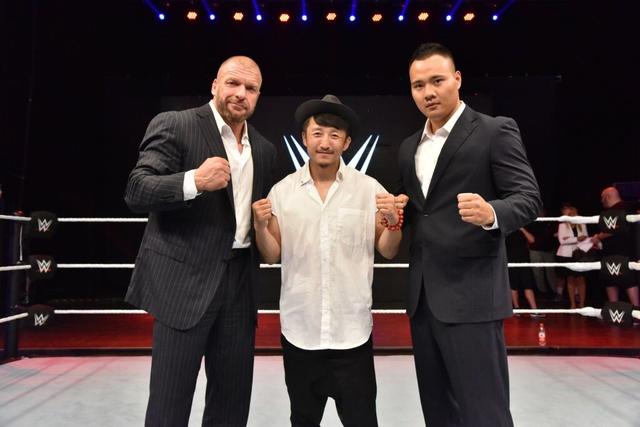
File photo: WWE Paul Levesque (L), Executive Vice President of WWE posed with Chinese boxing champion Zou Shiming (M) and Wang Bin (R) the first Chinese wrestler they have signed.
On September 8th, World Wrestling Entertainment (WWE) announced the signing of seven new recruits from China. They include: Gao Lei, Gu Guangming, Big Boa, Zhao Xia, Wang Xiaolong, Yifeng, and Cheng Yuxiang. After participating in a grueling week of tryouts, the successful seven were chosen from a pool of 34 candidates.
Two days later, WWE’s first-ever Chinese recruit, Bin Wang, made his official in-ring debut in Shanghai. The new recruit, now known as by his stage name Tian Bin, defeated Bo Dallas, a 26-year-old wrestler who’s been with the WWE for eight years. The two are part of an international show that’s already been featured in England and the Philipines.
The WWE is showing a clear commitment to entering the Chinese market. When they signed Tian Bin back in June, they also announced a multi-year product distribution agreement with PPTV. The agreement will ensure WWE staples, Raw and Smackdown Live, are broadcast live in Mandarin. This deal, as well as the newly signed recruits, is clear stepping-stones towards creating and inspiring a Chinese WWE fanbase.
 Fire brigade in Shanghai holds group wedding
 Tourists enjoy ice sculptures in Datan Town, north China
 Sunset scenery of Dayan Pagoda in Xi'an
 Tourists have fun at scenic spot in Nanlong Town, NW China
 Harbin attracts tourists by making best use of ice in winter
 In pics: FIS Alpine Ski Women's World Cup Slalom
 Black-necked cranes rest at reservoir in Lhunzhub County, Lhasa
 China's FAST telescope will be available to foreign scientists in April
 "She power" plays indispensable role in poverty alleviation
 Top 10 world news events of People's Daily in 2020
 Top 10 China news events of People's Daily in 2020
 Top 10 media buzzwords of 2020
 Year-ender:10 major tourism stories of 2020
 No interference in Venezuelan issues
 Biz prepares for trade spat
 Broadcasting Continent
 Australia wins Chinese CEOs as US loses