


Beijing Times reposted on its official Sina Weibo account on Sept. 5 the video that shows failed attempts to balance a coin on a Japanese high-speed train. [Photo/Weibo]
A video claiming to test the stability of Japanese bullet trains has recently attracted media attention. The video came on the heels of a similar video, purporting to test the stability of Chinese high-speed trains.
A nearly 10-minute video clip widely circulated on Chinese video portals and social media throughout 2015. A Swedish man named Ola Von Koskull claimed to have shot the video while aboard the Beijing-Shanghai high-speed railway, uploading it to YouTube on March 14, 2015. The Swede successfully balanced a coin on the window sill of a CRH380 train traveling at 300 kilometers per hour (186 miles per hour) for nearly eight minutes. The video has garnered complimentary comments on both YouTube and its Chinese counterpart, Youku.
On Sept. 1, the Sina Weibo account “Ding Ji Jian Zhu” posted a one-minute video claiming that someone had carried out the same test on the 700 Series Shinkansen bullet train in Japan. The video shows a person trying to balance a coin on the window sill of a moving train, but failing several times over the course of about 50 seconds. The video has been reposted by a number of Chinese media outlets, including the Beijing Times and Global Times.
Although the two tests were not totally comparable, as they used different coins, the relative stability and smoothness of the Chinese high-speed rail seems quite clear. Since the videos came out, several experts have offered explanations for the impressive stability of Chinese trains, thepaper.cn reported.
As the video shows, the coin stayed balanced even when the train stopped at the Changzhou North station, decelerating from 300 kilometers per hour to a full stop. This is due to the fact that the braking deceleration rate of the CRH380 train is less than 0.75 meters per second squared, which guarantees a smooth stop.
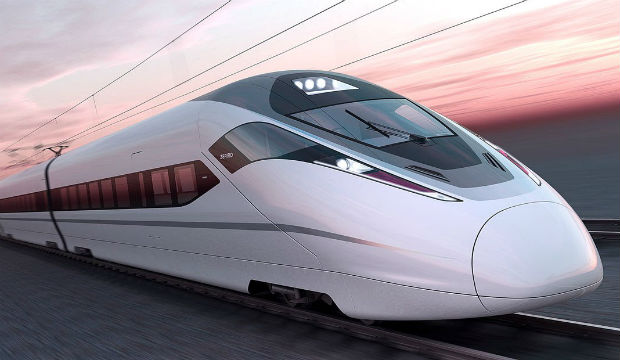
Chinese railways also adopt a larger railway curve radius, which prevents trains from making steep turns and ensures that trains make only the mildest horizontal motion when taking a turn. The minimum railway curve radius in European and Japanese railways is usually around 4 kilometers, but in China, for a train with a speed of 350 kilometers per hour, the curve radius is at least 7 kilometers. The CRH380 train in the video had a curve radius of 9 kilometers. To contain vertical vibrations, Chinese railways are built with mild slopes.
Another secret for stability is the use of long steel pieces, which reduces friction in the joints of the railway. Every piece of steel has a length of 100 meters, four times longer than those used to build most ordinary railroads. While welding two pieces of steel together, no gap is permitted to be more than 0.3 millimeters wide, which is equal in size to four human hairs.
Without a doubt, every component of China’s railways features precise craftsmanship.
 Fire brigade in Shanghai holds group wedding
 Tourists enjoy ice sculptures in Datan Town, north China
 Sunset scenery of Dayan Pagoda in Xi'an
 Tourists have fun at scenic spot in Nanlong Town, NW China
 Harbin attracts tourists by making best use of ice in winter
 In pics: FIS Alpine Ski Women's World Cup Slalom
 Black-necked cranes rest at reservoir in Lhunzhub County, Lhasa
 China's FAST telescope will be available to foreign scientists in April
 "She power" plays indispensable role in poverty alleviation
 Top 10 world news events of People's Daily in 2020
 Top 10 China news events of People's Daily in 2020
 Top 10 media buzzwords of 2020
 Year-ender:10 major tourism stories of 2020
 No interference in Venezuelan issues
 Biz prepares for trade spat
 Broadcasting Continent
 Australia wins Chinese CEOs as US loses