



'Mural doctor' devotes over 40 years to protecting ancient murals
At the Dunhuang Academy's conservation research institute in northwest China's Gansu Province, Fan Zaixuan, a "mural doctor" and a researcher at the academy, briefed colleagues on a new challenge shortly after returning from Nanjing, east China's Jiangsu Province: restoring murals buried underground in a region far more humid than the desert oasis where he had built his career.
Born in June 1961 in Xinxiang, central China's Henan Province, Fan joined what is now the Dunhuang Academy in 1981 and has spent more than four decades restoring ancient murals, rising from an apprentice to a leading figure in the field.
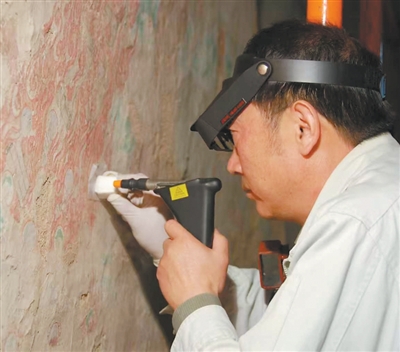
Fan Zaixuan restores a mural. (Photo courtesy of the interviewee)
He has authored multiple restoration standards, drafted more than 30 restoration plans, led over 10 restoration projects, secured patents for mural damage treatment techniques, and won multiple national awards for conservation science.
Over the decades, Fan has encountered nearly every mural ailment: flaking, hollowing, detachment, salt efflorescence and biological damage, each requiring its own "prescription."
Salt efflorescence — sometimes called "mural cancer" for its difficulty to treat — once threatened 710 square meters of murals at the Mogao Grottoes, a UNESCO World Heritage Site in Dunhuang. The damage occurs as soluble salts within a mural's plaster layer dissolve as humidity rises and recrystallizes when the air becomes drier, a repeated cycle that causes paint layers to detach.
Fan's team ran humidity simulations and found that 67 percent relative humidity was the tipping point that triggered salt movement. They developed a method using low-temperature steam to dissolve the salts, then remove them with an absorbent material combining nonwoven fabric, wood pulp and starch-based polyacrylamide resin — fast-absorbing, chemically inert and thin enough for delicate work.
After eight years of research, the team identified the mechanisms behind salt efflorescence and developed a scientifically sound restoration method. It has since restored more than 500 square meters of salt-damaged murals at the Mogao Grottoes.
The team went on to develop other solutions, including a surfactant compound that dissolves soot without harming murals, and a lightweight, fast-drying grouting material for hollow sections of the murals.
Fan is also the lead author of multiple technical standards. "Turning our experience into something systematic, scientific and standardized preserves the accumulated know-how of past restorers while also providing guidance and reference for future mural restoration," he said.
Fan applied to the Dunhuang Cultural Relics Research Institute, the academy's predecessor, in 1981 at age 20, later choosing to work in the institute's conservation research studio.
With fewer than 10 staff in the studio at the time, he taught himself inorganic, organic and analytical chemistry, pairing it with art history and archaeology knowledge from mentors including veteran restorers Duan Xiuye and Li Zuixiong. He later studied at Lanzhou University and Fudan University before working abroad as a visiting scholar.
Dai Chuan, Fan's colleague and former student who joined the academy in 2014, said Fan taught him not just restoration techniques but a scientific approach to conservation — balancing caution and reverence for relics with long-term, holistic judgment.
The academy's conservation team has since grown from fewer than 10 staff to more than 40 specialists in fields ranging from history and chemistry to geology, geography, civil engineering, architecture and biology.
Over the years, the academy's conservation team that includes Fan has also worked on restoration projects at the Tiantishan Grottoes in Gansu Province, the Potala Palace in southwest China's Xizang Autonomous Region and the Yungang Grottoes in north China's Shanxi Province.
Fan recalled that the Potala Palace project posed novel problems. Its murals sit more than 3,700 meters above sea level, versus roughly 1,300 meters at the Mogao Grottoes, and were built using different techniques, including a brittle soil-rock mixture that collapses easily when wet. The conservation team simulated the murals in the lab to select suitable materials before completing the restoration.
Fan has trained more than 300 mural restoration technicians for institutions nationwide. Even after retiring, he has continued working on the front lines of mural restoration.
"There are still problems in ancient mural research that remain unsolved. Generation after generation, our team must keep Dunhuang's beauty alive," Fan said.
Photos


Related Stories
- Giant mural featuring Chinese blockbuster 'Ne Zha 2' attracts thousands to village in E China's Shandong
- Murals from China's Tang Dynasty exhibited in Macao SAR
- Murals seen in Donggar and Piyang grottoes in Tibet
- Digital technology revives treasured murals in Beijing
- Pic story: mural artist paints wall paintings in hometown in SW China
- Female Gen-Zer recreates masterpiece from Dunhuang’s famed Mogao grottoes
- Photo exhibition highlights murals found on ancient buildings in China’s Fujian
- Muralists decorate countryside with creativity, passion
- Mural exhibition on Tibet opens in Shanghai
- Creative products give murals of ancient grottoes a modern spin
Copyright © 2026 People's Daily Online. All Rights Reserved.
