



Micro-dramas fuel rural revitalization in village in E China's Shandong
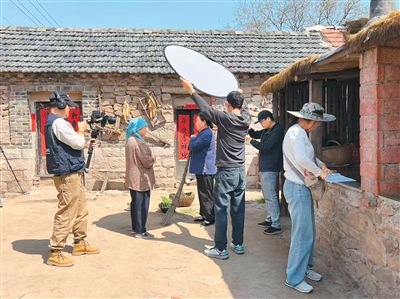
Villagers act in a micro-drama in Beiliangjiazhuang village, Zhuhai subdistrict, West Coast New Area, Qingdao, east China's Shandong Province, May 2026. (Photo courtesy of the interviewee)
Farmers with no acting experience have starred in a series of micro-dramas that have racked up more than 1 billion views.
The performers are from Beiliangjiazhuang village in Zhuhai subdistrict, West Coast New Area, Qingdao, east China's Shandong Province, a community of 247 households and about 520 permanent residents.
The project began in the summer of 2025, when villagers who had never performed before agreed to act in micro-dramas filmed in their own village. With no professional equipment, no acting training and no pay, they were driven by a simple goal: to put their village on screen and sell what they grew in the fields.
The strategy paid off. Chestnuts, sweet potatoes and cherries that once went unsold became sought-after products, a sweet potato vermicelli plant was built, and the village began attracting tourists.
Beiliangjiazhuang had never struggled to grow good produce. The challenge was selling it. Farmers either hawked goods by the roadside or sold them in bulk to traders at low prices.
Concerned, village Party secretary Zhang Wei turned to Ding Zhaoting, a social media influencer from a nearby town who had given up a building-materials business six years earlier and now runs several social media accounts with millions of followers each. The two settled on a plan: use micro-dramas to build an audience, then leverage that audience to sell goods.
In September 2025, the village's first micro-drama drew 270 million views in less than two months after its release. From then on, former doubters began asking Ding if they could take part. The village's follow-up productions each drew more than 100 million views.
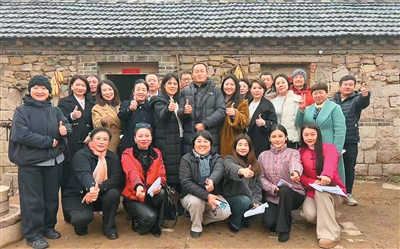
Villagers pose for a group photo after acting in a micro-drama in Beiliangjiazhuang village, Zhuhai subdistrict, West Coast New Area, Qingdao, east China's Shandong Province, May 2026. (Photo courtesy of the interviewee)
The dramas generate sales through what Ding calls "seamless product placement." For example, corn on a wall, chestnuts atop a kitchen range, and dew-covered cherries on a tree are woven into the scenes, helping viewers recognize the produce when villagers sell it through livestreaming.
Zhang Zhixing, 75, was an early beneficiary. He was too old to harvest his hawthorn berries himself, and with no buyers in sight, he grew anxious. When the film crew heard about it, several members went straight to his orchard to film videos and livestreams. Within days, all 3 mu (about 0.2 hectares) of hawthorn berries were sold out.
Beiliangjiazhuang's 600-mu cherry orchard recently opened to visitors. By 7 a.m., before the morning dew had even cleared, cars already lined both sides of the village road.
"It was the very first day, and my orchard was already packed with visitors," said villager Liu Ying. This year's foot traffic is two to three times what it used to be, thanks to the popularity of the micro-dramas and livestreams, Liu said.
"Fruit used to wait for buyers; now buyers wait for fruit. This year's cherry festival drew visitors not only from neighboring districts and counties, but also from as far as Jinan, Weifang and even other provinces," said Zhang Wei.
Since last year, livestreaming and other channels have brought the village more than 500,000 yuan ($74,000) in new income.
The buzz also attracted investment. Ding Xinqiang, a native who had worked elsewhere for years, reached out to Zhang Wei with a proposal to invest. Within a week, the first project was finalized: a sweet potato vermicelli plant, with an initial order of 25,000 kilograms.
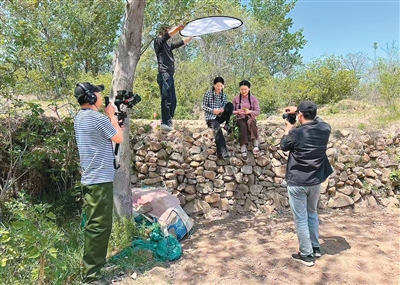
A micro-drama is filmed in Beiliangjiazhuang village, Zhuhai subdistrict, West Coast New Area, Qingdao, east China's Shandong Province, May 2026. (Photo courtesy of the interviewee)
The two sides agreed to cooperate on programs involving sweet potato tea, dried sweet potatoes, pet food and tourism, with total investment growing from 2 million yuan to 10 million yuan.
Micro-dramas have reshaped village life beyond income. More than 40 residents have appeared on screen, with more than 100 people from nearby villages also joining — some learning video editing, others studying camera composition, and still others bringing produce from their own fields into livestreams.
Ding said Qingdao's landmarks will be woven into future productions. The team plans to keep filming live-action micro-dramas while also exploring AI-generated ones, using the technology to showcase hometown scenery, landmarks and culture at lower cost.
"I want to use the camera to promote my hometown, so more people know about its scenery and high-quality produce," Ding noted.
In January 2026, West Coast New Area issued guidelines to support the micro-drama industry, encouraging its integration with tourism, branding, rural revitalization, consumption and other sectors.
Photos
 Night market of Xishuangbanna sees surge in visitor arrivals during summer peak tourism season
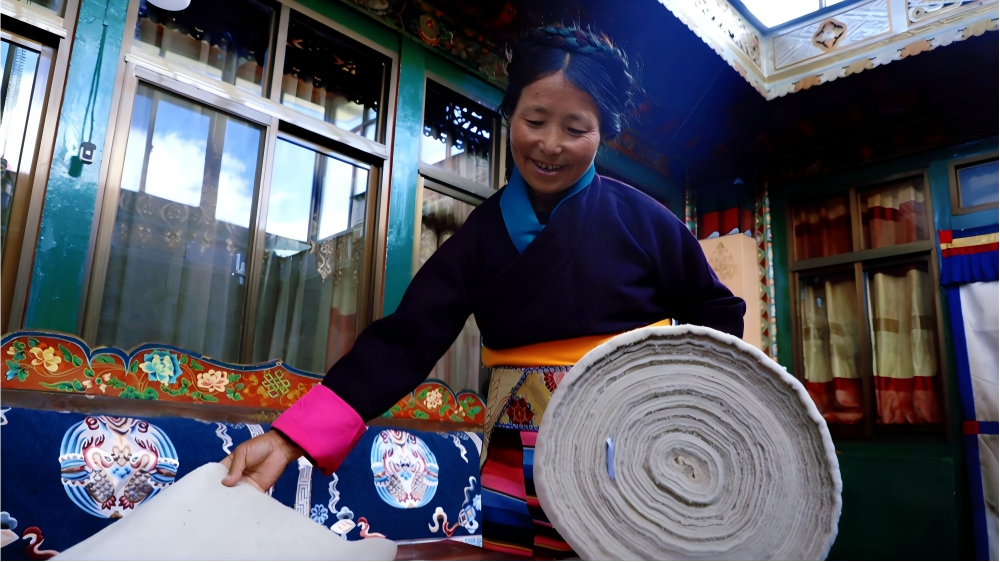 Pulu weaving tradition thrives in Kyimxi township, SW China's Xizang
 Intangible cultural heritage breathes new life into Dong village in SW China's Guizhou
 Badminton shuttlecocks boost development of county in SW China's Guizhou
Related Stories
- Chinese social media giant steps up investment in micro-drama industry
- China's micro-drama boom meets AI as industry shifts toward quality
- Micro-dramas boost rural sales in E China's Shandong
- iQIYI's global growth signals rising worldwide demand for Chinese content
- Chinese micro-drama surge in popularity across Southeast Asia
- Micro-dramas featuring children should be age-appropriate, China tells its content creators
- Chinese dance drama "Wing Chun" kicks off commercial run in Canada
- Media day event of Chinese dance drama Wing Chun held in Toronto
- Chinese dance drama Oriental Legend performed in Toronto, Canada
- Artists of China National Opera House perform in dance drama "Qiuci" in Beijing
Copyright © 2026 People's Daily Online. All Rights Reserved.
