



China to cancel vehicle and vessel tax preferential policy for energy-saving vehicles, NEVs
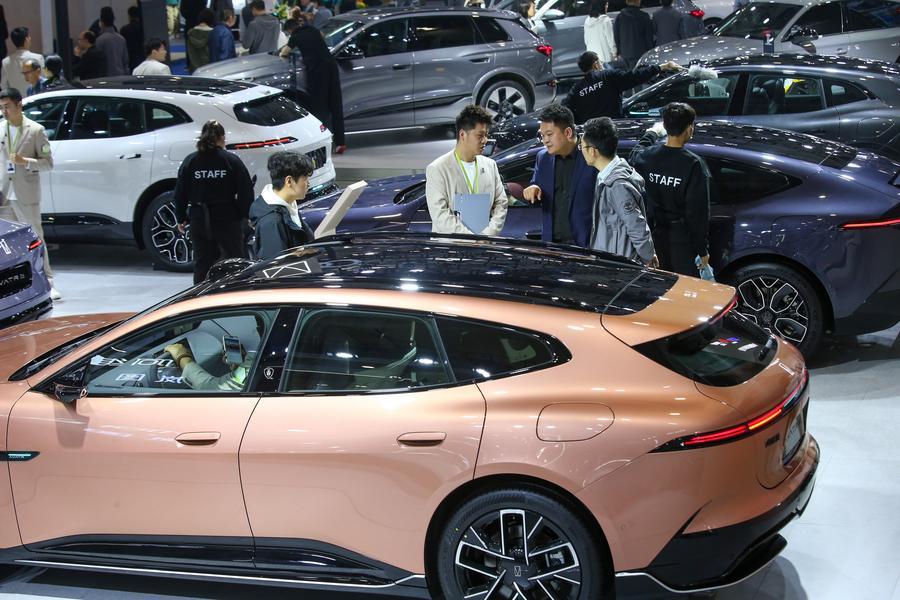
People visit an auto show in Jinan, east China's Shandong Province, April 10, 2026. (Photo by Hao Xincheng/Xinhua)
BEIJING, July 3 (Xinhua) -- Chinese authorities announced Friday that starting from January 1, 2027, the country will cancel the policies of halving the vehicle and vessel tax for energy-saving vehicles and exempting certain new energy vehicles (NEVs), including pure electric commercial vehicles, plug-in hybrid electric vehicles, and fuel cell commercial vehicles from the tax.
With the adjustment, taxpayers who have acquired or will acquire the above-mentioned vehicles will be required to pay the annual tax starting next year, according to the Ministry of Finance.
However, pure electric passenger vehicles and fuel cell passenger vehicles remain unaffected by this policy adjustment and will continue to be exempt from the tax, as the two categories do not fall within the taxable scope stipulated by the vehicle and vessel tax law.
The vehicle and vessel tax is a property tax levied annually on the owners or managers of vehicles and vessels. Provincial-level regions can set region-specific applicable tax amounts within a certain range of tax rates.
Since 2012, China has implemented preferential vehicle and vessel tax policies to support the growth of the NEV industry and promote energy conservation and emission reduction. In recent years, the sector has witnessed rapid growth, along with rising challenges brought about by the preferential treatment to tax equity and the regulatory role of tax.
Analysts believe that this policy adjustment will help promote tax equity and guide the sound development of the NEV industry. "Vehicle and vessel tax serves functions of wealth redistribution as well as regulating and guiding industrial development," said Liang Ji, director of the public revenue research center at the Chinese Academy of Fiscal Sciences.
According to industry analysts, the vehicle and vessel tax amounts are relatively modest. For instance, the annual tax for a plug-in hybrid electric passenger vehicle with a 1.5-liter engine displacement is 420 yuan (roughly 60 U.S. dollars) in Beijing, and 300 yuan in Shanghai and Guangdong.
Liu Bin, deputy head of the China automotive strategy and policy research center, said that as the tax accounts for a relatively small proportion of the total cost of car ownership and affects a limited range of vehicle models, the overall impact is expected to be reasonably minimal.
"After years of development, China's NEV industry has moved beyond dependence on universal preferential policies and entered a new stage of market-driven and autonomous growth," Liu said, adding that the policy adjustment will encourage enterprises to achieve high-quality development through market competitiveness.
Photos
 Immersive theater village inspired by poverty alleviation story opens in NW China's Ningxia
 Night scenery of Huishan Yingyueli area in China's Jiangsu
 Smart plant factory produces high-quality vegetables, creates jobs in Kuqa, NW China's Xinjiang
 Beijing-Shanghai High-speed Railway marks 15th anniversary of operation
Related Stories
- China's tax data reveals steady industrial revenue growth in first 5 months
- China to optimize departure tax refunds to boost inbound consumption
- China's instant tax refunds surge over 9-fold a year after rollout
- China to implement updated policies for departure tax refund: commerce minister
- China steps up tax compliance to foster unified national market
- China optimizes export tax rebate management for higher efficiency
Copyright © 2026 People's Daily Online. All Rights Reserved.
