



A 26-year green promise: cross-ocrean friendship blooms in Maowusu sandy area
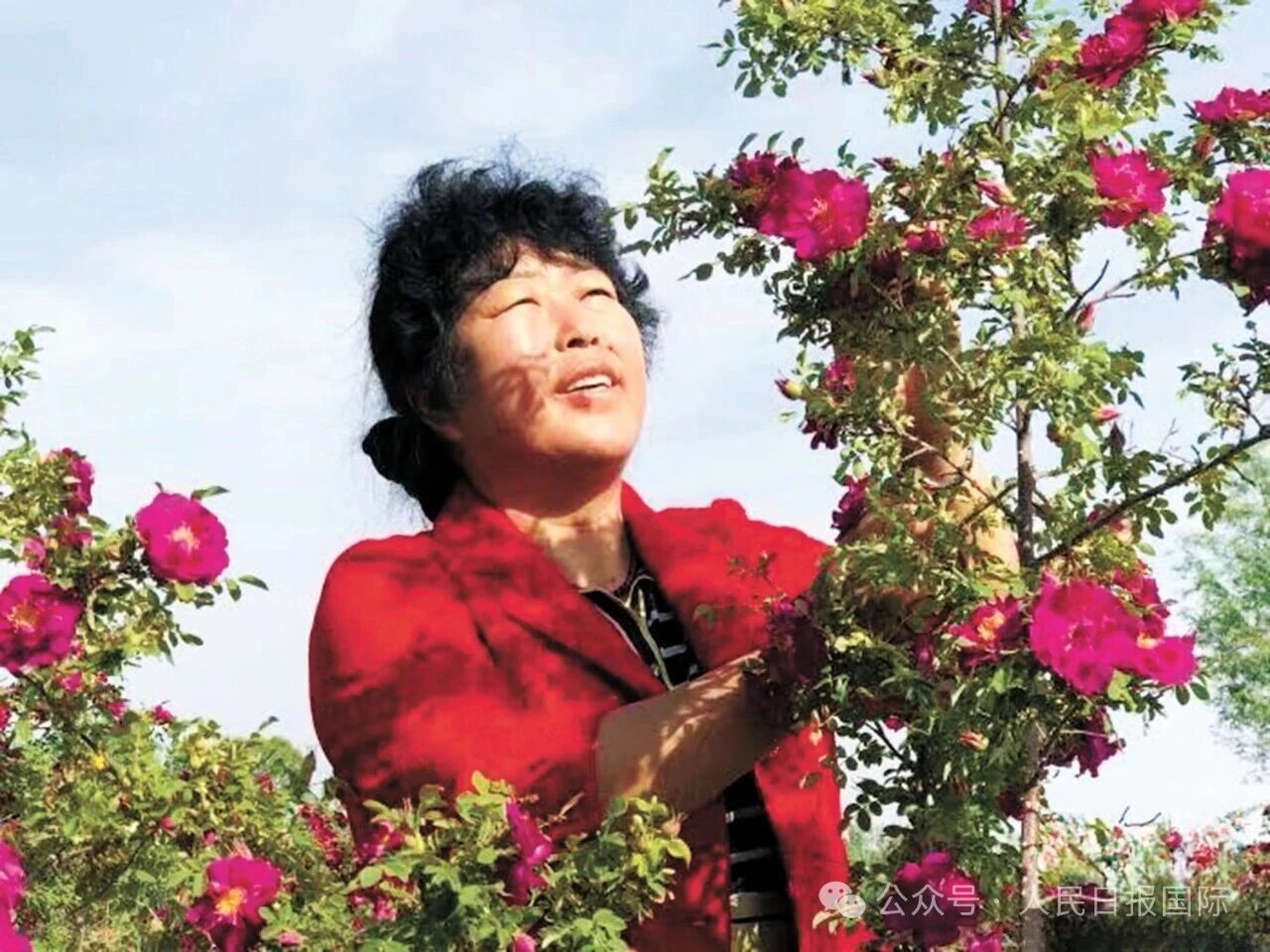
Yin Yuzhen poses for a picture with trees she has planted. (Photo from the official website of China's National Forestry and Grassland Administration)
For 26 years, a heartfelt promise forged amid desert sands and young trees has quietly endured across oceans and continents. Now, this long-standing bond has finally been rekindled -- first online, and soon, hopefully, with a long-awaited in person reunion.
A touching video recently went viral online. In it, Yin Yuzhen, a national model worker in China who has dedicated decades to combating desertification in Maowusu sandy area, north China's Inner Mongolia autonomous region, sends a heartfelt message in search of an American friend, hoping he would see the video and come back to China to visit.
The man Yin was searching for is Ronald Sakolsky. Back in 1999, Sakolsky raised $5,000 through a foundation to support Yin's tree-planting work. A year later, he traveled all the way to Maowusu sandy area to meet her in person. Though brief, that encounter left a lasting impression on Yin.
Thanks to widespread support from people across society, this green connection spanning 26 years finally led to a long-awaited reunion online.
"The trees you helped fund all those year ago have grown into a vast forest. When will you come and see them? I really want to meet you again," Yin says sincerely in the video.
Across the Pacific, 69-year-old Sakolsky was deeply moved after seeing the video. He replied that he would do his best to come and wanted to plant a tree with Yin together. The two have agreed to meet again in China in the near future.
People's Daily reporters recently visited Yin's home in Uxin banner, Ordos, Inner Mongolia autonomous region, deep within Maowusu sandy area, to hear firsthand the story behind this cross-border friendship and decades-long fight against desertification.

Photo shows Ronald Sakolsky (first from left). (Photo provided by Yin Yuzhen)
As the vehicle traveled through the Maowusu sandy area, fresh green shrubs flashed past on either side of the asphalt road.
"Come and take a look first -- this is all thanks to that $5,000!" Yin laughed, pointing toward a dense stretch of woodland outside the car window.
"Most of these trees were planted with that money. There are more than 50,000 of them," she noted.
In 1985, Yin married into Salawusu village in Uxin banner. Situated deep in the heart of Maowusu sandy area, the village was surrounded by endless dunes.
Yin understood from the beginning that if she wanted to tame the shifting sands, there was only one solution: planting trees.
In 1986, she sold one of the family's sheep to buy 600 saplings and planted them around her house. A violent sandstorm soon swept through, leaving fewer than ten trees standing.
"If around 10 survived, later it might be 100, then 1,000," Yin recalled.
Undaunted, she and her husband Bai Wanxiang headed deep into the sand dunes, bringing saplings and tools along.
In 1999, Sakolsky, who was then teaching at Luoyang Foreign Languages School in central China's Henan province, happened to see a television show about Yin's efforts and was deeply moved.
After watching the show, he kept thinking about how he could help.
That October, he emailed numerous organizations in the U.S. to raise funds for Yin's project. Eventually, an institution based in Boston donated $5,000 to support her afforestation efforts.
Yin was astonished when she received the donation.
"A complete stranger raised such a large amount of money for me without even verifying who I was," she recalled. "I had to plant those trees well. I couldn't let that trust down."
Yin carefully planned every detail: which species had the best survival rates, where trees should be planted to stabilize shifting sands, and how irrigation could conserve more water.
Several months later, seedlings began appearing across what had once been barren dunes.
In 2000, Sakolsky and his colleague Bai Fan came to China and met with Yin. With Bai serving as an interpreter, the Sakolsky and Yin exchanged simple conversations while the latter showed them the newly planted saplings.
When Sakolsky entered Yin's home, all he saw were simple tools: hoes, shovels and little else.
"He kept saying 'impossible' again and again," Bai recalled.
Although Sakolsky admired Yin's determination, he had little confidence at the time that the saplings would survive.
Yin, however, made up her mind. One day, she thought, Sakolsky would return and see that those tiny saplings had grown into towering trees.
Over the past four decades, supported by government-led efforts and inspired by desertification fighters like Yin, dramatic changes have taken place.
More than 4,600 hectares of sandy land around Yin's home has been rehabilitated, with over 8 million trees planted.
Today, 85 percent of Maowusu sandy area within Uxin banner, or nearly 560,000 hectares, has been brought under control, with forest coverage rising to 32.92 percent.
Sakolsky is far from the only person drawn to Yin's story. Over the years, volunteers from more than 20 countries and regions have traveled to visit her, establishing lasting friendships with this Chinese woman.
One of them is Donald Ashton Jones, another American.
In 2015, while teaching English at a school in Harbin, northeast China's Heilongjiang province, Jones watched a documentary about Yin's work and decided to seek her out to learn tree planting.
He began calling Yin his elder sister and even gave himself a Chinese name Yin Yifan.
Since then, he has returned almost every year whenever possible, joining Yin in planting trees and stabilizing the sands.
"With more people worldwide showing concern, I came to understand that this is a dream shared by all humanity," Yin said.
Further down the tree-lined road stands a stone monument inscribed with the words "Citizens of Earth". Its back bears the names of people from home and abroad, all of whom have lent their support to this woodland in their own ways.
Inspired by Yin's persistence, more than 240 major tree-growing households have emerged in surrounding areas, each having planted over 200 hectares of trees.
"I hope to encourage more people to join tree planting," Yin said. "Together, we can make our shared planet a better home for everyone."
Photos

Related Stories
- Chinese bamboo products go global, powering sustainable development
- Asia-Pacific Community: Turning waste into power: Chinese-invested plant boosts Bangkok's green shift
- International youths praise China's green development practices
- China issues guidelines to encourage green industrial design
- New industries take root in China's recycling economy
- 'Go to China and find green stories across the country': Erik Solheim in an interview with People’s Daily
- Powering the future: How China is going green
- Electrification accelerates China's green transformation
- China's reforestation leads to habitat expansion for 73.6 pct of forest bird species: study
- China's commitment to green transition recognized as COP30 opens in Brazil
Copyright © 2026 People's Daily Online. All Rights Reserved.
