



New industries take root in China's recycling economy
China's government work report this year called for boosting the green and low-carbon economy and stepping up the recycling of recyclable materials.
With the implementation of policies supporting large-scale equipment upgrades and consumer goods trade-ins, localities across the country have stepped up technological innovation and strengthened industrial chains to promote "urban mining" — the extraction of recyclable materials from discarded home appliances, electronic waste and other waste products. These efforts have raised both the recycling rate and utilization rate of renewable resources.
Statistics show that China recycled about 380 million tonnes of renewable resources in 2025. Effective recycling and utilization of renewable resources are injecting new momentum into green, low-carbon development and supporting sustainable economic and social development.
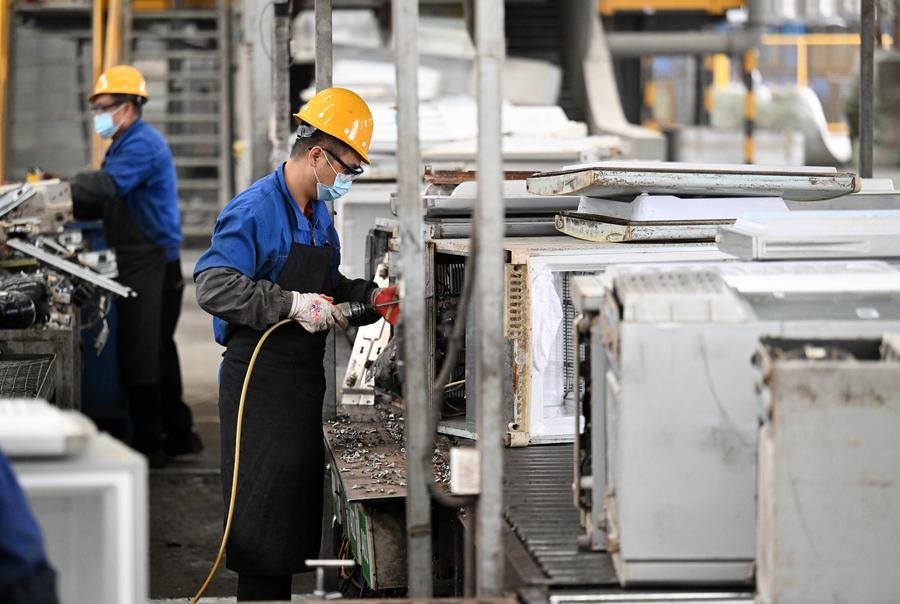
A staff member dismantles discarded refrigerators at a circular economy industrial park of the Tianjin Ziya Economic and Technological Development Area in Tianjin, north China, Oct. 22, 2024. (Xinhua/Zhao Zishuo)
Fujian Hongyuan Environmental Resources Co., Ltd. is one of four enterprises in southeast China's Fujian Province licensed to treat waste electrical and electronic products.
"We process more than 2,000 discarded home appliances every day," said company chairman Wu Bin. Wu noted that dismantling appliances involves various procedures, requiring all workers to undergo rigorous training and obtain certification. The entire dismantling process is strictly monitored to ensure maximum utilization of recoverable materials while preventing environmental pollution.
Inside Hongyuan's workshop, a refrigerator is taken apart and separated into plastic, metal, foam and other components, each entering a different recycling process.
The plastic panels are then loaded onto trucks and transported to a green sorting center for renewable resources in Mawei district, Fuzhou city, capital of Fujian. Opened at the end of 2024, the facility now handles the full range of recyclable plastics.
"Once processed, all these materials can be turned into treasure," said the head of the sorting center, holding up a plastic board. "This may once have been the door of a refrigerator. After crushing here and going through cleaning, melting, and molding at a downstream factory, it can become a park bench or a trash bin." The center's intelligent sorting system can process 100 tonnes of recyclable plastics per day.
As the recycling system improves, public participation is growing in step. From 2024 to 2025, the country brought about 53 million used home appliances and mobile phones into standardized dismantling channels, with an average annual increase of roughly 12 percent.
Zhejiang Ailis Dyeing and Finishing Co., Ltd., located in Shaoxing city, east China's Zhejiang Province, has partnered with Zhejiang Sci-Tech University to establish a research center dedicated to the high-quality recycling of waste polyester fibers. Together they have developed a physical-chemical recycling technique.
"This technique is both eco-friendly and cost-effective," said Jiang Fang, an associate professor from the university, who was involved in the research. She explained that the method not only addresses the disposal challenge of used clothing and reduces secondary pollution, but also helps textile companies secure a stable, locally sourced supply of recycled fibers.
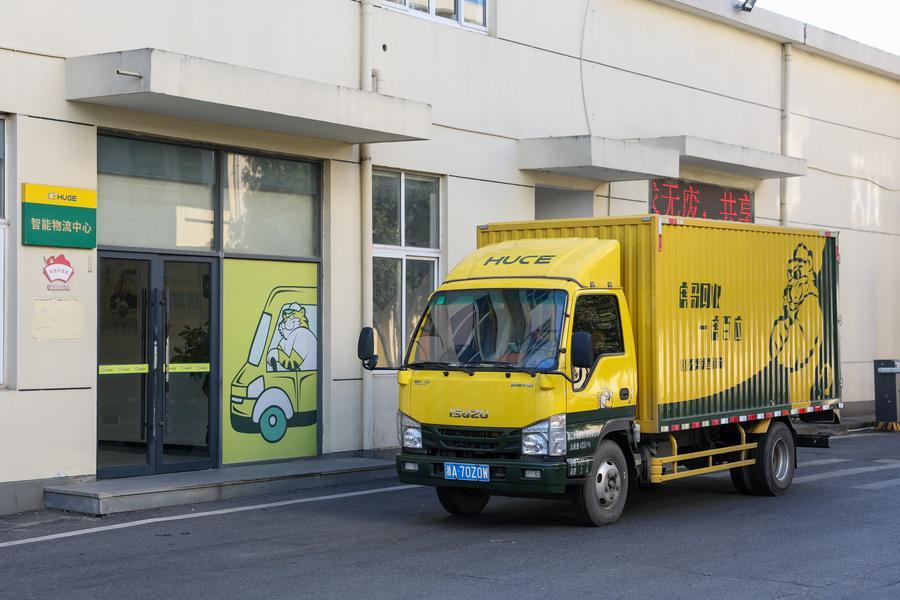
A truck for collecting recyclable waste is seen at Huge Recycle, a company handling household waste recovery and recycling, in Hangzhou, east China's Zhejiang Province, Jan. 14, 2026. (Xinhua/Jiang Han)
In Keqiao district of Shaoxing — well-known as a textile hub in China — innovations like this continue to emerge. Zhejiang Jiaren New Materials Co., Ltd. drew attention from domestic and overseas buyers at the China International Trade Fair for Fibers and Yarns with products made using recycled DMT (dimethyl terephthalate).
According to general manager He Jianli, the company can produce recycled DMT with a purity of up to 99.9 percent. Today, a full production line — from recycled DMT to yarn — is in place. A green recycling project with an annual capacity of 50,000 tonnes is now operational, and regenerated fiber production is expected to reach 500,000 tonnes by 2030.
Scrap steel carries significant industrial value. Each tonne of scrap steel used can reduce carbon emissions by 1.6 tonnes and save about 2 tonnes of mineral resources. However, despite large volumes of scrap steel collected over the years, the industry has long struggled with fragmentation and insufficient digitalized management.
That picture is now changing with the application of digital technologies. "At our facility, we use our independently developed smart grading, intelligent baling, remote monitoring, and QR-code tracing technologies. These help prevent adulteration during baling, cut logistics costs, and improve product quality," said Zhang Kai, general manager of Angang Green Gold Industry Development Co., Ltd. in Anshan city, northeast China's Liaoning Province.
As a procurement platform for scrap steel, the company has established five core facilities and 29 satellite sites across major steel production areas in Liaoning Province, building a recycling and processing network covering the entire northeast region.
At the city level, Anshan city is actively leveraging a digital platform for the renewable resources industry to regulate scrap-steel processing enterprises, improve supply-demand matching, and boost local consumption capacity for scrap steel.
To date, 11 enterprises in Anshan have been included in the national entry list for the scrap steel processing industry, with a combined approved capacity of 7.85 million tonnes. During the 14th Five-Year Plan period (2021-2025), Anshan's scrap-steel processing and sales volume increased to 4.87 million tonnes.
Photos




Related Stories
- Powering the future: How China is going green
- Electrification accelerates China's green transformation
- China's reforestation leads to habitat expansion for 73.6 pct of forest bird species: study
- China's commitment to green transition recognized as COP30 opens in Brazil
- Chinese innovation acts as positive asset of global green transformation
Copyright © 2026 People's Daily Online. All Rights Reserved.
