



New technologies, equipment make farming smarter in China
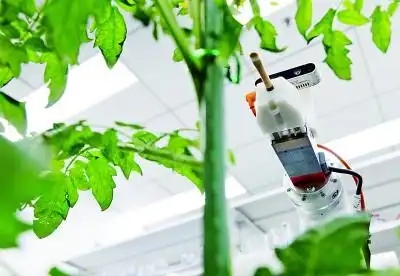
GEAIR, a smart breeding robot, conducts a hybrid pollination experiment. (Xinhua/Jin Liwang)
China's agriculture is undergoing a high-tech transformation, with innovations boosting efficiency and productivity. Science and technology now drive more than 64 percent of agricultural output growth, signaling a major shift toward modern, tech-driven farming.
Improved crop variety coverage in China has exceeded 96 percent, and the comprehensive mechanization rate for crop cultivation and harvesting has reached 76.7 percent. Intelligent tools are making farming more efficient and less labor-intensive.
In a greenhouse filled with flourishing tomato plants, GEAIR, an intelligent breeding robot, glides along its track, using its mechanical arm to pollinate flowers.
"Traditional hybrid breeding is slow and labor-intensive," said Xu Cao, a researcher at the Institute of Genetics and Developmental Biology under the Chinese Academy of Sciences. "Previously, we had to remove stamens and manually pollinate flowers."
Now, through gene editing and artificial intelligence, robots can precisely identify and pollinate flowers. For example, gene edits allow tomato and soybean flowers to naturally expose their stamens, eliminating the need for manual labor.
The combination of AI and robotics can cut tomato breeding cycles from five years to one, saving over 25 percent in labor costs, and reduces artificial pollination time for soybeans by 76.2 percent.
As spring greens the Loess Plateau, farmer Zhao Bin in Dingxi city, northwest China's Gansu Province, puts a pivot steering tractor to work. Designed with articulated steering, the machine can pivot easily, making it ideal for the region's steep, fragmented terraces.
"Traditional tractors were too bulky and couldn't handle tight turns. We still had to rely on manual labor," Zhao said. The new tractor can till, seed and furrow narrow plots — some under 3 meters wide — in a single pass. Built for rugged terrain, the tractor features a dedicated navigation system that maps routes across irregular fields.
The innovation addresses a long-standing challenge. In Gansu Province, 76 percent of farmland lies in hilly or mountainous areas, where more than 60 percent of local specialty industries are also concentrated.
Compared with the plains, the market for agricultural machinery in these regions is small, farmers have limited purchasing power, and companies have been less inclined to invest in research and development. This has created a long-standing shortage of available and suitable machinery, which has become a major bottleneck for agricultural development in the hilly areas.
To bridge the gap, Gansu has launched an integrated pilot project to improve agricultural machinery adaptability, with enterprises innovating, farmers validating, and research institutions solving technical challenges.
In 2025, the mechanization rate in the hilly and mountainous areas in Gansu reached 67 percent, according to an official from the Department of Agricultural and Rural Affairs of Gansu Province.
In Yongcheng city, central China's Henan Province, farming is going high-tech.
When Feng Lei's phone buzzes, it's an alert from an agricultural app telling him a field needs watering. With a single tap, the 5G-enabled irrigation system kicks in, sending water and nutrients straight to the radish roots through underground drip lines.
Feng heads a farming cooperative, which runs a smart farm where automation is part of everyday work. Driverless tractors carve out neat, evenly spaced ridges, irrigation systems run on their own, and drones lift off to spread fertilizer.
Farming here has shifted from manual labor to technical work, said Li Guoqiang from the Henan Academy of Agricultural Sciences.
The farm uses soil sensors and environmental monitoring equipment to collect real-time data. This data feeds a digital platform that optimizes irrigation and fertilization. As a result, water use is down 30 percent per mu (1 mu is about 667 square meters), and agrochemicals are reduced by 25 percent.
Photos



Related Stories
- Spring farming in full swing across China
- Technology transforms spring farming in C China's Hubei
- Digital tide breathes new life into NW China spring farming
- Spring farming in full swing across China
- Farmers busy with spring plowing in China's Gansu
- Technology drives sowing of broad beans in Huangzhong district, NW China's Qinghai
- Spring farming in full swing in Fengnan, China's Hebei
- Drones empower China's smart spring farming
- Farmers busy with spring ploughing across China
- A glimpse into China's smart spring farming
Copyright © 2026 People's Daily Online. All Rights Reserved.
