



Miao designer brings traditional fashion to the world stage
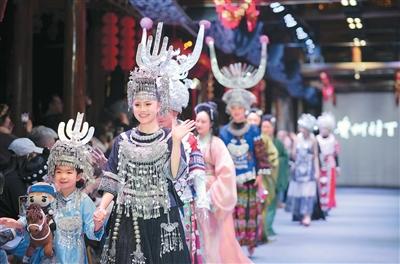
Models present traditional outfits during a "Village T" fashion show at the Miao and Dong Ethnic Customs Park in Kaili city, southwest China's Guizhou Province. (People's Daily/Cai Xingwen)
Women from all 56 of China's ethnic groups walked the runway in their respective bridal attire at the 2026 China International Fashion Week — a sweeping display of color, pattern and craftsmanship that showcased the country's cultural diversity.
The show was the work of Yang Chunlin, a Miao ethnic fashion designer and the founder of Guizhou's "Village T," a grassroots fashion show.
"A bride's wedding dress is one of the most emotionally resonant and ceremonially significant garments a culture can produce," Yang said.
Bringing together women from all 56 ethnic groups, he added, was not just about showcasing clothing but an invitation for audiences to appreciate the distinct beauty each ethnic group has to offer, and to bring the intangible cultural heritage tucked away in villages into wider view.
Yang grew up in a Miao village in Kaili city, southwest China's Guizhou Province. He wore hand-me-downs from older cousins, but his mother would embroider little tigers and flowers over the worn patches, turning plain old clothes into something personal and unique. At festivals and weddings, the whole village came out in elaborate traditional dress, with silver ornaments and vivid embroidery fully on display. The impression never left him.
"Every pattern in Miao clothing carries a story, a piece of nature, a slice of life. It taught me early on that clothing is never just fabric — it is a vessel for culture and emotion," he said.
In 2007, Yang became the first person from his village to attend university. To pay off his student loans, he set up a street stall selling Miao embroidery and silverwork and quickly found that while the pieces drew crowds, they didn't fetch the prices they deserved. He resolved to bring traditional embroidery into contemporary ready-to-wear design, and his clothing brand was born.
His approach has always been adaptive rather than imitative: he incorporates Miao embroidery motifs into denim jackets and hoodies, and distills silverwork elements into accessories suited for everyday wear.
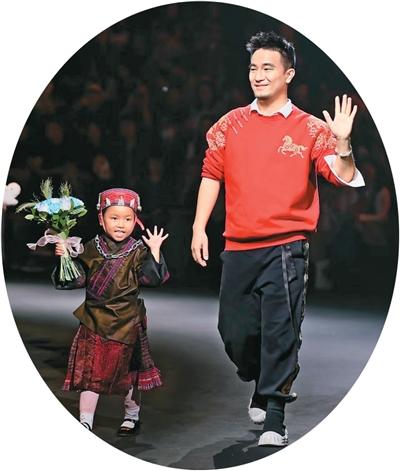
Yang Chunlin (right) and a kid walk the runway at the 2026 China International Fashion Week. (Photo courtesy of the interviewee)
A turning point came in 2024, when Yang brought his 62-year-old mother onto the runway at China International Fashion Week.
After the show, the two traveled to Europe together. Standing amid foreign crowds, his mother said quietly: "The world is too vast to see it all. Can we bring the world to Kaili instead?"
The remark hit Yang like a revelation. "I found myself asking: why can't ethnic groups have our own fashion week?" He returned to his hometown and launched Guizhou's "Village T" fashion show.
That July, Yang put up a simple runway at the Miao and Dong Ethnic Customs Park in Kaili city and opened the stage to villagers and professional models alike. The "Village T" fashion show brought intangible cultural heritage elements onto the catwalk, from the lusheng, a traditional reed-pipe instrument of the Miao people, to Miao embroidery, local cuisine and folk songs. The show quickly gained traction online.
The village fashion show has since grown well beyond its origins. After the 2026 China International Fashion Week, Yang led the 56 women in their bridal attire to Beijing's Temple of Heaven for a flash mob performance. Their singing and dancing drew large crowds of domestic and foreign tourists.
"These outfits are stunning — so distinctly Chinese," a French visitor said.
Shortly afterward, the spokesperson account of China's Ministry of Foreign Affairs on Facebook shared a short video of the performance.
Since its founding in 2024, Guizhou's "Village T" fashion show has staged more than 900 events and welcomed over 80,000 ordinary participants onto its runway. The village fashion show has appeared at Singapore Fashion Week, London Fashion Week and New York Fashion Week, as well as the United Nations Climate Change Conference and the Osaka Expo 2025, among others.
In recent years, Yang has regularly posted short videos on Douyin and other social media platforms to connect with audiences. "Short video breaks down geographic barriers and allows the beauty hidden in Kaili's mountains to be seen nationwide and worldwide," he said.
The clips have introduced countless viewers to Guizhou's "Village T" fashion show and sparked genuine enthusiasm for traditional ethnic dress, drawing many to make the trip to Guizhou in person and bringing more like-minded collaborators into the fold.
Looking ahead, Yang has a clear set of priorities: ensuring that intangible cultural heritage inheritors earn a real income from their participation, not just applause; bringing more designers into heritage-led innovation; and nurturing younger generations so that traditional crafts are carried forward.
"I believe that what belongs to an ethnic group belongs to the world," he said, aiming to let traditional ethnic fashion shine ever more brightly on the global stage.
Photos


Related Stories
- Exhibition of Maison Margiela held during Shanghai Fashion Week
- In pics: 2026 Autumn/Winter Shanghai Fashion Week
- AW2026 Beijing Fashion Week kicks off
- Fashion show presents traditional attire recreated through AI
- Bag charms gain popularity among young consumers, fueling a booming industry
- Historic Chinese city reinterprets fashion with constant innovation
- Fashion show held at Luoyi ancient city in C China's Luoyang
- Pakistan-China Fashion Show strengthens cultural ties
- Diplomats and designer praise China-Pakistan ties at Great Wall fashion show
- Fashion takes center stage at the Great Wall
Copyright © 2026 People's Daily Online. All Rights Reserved.
