



AI-powered farming transforms China's grain production
China is increasingly turning to artificial intelligence to modernize agriculture, improve efficiency, and secure the nation's food supply, according to national lawmakers and political advisors at the recently concluded "two sessions," the annual meetings of the National People's Congress (NPC), China's top legislature, and the Chinese People's Political Consultative Conference (CPPCC), China's top political advisory body.
From drones surveying fields to automated planting and harvesting machines, AI-powered equipment is playing an increasingly important role across the entire farming process, said Chinese Minister of Agriculture and Rural Affairs Han Jun.
"Last year, we used more than 300,000 agricultural drones, the highest number worldwide," Han said during the fourth session of the 14th NPC.
Many national lawmakers and political advisors at the "two sessions" stressed the role of AI in ensuring grain production meets quantity, quality and variety targets.
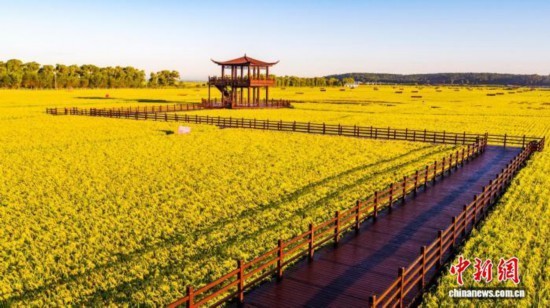
Photo shows the ecological experience zone of Qiaofu Dayuan Agricultural Co., Ltd. in northeast China's Heilongjiang Province. (Photo courtesy of Qiao Wenzhi)
In northeast China's Heilongjiang Province, a major grain-producing region, authorities have introduced integrated smart farming solutions that replace traditional weather-dependent practices with data-driven, remotely monitored operations, according to Liang Huiling, governor of Heilongjiang Province.
"In 2025, Heilongjiang's grain output surpassed 82 billion kilograms, maintaining its position as China's top grain producer for the 16th consecutive year," Liang said.
"Agricultural production has evolved from reliance on oxen and horses to tractors, and now to intelligent equipment," said Qiao Wenzhi, chairman of Qiaofu Dayuan Agricultural Co., Ltd., based in Wuchang city, Heilongjiang Province.
Qiao, who is also an NPC deputy, noted that smart technologies have made standardized farming a reality, helping maintain yields and improve quality.
NPC deputy Nie Shoujun, who is also the deputy head of the Suihua Branch of Heilongjiang Academy of Agricultural Sciences, said that fully automated farms are already operational in Heilongjiang, reducing labor intensity while increasing precision and efficiency.
"In the past, farmers applied pesticides manually using backpack sprayers," Nie said. "Today, drones handle aerial spraying operations, greatly improving efficiency and ensuring more precise application."
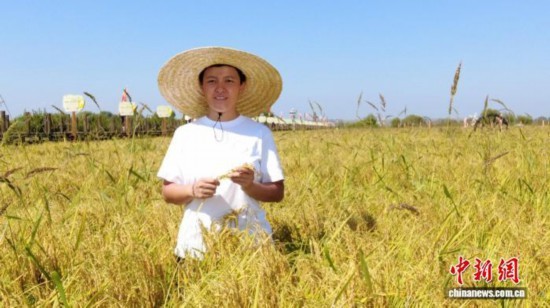
Chen Yujia, secretary of the Communist Party of China branch in Shangguandi village, Bohai town, Ning'an city, northeast China's Heilongjiang Province, and also a deputy to the 14th National People's Congress (NPC), China's top legislature, checks the growth of rice in a rice field. (Photo courtesy of Chen Yujia)
"At Qixing farm, you can hardly see anyone working in the fields. Fully unmanned operations and automated management have taken root across Heilongjiang," he added.
As the first college graduate in her village to return to her hometown to start a business, NPC deputy Chen Yujia has witnessed how technology has transformed farming and empowered farmers.
"Farming used to rely on experience; now we can use technology-driven tools such as meteorological cloud platforms and solar-powered insecticidal lamps," Chen said.
The nationwide push for smart agriculture is also gaining attention from political advisors from the country's Hong Kong Special Administrative Region (HKSAR).
During the "two sessions," Wei Mingde, a member of the Legislative Council of HKSAR and a member of the 14th National Committee of the CPPCC, made concrete suggestions on the in-depth integration of advanced technological achievements into various links of agricultural production.
He suggested integrating AI, the Internet of Things, big data, and blockchain into farming operations, along with intensified investment in digital infrastructure and talent development to ensure technological innovations reach the fields.
Photos



Related Stories
- A sweet global share: China's apple industry in numbers
- Chinese scientists discover new mechanism to boost cold resilience, nutrient use in maize
- China's grain boom
- China's vegetable capital embraces smart farming, eyes global markets
- China cultivates more high-standard farmland in 2025 amid modernization drive
- China's Science and Technology Backyard program contributes to global green transformation of agriculture
- China details measures to further advance agricultural modernization, rural revitalization
- China's top grain-producing province enhances agricultural returns via expanded contract farming
- Interview: China emerging as key hub for agricultural innovation, says Syngenta CEO
- China's grain output hits new high in 2025
Copyright © 2026 People's Daily Online. All Rights Reserved.
