



China's vegetable capital embraces smart farming, eyes global markets
Known as China's "vegetable capital," Shouguang, a county-level city administered by Weifang in east China's Shandong Province, ships more than 17,000 kilograms of vegetables to markets every minute on average. This agricultural powerhouse has built a complete vegetable industrial chain and is now undergoing a smart transformation of its greenhouse farming.
Zheng Jingqu, a second-generation farmer born in the late 1980s, sells vegetables to overseas markets from Shouguang. He steps into one of his greenhouses, where a smart monitoring screen now hangs on the wall, displaying real-time data. Outside, a logistics warehouse bustles with activity. His white-haired father, Zheng Yuxing, stands on his tiptoes to check the shipping list.
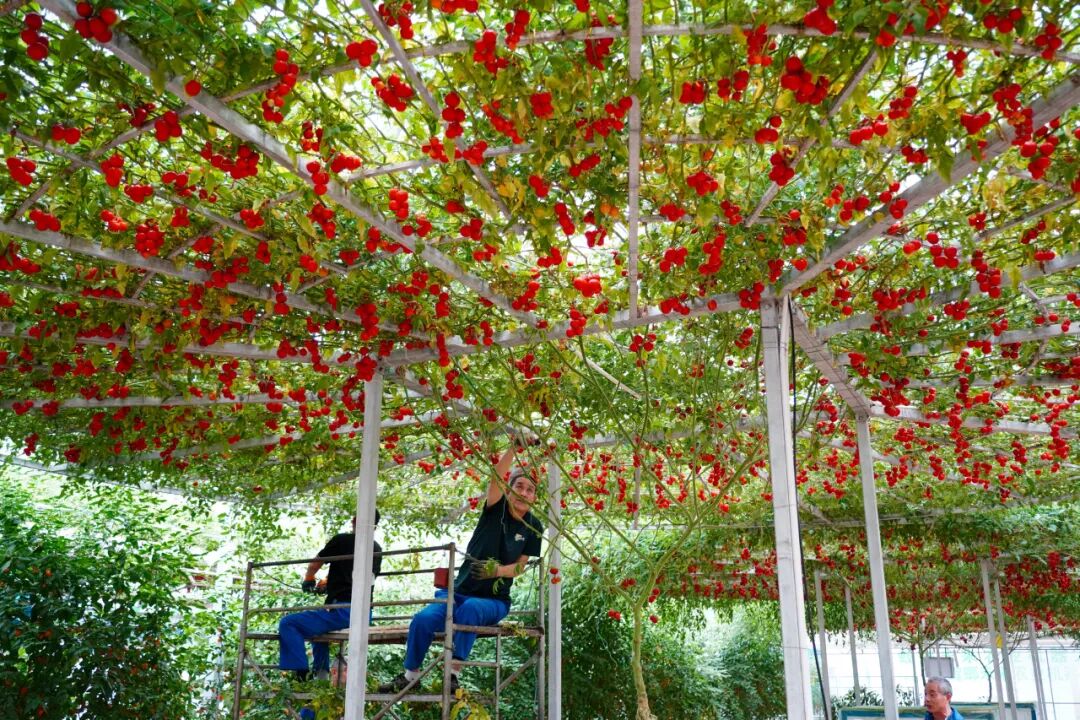
Staff members take care of tomato plants at Shouguang Vegetable High-tech Demonstration Park in Shouguang, a county-level city administered by Weifang in east China's Shandong Province. (Xinhua/Xu Suhui)
The father-and-son duo reflects the ongoing transformation of Shouguang's vegetable industry.
In 1990, Zheng Yuxing built an old-fashioned greenhouse 8 meters wide and 2.2 meters high. In 2017, when Zheng Jingqu returned from working elsewhere to start his own venture and proposed building 12 high-standard greenhouses, his father expressed concerns.
"With such a huge investment, when will we break even? Do we have enough workers?" his father asked.
Undeterred, Zheng Jingqu established Ruijing Family Farm, installing rows of smart equipment that transformed traditional farming methods. What truly changed his father's attitude was the tangible returns: previously, 1 mu (about 0.07 hectares) of land generated an annual output of around 10,000 yuan (about $1,450); now, each mu produces 80,000 yuan in annual value.
By late 2022, Zheng Jingqu invested 40 million yuan to build a second farm. His new greenhouses measure 15 to 16 meters wide and 150 to 160 meters long, with spacious canopies. The operation now benefits around 500 neighboring farming households.
The facilities are far smarter too, equipped with sensors monitoring temperature, humidity, and other factors, with real-time data feeding directly to display screens. In addition, AI algorithms now serve as "vegetable cultivation managers."
"An automated greenhouse roll-up motor, for example, used to be either fully open or closed at the push of a button. Now it monitors light and temperature conditions and flexibly adjusts curtain positioning," Zheng Jingqu said.
Behind this effort lies Shouguang's determination to transform agriculture through the industrial internet. In recent years, the municipal bureau of agriculture and rural affairs, together with the Shouguang branch of the State Grid Corporation of China, has continuously upgraded agricultural infrastructure and industrial equipment. In newly built greenhouses, smart equipment adoption, Internet of Things (IoT) applications, and standardized production all exceed 85 percent. Meanwhile, labor productivity has increased by 30 to 50 percent, and per-mu yield has reached three to five times pre-upgrade levels.
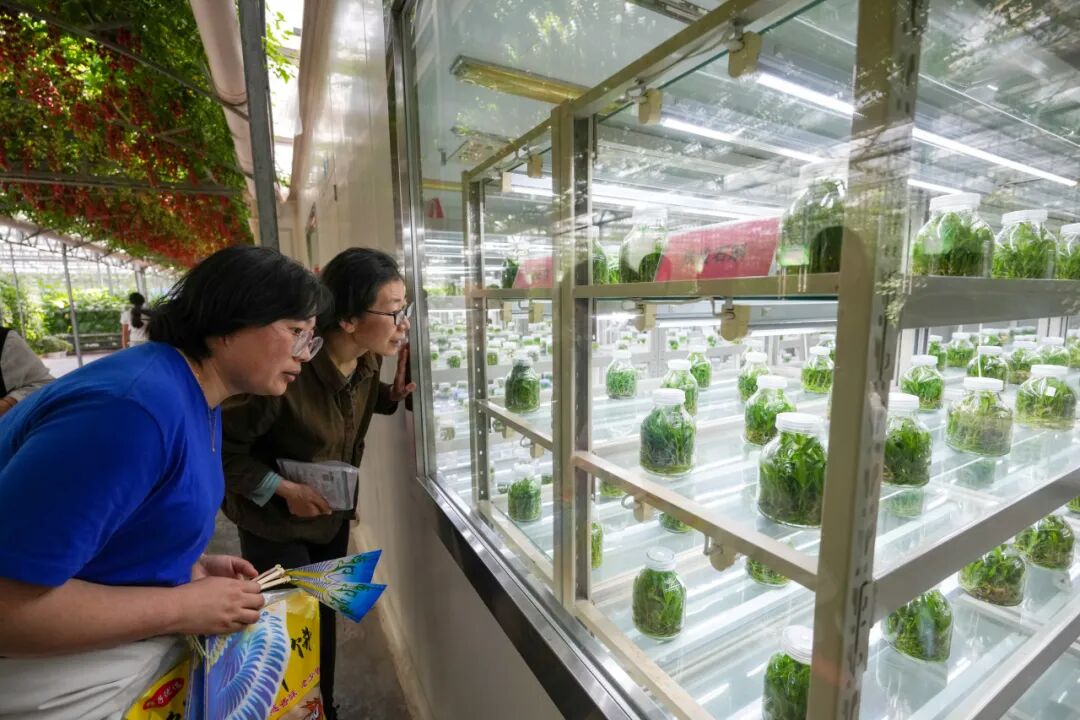
Visitors tour Shouguang Vegetable High-tech Demonstration Park in Shouguang, a county-level city administered by Weifang in east China's Shandong Province. (Xinhua/Xu Suhui)
Zhang Linlin, deputy director of the vegetable industry development center at the municipal bureau of agriculture and rural affairs, said Shouguang regularly organizes training sessions for new-type agricultural business entities, bringing together young people skilled in technology and business management.
At one such gathering, Zheng Jingqu met Ma Taiting, who focuses on supermarket supply chains, and together they tried a new "direct procurement and supply" model.
Vegetables from Ruijing Family Farm go directly from the field to shelves at retailers such as JD.com, Yonghui Superstores, and Freshippo. Shortened supply chains have translated into rising economic returns. In 2025, the farm expanded from its initial 100-plus mu to 400 mu, and Zheng Jingqu gradually built a complete industrial chain covering logistics, retail terminals, and brand operations.
Meanwhile, researchers are no longer focused solely on disease resistance and yield; they've incorporated taste and nutrition as core indicators, driving growing adoption of new varieties.
"For example, a tomato variety independently developed by Shandong Shouguang Sanmu Seedlings Co., Ltd. features high quality, disease resistance, and strong commercial appeal. The domestically bred variety is gradually replacing imported seeds that once dominated the market," Zhang said.
"Defining 'delicious' relies on data, not subjective feeling," said Gao Juexiao, head of certification at the National Vegetable Quality Standard Center in Shouguang. The center has established a scientific vegetable quality evaluation system based on four dimensions: appearance, mouthfeel, flavor, and texture. It has partnered with the Institute of Vegetables and Flowers of the Chinese Academy of Agricultural Sciences to develop industry standards for vegetable quality assessment and launched a certification program for delicious vegetables.
In recent years, Zheng Jingqu's overseas business has expanded significantly, with annual exports exceeding 1,000 tonnes.
Currently, over 30 Shouguang enterprises and cooperatives operate overseas, establishing more than 300 farming operations across over 40 countries and regions. From January to October 2025, vegetable and vegetable product exports reached 320 million yuan, accounting for 21.5 percent of total agricultural exports.
Photos


Related Stories
- China cultivates more high-standard farmland in 2025 amid modernization drive
- China's Science and Technology Backyard program contributes to global green transformation of agriculture
- China details measures to further advance agricultural modernization, rural revitalization
- China's top grain-producing province enhances agricultural returns via expanded contract farming
- Interview: China emerging as key hub for agricultural innovation, says Syngenta CEO
Copyright © 2026 People's Daily Online. All Rights Reserved.
