



Washproof silk helps boost sales of 'China-chic' costumes
New Chinese-style clothing that blends traditional aesthetics with contemporary design proved immensely popular among consumers during the recently concluded Spring Festival holiday.
Data show that the market for guochao apparel, represented by new Chinese-style clothing, exceeded 220 billion yuan (about $31.96 billion) in 2024, and is projected to surpass 250 billion yuan in 2025. Guochao, also known as "China-chic," is a fashion trend that blends modern designs with traditional cultural elements.
Behind the boom lies a quiet but crucial technological revolution. "Sales of new Chinese-style clothing this year have surpassed all previous years — on our busiest day, we sold more than 20 bespoke outfits, three times the usual amount," said Li Yun, who runs a new Chinese-style clothing shop in Hangzhou, east China's Zhejiang Province. Her store stocks a variety of traditional fabrics — Song brocade, Yun brocade, gambiered Guangdong gauze (or Xiangyunsha in Chinese) — many of which now incorporate high-tech features that have proven especially appealing to younger customers.
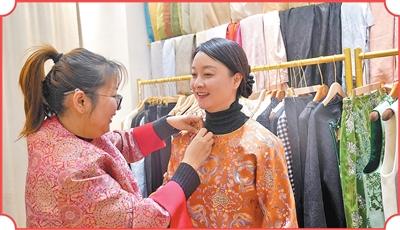
Li Yun (left) helps a customer try on a set of new Chinese-style clothing. (Photo/Guo Yang)
Li Yun has been in the business of custom new Chinese-style clothing since 2018 and has witnessed changes in her customer base and their consumption habits. "A significant portion of our customers these days are around 30. Younger consumers care a lot about ease of maintenance," she said.
One such customer, Hu Jing, had long been a fan of new Chinese-style summer wear but found pure silk frustrating. While soft and breathable, the fabric felt almost too precious to own. "You're afraid to hand-wash it in case you ruin it, so it goes to the dry cleaner every time," she explained. The cumulative cost of dry cleaning, she calculated, had nearly matched the original price of the garments.
Li Yun understood the frustration well. Over the years, customers had repeatedly raised issues like color bleeding, which had become a significant pain point for new Chinese-style clothing primarily made from silk.
Su Miao, Party chief of the International Institute of Silk at Zhejiang Sci-Tech University, said silk fabrics had long been confined to high-end niches, such as formal gowns and banquet wear. However, the rising popularity of new Chinese-style clothing has raised consumer expectations for silk, expanding perceptions of what the fabric can offer.
In response to this shift, Li Yun began exploring alternatives at international fabric trade fairs in Shanghai and Guangzhou, south China's Guangdong Province, over the past two years, where she encountered machine-washable and UV-protective silk varieties. She decided to give them a try. The response was immediate — inquiries and orders poured in.
"This machine-washable silk might cost an extra 30 to 50 yuan per meter, but it genuinely frees your hands," she said. Encouraged by positive market feedback, Li Yun has grown increasingly confident in the potential of high-tech fabrics. Her machine-washable silk comes from Zhejiang Cathaya International Co., Ltd.
Tang Lin, president of the China Silk Association, identified two perennial weaknesses of silk: it shrinks from washing and wrinkles easily. The core challenge in improving silk's performance lies in enhancing its functionality without compromising its natural qualities.
Li Peng, director of the national industrial design center at Cathaya Group, explained that the conventional approach to improving silk's wash resistance involved applying a surface coating — a method that inevitably dulled the fabric's signature sheen, softness, and skin-friendly feel.
"We took a different approach, working directly with the silk fibers and inducing specific amino acids to form three-dimensional structures that could withstand the mechanical stress of machine washing," Li Peng said. The group began assembling a technical team of more than 20 researchers in 2020, and by late 2023 had ensured mass production.
Machine-washable silk is not the only innovation on display in Li Yun's shop. Shelves now feature UV-protective silk, machine-washable wool, and high-pilling-resistance cashmere, among other advanced textiles. "These practical, functional fabrics have truly opened up the market," she said. Cashmere, for instance, used to pill so badly that it was only suitable for outerwear — now, with improved pilling resistance, it can be made into fitted inner layers that pair seamlessly with new Chinese-style ensembles.
Wang Pengcheng, brand director at Cathaya Group, said Chinese silk fabric companies have advanced rapidly on the technical front — in some respects, they are ahead of the curve — but there remains significant ground to cover in design sophistication and brand building. New Chinese-style fashion, he believes, offers a well-timed entry point.
"Innovation in silk fabrics is the next major trend in the textile industry and an inevitable response to the pressure of homogeneous competition," Tang said.
Photos




Related Stories
- New Chinese-style clothing market surges to over 100 billion yuan
- City in C China's Hubei builds global clothing network through e-commerce
- Smart manufacturing boosts school uniform industry in China's 'children's clothing capital'
- From lingerie workshops to global hub: The rise of China's 'themed apparel capital'
- From Shantou to the world: textile and garment industry weaves new vitality into BRI
- Mother-daughter viral harvest catwalk showcase
- The empire dress: An icon of Western courtly elegance
- China's Puyuan ramps up efforts to develop knitwear industry
- Spring outing in traditional Chinese clothing
- Pinghu in E China sees rapid development in down garment industry
Copyright © 2026 People's Daily Online. All Rights Reserved.
