



China's Spring Festival lantern fairs blend tradition, technology
Lantern fairs lit up cities across China during the 2026 Spring Festival, drawing throngs of visitors with a blend of traditional folk culture, intangible cultural heritage performances, technological innovation and immersive interactive experiences.
In Beijing, the 2026 Jingcai Spring Festival Lantern Carnival transformed Beijing World Park with seven themed exhibition areas and 180 lantern installations, creating a visual spectacle by day and night that became one of the capital's most popular Spring Festival attractions.
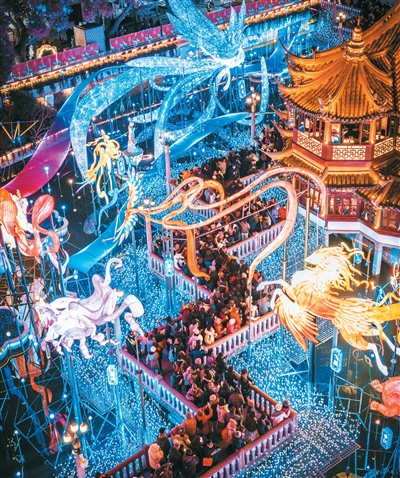
Tourists view lanterns at the Yuyuan Garden Lantern Festival during the 2026 Spring Festival. (Photo courtesy of the Yuyuan Garden Lantern Festival)
Shanghai's Yuyuan Garden Lantern Festival expanded beyond its traditional boundaries for the first time this year, stretching into the Bund Finance Center, Gucheng Park and the Bund, said Hu Junjie, vice president and spokesperson of Yuyuan Inc.
"By weaving together intangible cultural heritage lantern art, digital technology, contemporary art and the hustle and bustle of daily life, we created an integrated Spring Festival experience platform with local features where visitors can admire lanterns, explore the city, take part in interactive activities and shop in one place," Hu said.
In Xiamen, southeast China's Fujian Province, the lantern fair at Xiamen Horticulture Expo Garden wrapped the venue in shades of pink — a deliberate nod to the bougainvillea, the city's official flower. Thirty-one themed lantern installations proved a major draw during the holiday, cementing the fair's status as one of the city's most sought-after Spring Festival destinations.
Tuo Yanzheng, an associate professor at Nankai University's College of Tourism and Service Management, said lantern fairs have become an important vehicle for public engagement with Chinese New Year customs. The richness of the visual experience and the festive atmosphere make them a natural choice for tourists looking to celebrate the Spring Festival, Tuo added.
Lantern fairs delivered integrated cultural tourism experiences, offering visitors something new to discover, experience or take part in. Hengdian World Studios in east China's Zhejiang Province, one of the country's largest film and television production bases, was a case in point.
"Walking into the Hengdian Shangyuan Lantern Fair felt like stepping onto a TV drama set," said Ding Jingjie, a visitor from Yiwu city in the province. "I even got a period costume makeover and tried out an interactive role as an extra — it was unlike any lantern fair I've been to."
Diao Zhuo, a tour guide at the Hengdian Shangyuan Lantern Fair, elaborated on what sets the event apart.
"The lantern fair features costumed performers who interact with visitors, period costume parades and acrobatic performances," Diao said. "Visitors don't just view the lanterns or watch shows — they step onto actual filming locations and become part of the story themselves. The scenic area also offers a service where guests can recreate iconic scenes from hit dramas like 'Empresses in the Palace,' giving them a truly one-of-a-kind Spring Festival keepsake."
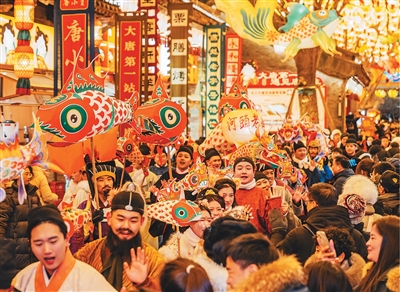
A fish-shaped lantern parade attracts visitors during a lantern festival themed around the Tang Dynasty (618-907) at Hetou Old Street in Tangshan, north China's Hebei Province. (Photo/Wen Baolong)
A lantern festival themed around the Tang Dynasty (618-907) and held at Hetou Old Street in Tangshan, north China's Hebei Province, drew on the dynasty's cultural legacy, with over 1,000 performances staged daily. More than 200 costumed performers carrying fish-shaped lanterns paraded through the streets, evoking the splendor of a Tang Dynasty lantern festival.
The event also brought together more than 30 intangible cultural heritage performances, alongside over 30 regional snack varieties from across China and 170 local Tangshan specialties, according to Xu Xiaowen, who is in charge of Hetou Old Street.
"A defining feature of this year's lantern fairs is that technology is no longer just decorative — it is fundamentally reshaping how visitors experience the events," said Zhao Yijing from the China Tourism Academy. "The use of AI, VR, AR, drone formations and real-time interactive technology has broken free from the limitations of static displays, giving rise to genuinely immersive and interactive environments."
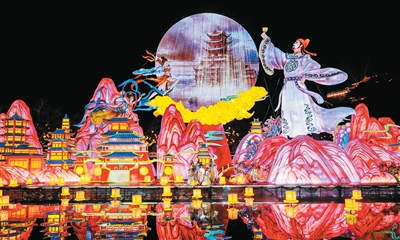
Lanterns on display at the 2026 Guangdong-Hong Kong-Macao Greater Bay Area Lantern Carnival in Nansha district, Guangzhou, south China's Guangdong Province. (Photo courtesy of the Publicity Department of the Communist Party of China Nansha District Committee)
That technological ambition was on full display at the 2026 Guangdong-Hong Kong-Macao Greater Bay Area Lantern Carnival in Nansha district, Guangzhou, south China's Guangdong Province. There, AI, holographic projection, interactive floor screens, surround sound and motion-sensing installations were deployed to give traditional cultural content a thoroughly contemporary feel.
Thanks to modern light-and-shadow technology, lantern fairs are bridging traditional folk customs and contemporary expression, awakening a sense of cultural connection among younger generations, Tuo said.
Zhao noted that technology will push lantern fairs from passive viewing toward immersive, interactive experiences. At the same time, the further integration of culture, commerce, tourism and sports will generate more diverse consumption scenarios, giving lantern fairs a permanent place in the nighttime economy well beyond the festive period.
Photos



Related Stories
- Chinese festive goods spread Spring Festival spirit worldwide
- Woodblock Chinese New Year paintings thrive in village in C China's Henan
- International visitors flock to Beijing for 2026 Spring Festival
- Feature: Chinese Spring Festival gains traction in Russian universities
- Free trains and buses carry migrants back to work
Copyright © 2026 People's Daily Online. All Rights Reserved.
