



China averages 100 trees per person as nation accelerates greening efforts
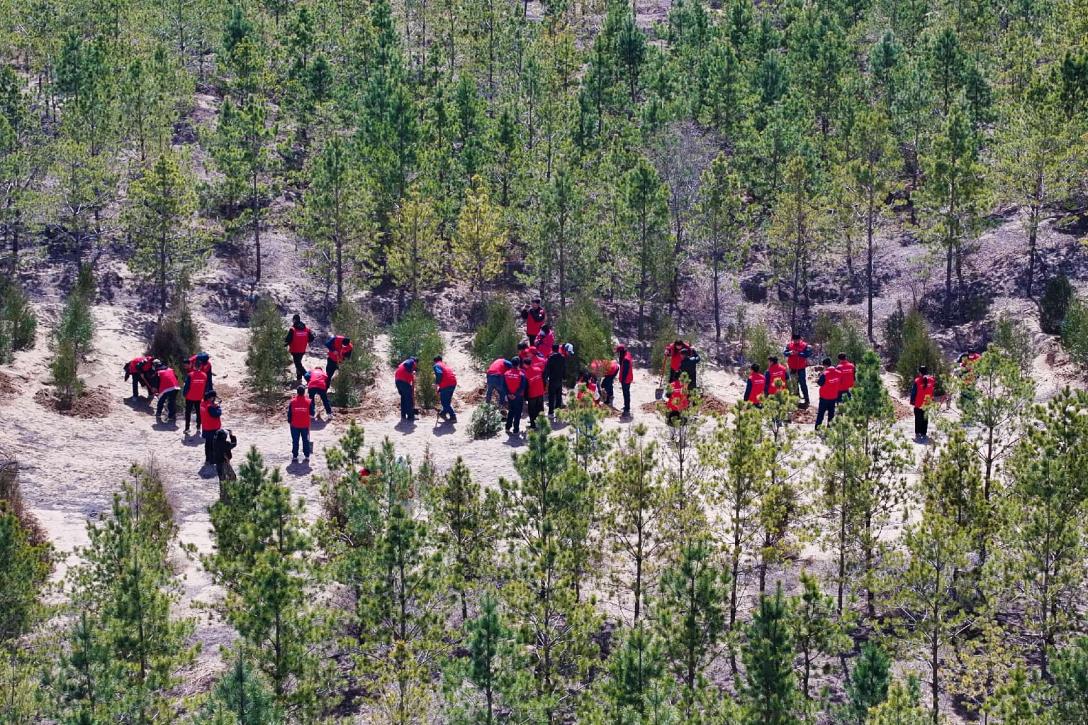
Volunteers plant trees in Baijitan National Nature Reserve on the edge of the Mu Us Desert in Lingwu, northwest China's Ningxia Hui autonomous region. (Photo/Yuan Hongyan)
How many trees grow across China?
The latest data from the National Forestry and Grassland Administration show that the country's total forest area now spans 240 million hectares.
During the 14th Five-Year Plan period (2021-2025), China completed afforestation covering 12.3 million hectares, recording the world's fastest and largest expansion of greening.
A 2025 research outcome released by a team led by Guo Qinghua at Peking University estimated that, as of 2020, China had approximately 142.6 billion trees -- equivalent to about 100 trees per person. Using drones, LiDAR technology, and algorithmic models, the team surveyed more than 76,000 sample plots, completing the country's first nationwide tree-count assessment.
The figure of "100 trees per person" makes China's green assets more concrete and its ecological progress easier to grasp. These gains stem from both strengthened protection and sustained afforestation.
Over the past five years, China has carried out standardized protection for approximately 5.08 million ancient and notable trees, while effectively conserving 172 million hectares of natural forest resources. Since 2012, cumulative afforestation has exceeded 73 million hectares, accounting for roughly 1/4 of the world's newly added green area.
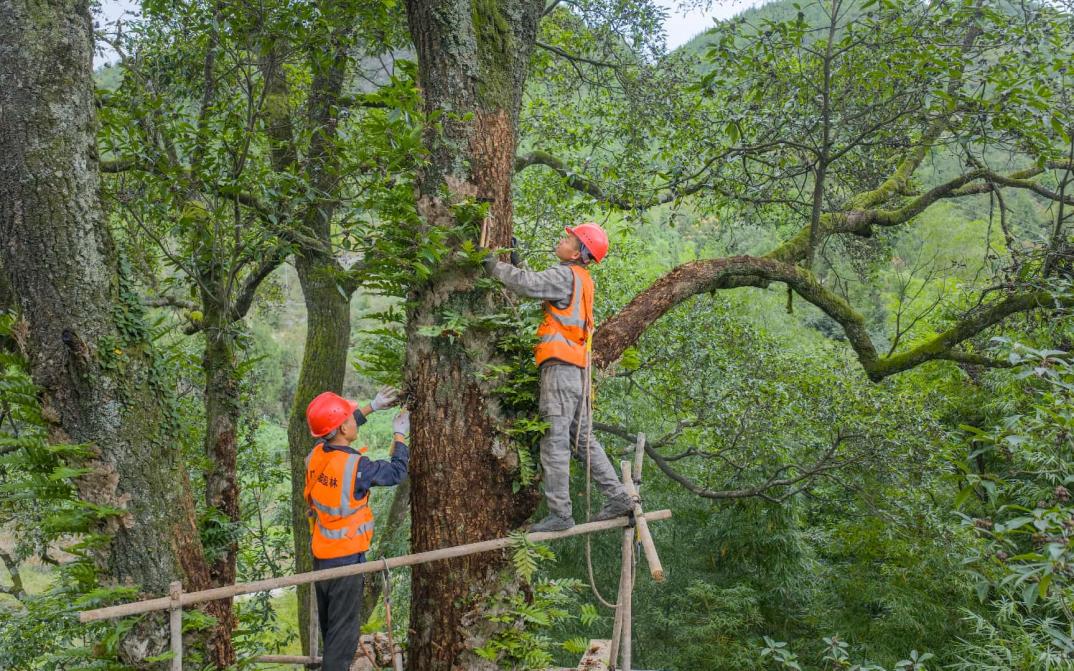
Workers restore an ancient tree in Tanjia township, Kaizhou district, southwest China's Chongqing municipality. (Photo/Wang Xiaoyu)
Following an integrated approach to conserving mountains, rivers, forests, farmland, lakes, grasslands, and deserts, China has implemented a series of major ecological programs. Among them, the Three-North Shelterbelt Forest Program has achieved a cumulative afforested and preserved area of 32 million hectares -- about half the size of the Loess Plateau.
These achievements highlight the governance capacity underpinning China's ecological transition.
In Nagqu, southwest China's Xizang autonomous region, at an average altitude of 4,500 meters and once known as "the only city in China without trees," cold-, wind-, and UV-resistant species such as spruce have been introduced during the 14th Five-Year Plan period. With patented technologies overcoming high-altitude planting challenges, trees and forests are now taking roots across the city.
China's approach to greening prioritizes expanding tree cover, improving forest quality, and strengthening long-term management. National land greening efforts are being advanced in a coordinated manner -- increasing green coverage, fostering green development, and safeguarding green resources. Guided by the principle of aligning afforestation with local water availability and ecological conditions, China has pursued a scientific, ecological, and cost-effective path to greening.
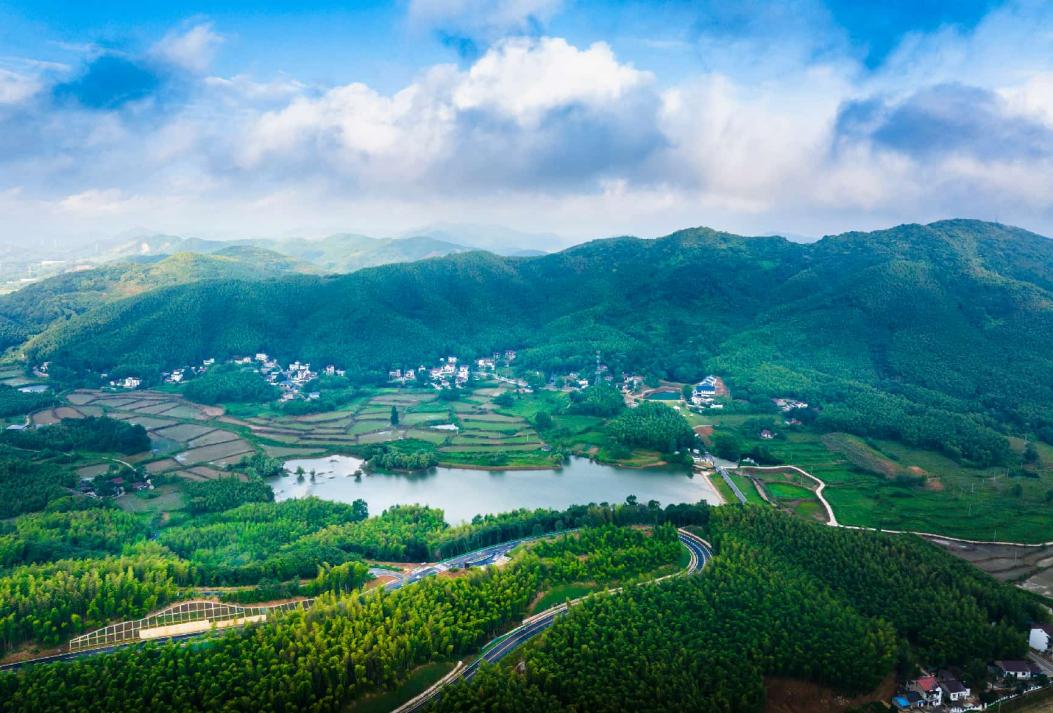
Photo shows Dongdao village in Wuhu, east China's Anhui province, surrounded by lush forests. (Photo/Xiao Benxiang)
The idea that "lucid waters and lush mountains are invaluable assets" has gained broad social acceptance. In 2025, the total output value of China's forestry and grassland industries approached 11 trillion yuan ($1.6 trillion), supporting employment and income growth for more than 60 million people. More than 1.7 million forest rangers now safeguard these ecosystems.
According to the Global Forest Resources Assessment 2025 released by the Food and Agriculture Organization of the United Nations, China recorded an average annual net increase of 1.69 million hectares of forest area between 2015 and 2025 -- the highest in the world.
Looking ahead, China's recommendations for formulating the 15th Five-Year Plan (2026-2030) call for well-planned, large-scale greening programs. The country aims to peak carbon emissions before 2030 and increase total forest stock volume to over 24 billion cubic meters by 2035. Anchored in the goal of building a beautiful China, it pledges to remain a steadfast participant and a major contributor to global green development.
Photos


Related Stories
- China takes lead in global reforestation efforts
- Saihanba secures "green pass" to international market
- Crimson splendor: the bald cypress forests of southern Anhui
- Researchers release high-resolution maps of China's forest diversity
- China unveils regulation on forest, grassland fire management
- Pic story: Forest rangers dedicated to guarding woodland in SW China's Guiyang
- E China's Jiangxi sees growth in forest farming and related industries
- Forests fuel economic growth in Guangchang, E China's Jiangxi
- China reinforcing logging ban in sustainable forestry quest
- China's man-made forest, grassland areas lead globally
Copyright © 2026 People's Daily Online. All Rights Reserved.
