



Big data drives transformation in China's ancient jujube industry
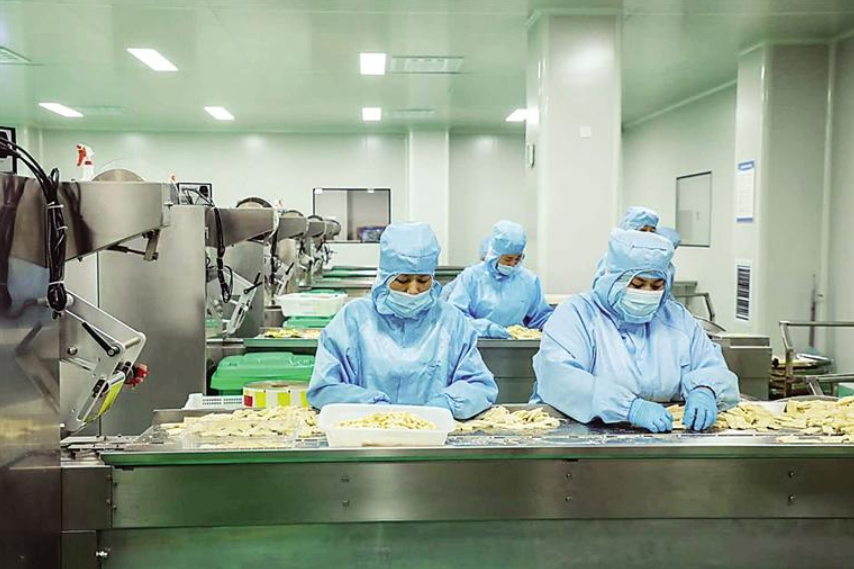
Jujubes are processed in a workshop of a food company in Cangzhou, north China's Hebei province. (Photo from the media center of Cangxian county)
In Cangxian county, Cangzhou, north China's Hebei province, the humble jujube (red date) is undergoing a remarkable transformation, powered by big data and artificial intelligence. This region, renowned for its prized Jinsi (Golden Thread) jujube cultivated for over 3,000 years, is leveraging technology to innovate and revitalize its signature industry.
With vast orchards covering approximately 12,733 hectares and a major trading hub, Cangxian's jujube sector is embracing digital tools. Local enterprises are utilizing big data analytics and AI to drive cross-sector innovation, leading to a surge in popular new products.
Beyond traditional sun-dried jujubes, producers now offer a diverse range including creamy stuffed dates favored by younger consumers and health-focused varieties infused with ingredients like codonopsis.
"Each year, we sift through 10,000 product ideas to create 1,000 samples. From those, 100 make it to trial sales, and based on real feedback, just 10 go into mass production," said Wang Yunfei, general manager of Cangzhou-based jujube company Meizaowang, speaking at the company's exhibition hall. Behind him, shelves overflowed with an array of jujube-based snacks and nut products.
Where do so many ideas come from? "Building on our existing research and development (R&D) system, we use a Recipe Engine powered by big data to generate creative concepts," Wang explained.
In 2023, he conceived the idea of integrating food product R&D with artificial intelligence. That same year, he partnered with a team from Fudan University to jointly develop the Recipe Engine.
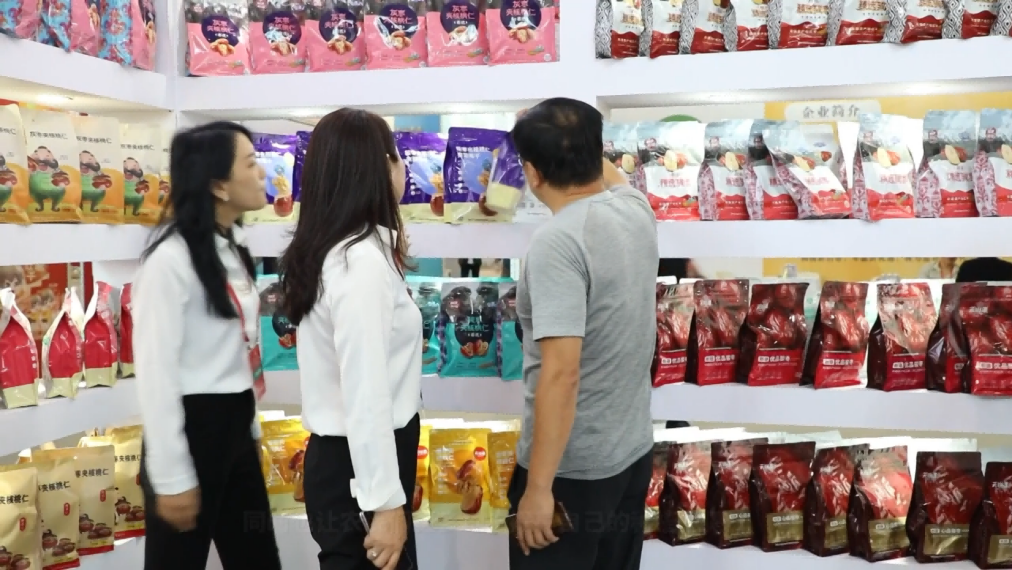
Jujube products are showcased in an exhibition hall of a jujube processing company in Cangzhou, north China's Hebei province. (Photo from the media center of Cangxian county)
"With the help of this big data model, a product concept can be generated in just 30 seconds," Wang said. The system aggregates data on production processes, ingredient properties, formulations, and market demand, forming a multidimensional knowledge graph covering food technology, raw materials, and market trends.
By dynamically analyzing content from e-commerce platforms, content-sharing platforms, and industry information websites, it can automatically generate new product ideas.
"The system can not only generate ideas on its own but also design products based on specific requirements." Wang demonstrated by inputting a request: "Create a healthy snack featuring jujube, ginseng, longan, and goji berries as main ingredients." Within moments, the system produced two product concepts, complete with ingredient ratios, product renderings, process parameters, packaging suggestions, and cost estimates.
"The Recipe Engine has transformed our traditional R&D model, shifting us from experience-driven to data-driven innovation, and significantly improving efficiency," Wang noted. Since its adoption, the company's product range has expanded from eight varieties to more than 50, with sales continuing to rise.
Beyond enriching product categories, big data is also helping companies refine their production and operations.
At the digital operations center of food company Huaju in Cangzhou, a large screen displays real-time sales dynamics across the company's product lines. Order distribution heat maps, product sales rankings, shipping progress bars, and channel share analyses are all clearly visible.
"These visualized data serve as the 'brain' guiding our production and operations," said Sun Zehui, chairman of Huaju. Leveraging the digital platform, the company has not only built an e-commerce sales network but also optimized its production structure.
"Over the past two years, based on market data analysis, we have phased out dozens of products with low sales and weak returns," Sun said, adding that the freed-up capacity has been redirected toward developing new products.
Data has also helped forge a collaborative industrial ecosystem. According to Sun, by enabling resource sharing through the digital platform, the company has integrated logistics, warehousing, and wholesale market resources, driving the coordinated development of small and medium-sized enterprises.
"We are actively advancing the development of a jujube industry cluster, promoting the optimization and upgrading of the entire industrial chain, and encouraging enterprises to use digital tools to diversify products, improve quality, and build stronger brands," said Cai Yong, director of the Cangxian bureau of science, industry, information technology and commerce.
Today, Cangxian is home to more than 3,000 enterprises engaged in jujube processing and sales, with an annual deep-processing volume of around 300,000 tons.
Photos



Related Stories
- 'DATA Night': Embodied future, blooming anew
- Professional exhibition of 2025 China International Big Data Industry Expo opens in Guiyang
- China Int'l Big Data Industry Expo 2025 opens in SW China's Guiyang
- China big data industry expo to showcase digital economy innovations
- China taps big data to close graduate job gap
Copyright © 2026 People's Daily Online. All Rights Reserved.
