



Report on global trends of higher education innovation issued in Beijing
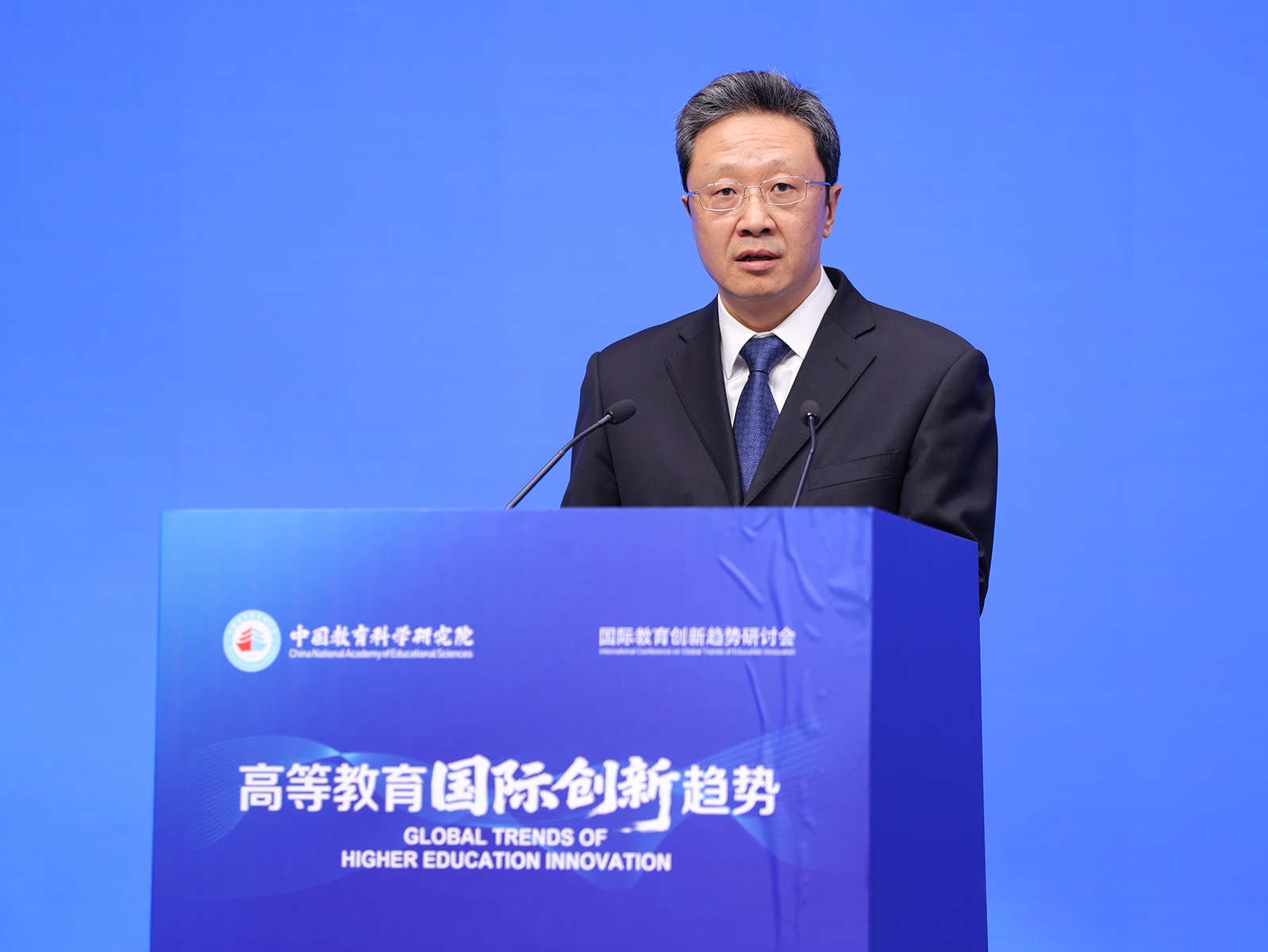
(Photo/Xinhua)
A report on global higher education innovation trends was unveiled by Li Yongzhi, president of the China National Academy of Educational Sciences, at the academy's International Conference on Global Trends in Education Innovation in Beijing on Jan. 22, 2026.
The report identifies the following eight global trends in higher education innovation.
AI transforms knowledge creation
AI is fundamentally reshaping knowledge production, with companies increasingly driving innovation in key areas such as AI development, biomedicine, integrated circuits and quantum technology. Major platforms and resources are supporting organized research, while application-driven scenarios are fostering cross-disciplinary collaboration. The integration of human and artificial intelligence is expanding the boundaries of human cognition through data-driven approaches and algorithmic optimization.
Talent cultivation models face challenges
Traditional degree-based education is facing mounting challenges as technology brings unprecedented transparency to knowledge access. Student competencies are being redefined around abilities that AI cannot replicate, such as understanding, applying, directing and leading AI systems. Short-term "micro-credentials" and flexible learning programs are gaining traction, while project-based, interdisciplinary learning focused on solving complex real-world problems is becoming mainstream.
Universities undergo systemic transformation
New types of institutions — including emerging universities, virtual campuses and specialized colleges — are diversifying the global higher education landscape. Graduate education is claiming a larger share of university enrollment as master's and doctoral programs expand. AI-driven technological transformation is reshaping university operations across teaching, research and governance.
National strategic priorities take center stage
Universities are becoming central hubs integrating education, technology and talent development — elements increasingly recognized as critical to national competitiveness. Higher education institutions provide crucial support for national scientific and technological innovation, serving as the backbone of basic research and major technological breakthroughs. These institutions also leverage their unique advantages to attract and cultivate strategic national talent — drawing top-tier experts from around the world while independently training high-level domestic specialists.
Promoting in-depth regional innovation development
Universities are breaking down institutional barriers to form innovation communities with local governments, enterprises and research institutes. By optimizing academic programs, innovating training models and integrating faculty and laboratory resources, universities are advancing deeper industry-academia-research integration. This collaboration between universities and cities drives urban renewal and innovation upgrades.
International cooperation adopts diverse approaches
Regional internationalization is emerging as a dominant model for global collaboration. "Internationalization at home" — bringing global resources to local contexts — offers a more resilient model of international engagement amid slower globalization and digital transformation. Virtual internationalization is also gaining prominence as governments, universities, and institutions worldwide actively build digital platforms supporting deeper global higher education cooperation.
Equity evolves beyond access
Equity has become a global priority in higher education, with information technology creating new opportunities to advance fairness. The focus is shifting from mere access to a more comprehensive approach that addresses processes, outcomes and quality. This holistic view of equity emphasizes tangible, understandable support that genuinely enhances students' social welfare, building positive momentum and creating lasting impact.
Sustainable development moves from consensus to action
Universities are embedding sustainability into their core missions by integrating the U.N. Sustainable Development Goals into strategic planning and curricula. They are actively engaging in multilateral networks focused on policy research and public governance to accelerate global sustainability efforts. Through cross-sector collaboration within national and regional frameworks, universities are driving broad cooperation on international sustainable development challenges.
Photos



Related Stories
- China rising in rankings of universities
- China's higher education enrollment ratio reaches 59.6 pct in 2022
- China's higher education enrollment rate reaches 57.8 pct
- Central, western China to push engineering, agriculture in higher education
- More students with disabilities pursue higher education in China
- Senior official stresses Party building at higher education institutions
- China's higher education enrollment rate reaches 54.4 pct
- China's gross enrolment ratio in higher education reaches 48 pct
- Belt and Road projects lead to massive growth in higher education for overseas students in China
- China to open 400 big data, AI majors in universities for global competition
Copyright © 2026 People's Daily Online. All Rights Reserved.
