



Four years on, RCEP continues to boost China's foreign trade growth
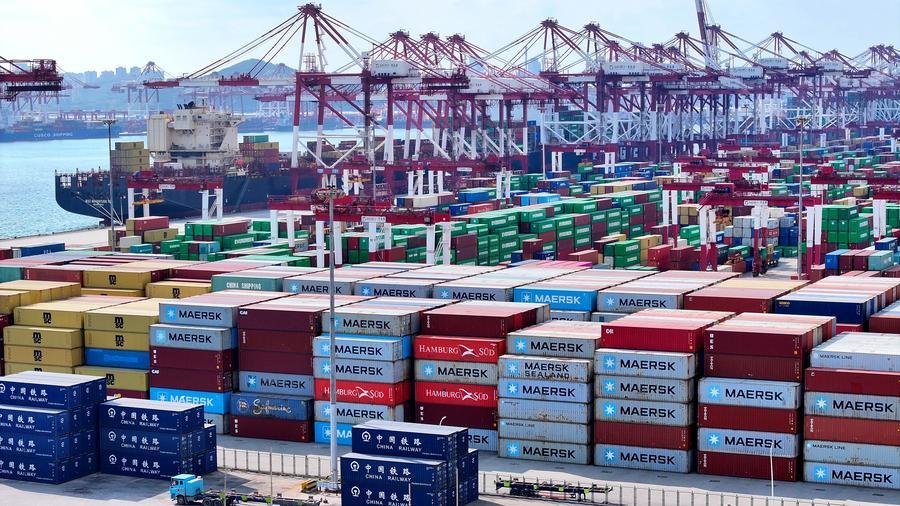
A drone photo shows a view of Qingdao Port in Qingdao, east China's Shandong Province, Oct. 29, 2025. (Xinhua/Li Ziheng)
Four years on, the Regional Comprehensive Economic Partnership (RCEP) agreement, which took effect on Jan. 1, 2022, has remained a driving force behind China's foreign trade growth.
China's total foreign trade in goods grew by 3.8 percent year on year in 2025 to reach 45.47 trillion yuan (about $6.51 trillion), hitting a new record and surpassing the 45-trillion-yuan threshold for the first time. During the same period, the country's trade with ASEAN, its largest trading partner, exceeded $1 trillion.
This surge in foreign trade is credited to the benefits of RCEP, which comprises 15 countries: China, Japan, South Korea, Australia, New Zealand, and the 10 ASEAN member states.
As a crucial institutional outcome of RCEP's institutional opening up in goods trade, tariff reductions have delivered tangible benefits to both foreign trade entities and consumers.
On Jan. 8, under the supervision of customs officers at Huadu Customs, an affiliate of Guangzhou Customs in south China's Guangdong Province, Guangzhou Xuelei Cosmetics Co., Ltd. shipped a batch of perfume valued at 976,000 yuan to Malaysia. With a declaration of origin issued independently by the company, the shipment enjoyed zero-tariff treatment under RCEP rules, saving the enterprise nearly 48,000 yuan.
Xuelei specializes in the research, development, production, and sales of perfume and fragrance products, with an annual production capacity exceeding 100 million bottles. Over 70 percent of its products are sold to overseas markets, including Southeast Asia, the Middle East, and Latin America, according to Wu Binghe, director of the company's foreign trade department.
Since RCEP took effect, the company's perfume and fragrance sales in Southeast Asian markets have continued to grow. In 2025, its shipment volumes nearly doubled compared to 2024, and the company aims to increase shipments to Southeast Asia by another 30 to 50 percent in 2026.
"Don't underestimate these few percentage points of tariff reduction, for manufacturers, consumers, distributors, and e-commerce platforms, this is a real bonus," Wu said. The company can now either apply to customs for certificates of origin or issue declarations of origin independently, offering more flexible options to receive preferential treatment. In 2025, based on customer needs, the company independently issued 17 RCEP declarations of origin, with preferential goods valued at approximately 15.93 million yuan.
RCEP has simplified customs clearance procedures, enabling international trade enterprises to operate more efficiently.
In central China's Hubei Province, a company established in 2022 mainly focuses on extracting polysaccharides, polypeptides, small molecule peptides, and tea polyphenols from high-quality dried edible fungi, tea leaves, and other raw materials. The company's products are widely used as food ingredients, health supplement ingredients, and cosmetic additives, with exports primarily destined for Vietnam, Thailand, and Malaysia.
For He Xiaoling, head of the company's customs affairs, beyond the benefits of tariff reductions, the improvement in customs clearance facilitation has left a lasting impression.
"Our office is quite far from Suizhou Customs, and initially, our business grew rapidly, so we had to make over a dozen trips each month to handle certificates of origin. Later, to accommodate demand driven by RCEP, Suizhou Customs implemented a certification model integrating online declaration, intelligent review, and self-service printing, helping us to apply for certificates online in a step-by-step process. This saved me tremendous time and energy," he said. This year, the company aims to stabilize export value at over $50 million.
Along with increasing exports, the company's demand for local shiitake mushrooms has grown steadily. Currently, the enterprise has driven over 300 households in the surrounding area to cultivate shiitake mushrooms, with each household's annual income increasing by more than 20,000 yuan.
China's thriving international trade is reflected not only in growing trade volumes but also in closer ties with regional industrial and supply chains.
Data shows that from 2022 to November 2025, Qingdao Customs and Jinan Customs in east China's Shandong Province applied RCEP tariff rates to imported goods worth 20.94 billion yuan, reducing tariffs by 840 million yuan. Besides serving the domestic market, a considerable portion of these imported goods acts as raw materials for export processing.
For more foreign trade entities, the increasingly prosperous business has also offered a promising vision for competing in broader international markets.
Zhou Ju, customs manager at Guangxi Jin'gui Pulp & Paper Co., Ltd. in south China's Guangxi Zhuang Autonomous Region, said that as an important papermaking base of Indonesia's Sinar Mas Group in China, the company's exports of laminated paper, uncoated paperboard, white cardboard, and other products exceeded 1 million tonnes in 2025, up 121 percent year on year.
"RCEP contributed greatly to the impressive performance," Zhou said. Nanning Customs, in collaboration with the commerce department and others, compiled and continuously updated Guangxi's "three lists" of advantageous export commodities under RCEP, covering preferential import tariff rates from 2022 to 2027 for over 1,000 commodities across Guangxi's advantageous industries. Enterprises can consult the lists to find optimal tariff rates, thereby optimizing production layouts and exploring international markets more strategically.
Today, our company's export markets have expanded from Southeast Asia to include countries like South Korea and Australia," Zhou added.
Photos



Related Stories
- BRI, RCEP offer tremendous opportunities for Cambodia's development: expert
- RCEP, CCFTA boost Cambodia's rice export to China: Cambodia rice chief
- Sri Lanka moves forward in RCEP accession process
- China will safeguard multilateral trading system with greater resolve -- premier
- Chinese premier urges greater resolve to preserve multilateral trading system at RCEP meeting
- Chinese premier calls for accelerated RCEP expansion
- RCEP heritage alliance signs first cooperation agreements
- RCEP set to help stabilize global trading system
- Cambodia promotes implementation of RCEP commitments on standards, trade facilitation
- RCEP emerges as anchor for free trade amid rising protectionism
Copyright © 2026 People's Daily Online. All Rights Reserved.
