



Inbound tourism boom highlights more open, accessible China

Foreign travelers learn the story behind a mural in Dunhuang, northwest China's Gansu province. (Photo/Zhang Xiaoliang)
During the New Year holiday, China's inbound tourism market experienced robust growth, with ticket bookings rising by 110 percent year on year and reservations for experiential leisure activities surging more than thirtyfold, according to data from research institutions.
The rapid growth underscores the dynamic interplay between tradition and modernity in China, offering international visitors a glimpse into the enduring vitality and brilliance of Chinese culture.
New business models and new tourism products are delivering fresh experiences while injecting new momentum into development.
Following the launch of island-wide special customs operations, Hainan has seen a surge in popularity for a tourism model that combines duty-free shopping with seaside vacations. A panda-themed tourist train takes travelers across Sichuan, Chongqing and Guizhou, showcasing cultural landmarks such as the Sanxingdui Ruins and Qianhu Miao Village. In Fujian in southeast China, diverse themed routes offer visitors a chance to experience the legacy of the Maritime Silk Road and the rich traditions of Minnan culture.
As "China travel" continues to integrate more deeply with culture, sports and agriculture, overseas visitors are moving beyond brief sightseeing toward immersive experiences. Road trips, rural tourism and tours of historical architecture have become standout attractions for them.
Online travel platforms report that in 2025, bookings by inbound travelers for immersive activities such as intangible cultural heritage workshops, folk performances and urban life explorations jumped by 300 percent year on year.
China's abundant cultural and tourism resources are fostering broader and deeper people-to-people exchanges, enabling overseas visitors to experience a more vivid and multifaceted China.

Photo shows a foreign traveler in a shop selling qipao, or mandarin gown, in Ciqikou ancient town in southwest China's Chongqing municipality. (Photo/Sun Kaifang)
Spontaneous, hassle-free travel to China has become a reality thanks to strong policy support. China has rolled out a series of measures to facilitate inbound travel, including unilateral visa-free entry or mutual visa exemptions for citizens of 76 countries. The 240-hour visa-free transit program now applies to travelers from 55 countries and is available at 65 entry ports.
These continuously optimized visa measures, combined with policies such as instant tax refunds and the integration of international bank cards to domestic payment platforms, have created a convenient and appealing environment for visitors. Shopping and dining in China have become new trends.
In the first three quarters of 2025, China recorded 20.89 million visa-free inbound visits by foreign nationals, up more than 50 percent year on year. Since China launched the 240-hour visa-free transit program more than a year ago, the number of inbound foreign visitors through ports nationwide reached 40.6 million, a year-on-year increase of 27.2 percent.
The World Travel & Tourism Council predicted that China's tourism industry will grow at an average annual rate of 7 percent over the next decade, positioning the country to become the world's largest tourism market by 2031.
The U.S.-based Travel and Tour World magazine in the United States noted that China's tourism industry, supported by well-developed infrastructure, enabling policies and a steadily rising reputation as a top global destination, is poised to reach new heights in the coming years.
Deeper recognition of China's image among overseas visitors is further fueling the sustained popularity of "China travel." An article on the UK-based Tourism Review website highlights how foreigners are dispelling long-held stereotypes through their experiences of China's friendly, convenient and efficient services.
A safe and harmonious environment, a warm and welcoming atmosphere, vibrant and trend-setting culture, and smart, efficient daily life—many overseas visitors remark that today's China feels "more modern, more convenient, and easier to connect with."
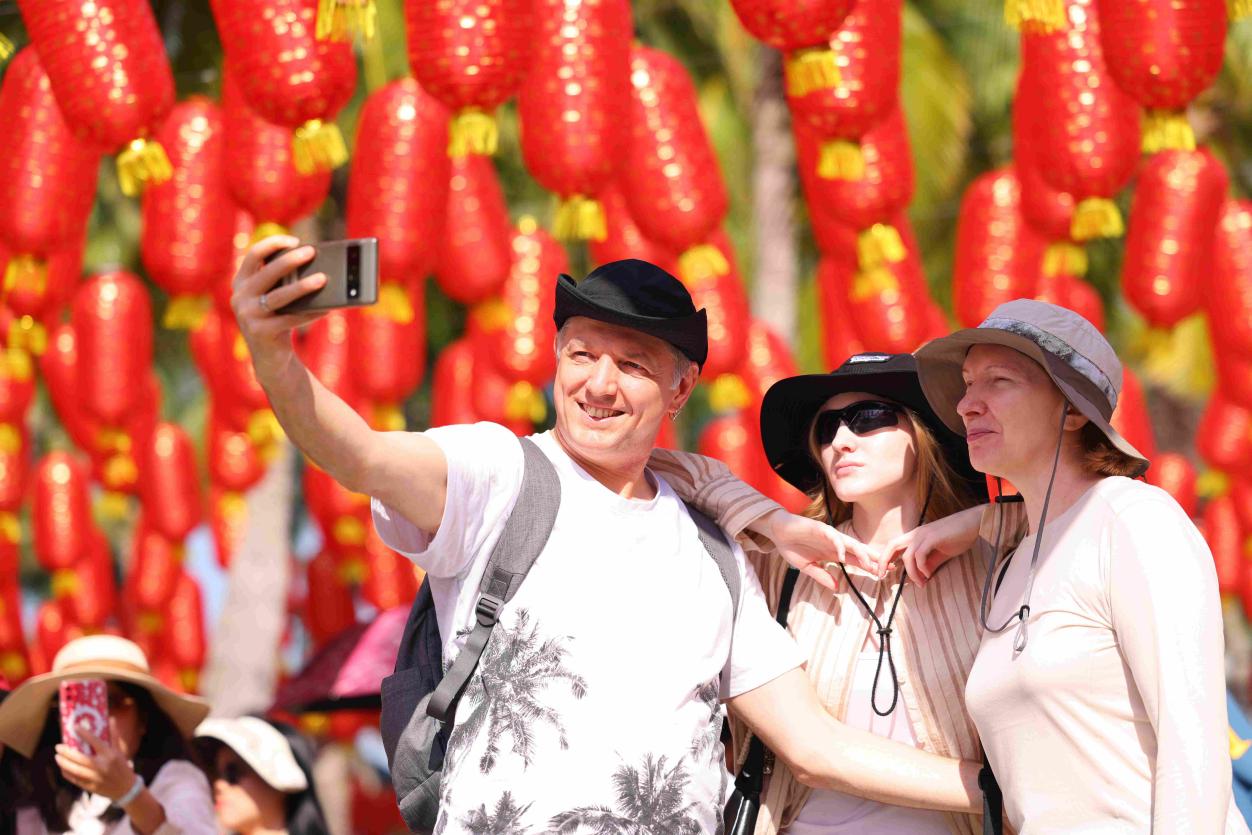
Foreign travelers pose for a photo at the Nanshan Cultural Tourism Area in Sanya, south China's Hainan province. (Photo/Chen Wenwu)
According to the World Tourism Cities Development Report (2024–2025) released by the World Tourism Cities Federation, five Chinese cities rank among the world's top 20 in tourism safety, while another five place in the global top 10 for smart tourism. Positive travel experiences and China's dynamic image are directly contributing to its growing appeal as a destination for inbound tourism.
A more open, higher-quality and more welcoming inbound tourism market is acting as a vital bridge for global travelers to connect with China's pulse. As the potential of "China travel" continues to be unleashed, people-to-people exchanges will further deepen, enabling people around the world to encounter a China that is real, multidimensional and fully alive.
Photos



Related Stories
- Richer, deeper, heartier -- behind China's New Year inbound traveler influx
- China's Shanxi develops ice and snow-themed tourism
- Snow becomes gold as tourists embrace the cold in China
- Southwest China peaks become winter magnet for Southeast Asian tourists
- Polished inbound tourism sector sparkles brightly again
- Ice, snow tourism heats up across China, drawing global visitors
- China sees record number of enterprises in ice and snow tourism
- Tourism market posts strong start during 2026 New Year holidays
- China’s tourism market sees robust growth in New Year holidays
- NW China's Zhaosu County develops winter tourist services to attract visitors
Copyright © 2026 People's Daily Online. All Rights Reserved.
