



China emerges as a global leader in seed industry innovation
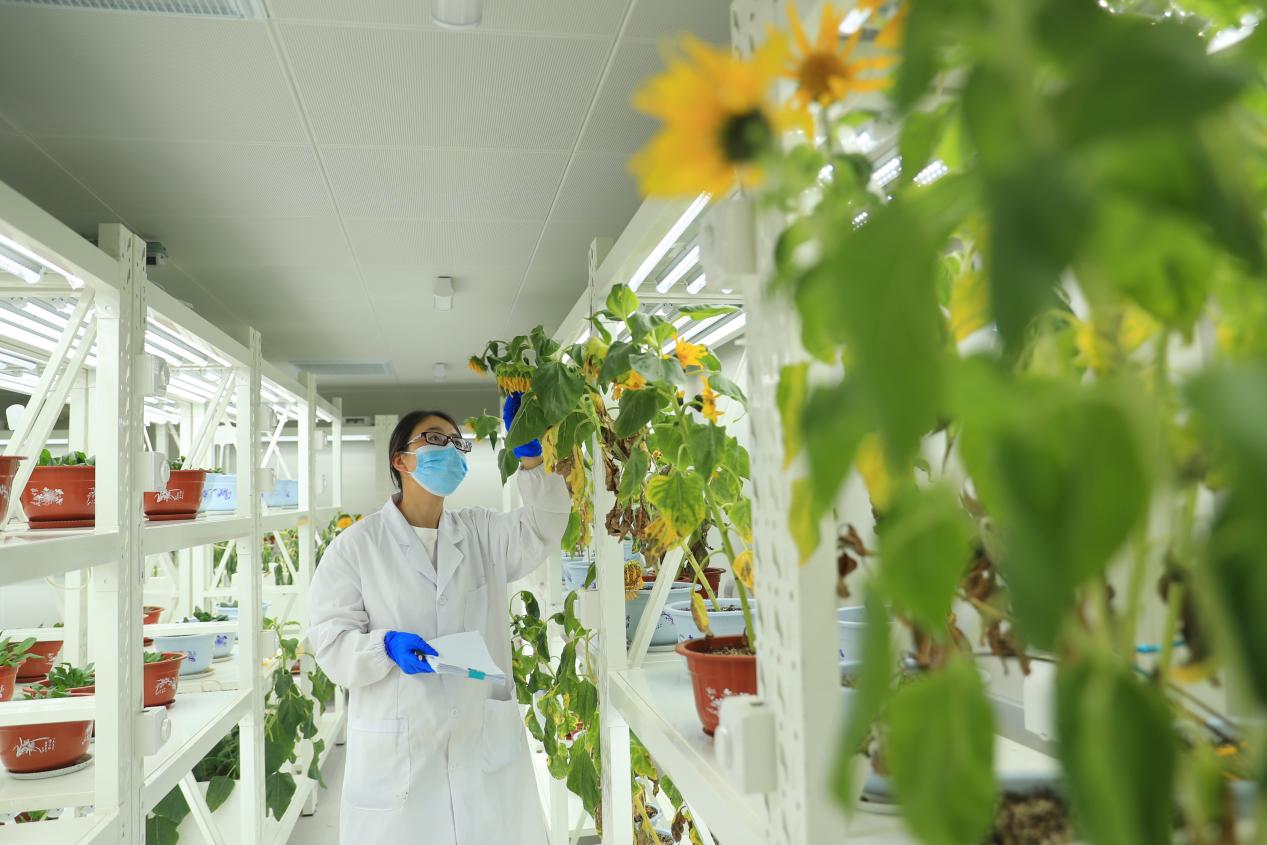
A research check the growth of sunflowers in a laboratory of a seed enterprise in Jiuquan, northwest China's Gansu province. (Photo/Chen Kun)
At the Guanshan rice research and development base of Yuan Longping High-tech Agriculture Co., Ltd. (LPHT) in Changsha, central China's Hunan province, newly bred rice varieties at the heading and flowering stage are neatly arranged in rows. Inside a smart greenhouse, 12 temperature gradients are maintained daily to conduct low-temperature tolerance tests on rice.
"Temperature is a critical factor influencing both yield and quality," said Yang Yuanzhu, the company's chief rice expert. "By simulating natural environments in smart greenhouses, we can accurately assess the tolerance of new varieties to temperature extremes, eliminate underperformers, and ensure safe, large-scale cultivation."
The company has also established AI-driven platforms for speeding up rice reproduction and breeding through whole-genome selection, boosting breeding efficiency by more than 60 percent and yielding a number of high-yield rice varieties.
Since the launch of its seed industry vitalization initiative in 2021, China has made significant investments in breeding innovation. Henan province in central China has allocated 240 million yuan ($34 million) toward joint breeding research on 16 varieties across three major categories, including crops, edible fungi, and livestock and poultry. During the 14th Five-Year Plan period (2021-2025), 25 wheat varieties from the province were recognized as nationally recommended leading varieties.
In south China's Hainan province, 20 major research platforms and pilot projects have been established, including the Yazhou Bay Seed Laboratory, the National Key Laboratory for Tropical Crop Breeding, and a national technology innovation center for salt- and alkali-tolerant rice. Four local enterprises have been approved to host key laboratories under China's Ministry of Agriculture and Rural Affairs, further bolstering the foundation for breeding innovation.
Over the past five years, China has achieved substantial progress in seed industry development. The share of self-developed crop varieties now exceeds 95 percent of total planted area, while domestically developed livestock and poultry, and aquatic species account for more than 80 percent and 85 percent of their respective markets. National seed industry bases now provide 80 percent of the country's seed supply.
The structure of China's seed industry resembles an "olive-shape," with notable strengths at the top: yields and quality of staple crops such as rice and wheat continue to improve, reinforcing China's global leadership. Mid-tier gaps are narrowing, with self-developed maize varieties increasing their shares from 91 percent in 2020 to 94 percent today, and vegetables from 87 percent to 91 percent. At the lower end, breakthroughs in varieties such as spinach, broccoli, and onions have significantly reduced import dependence.
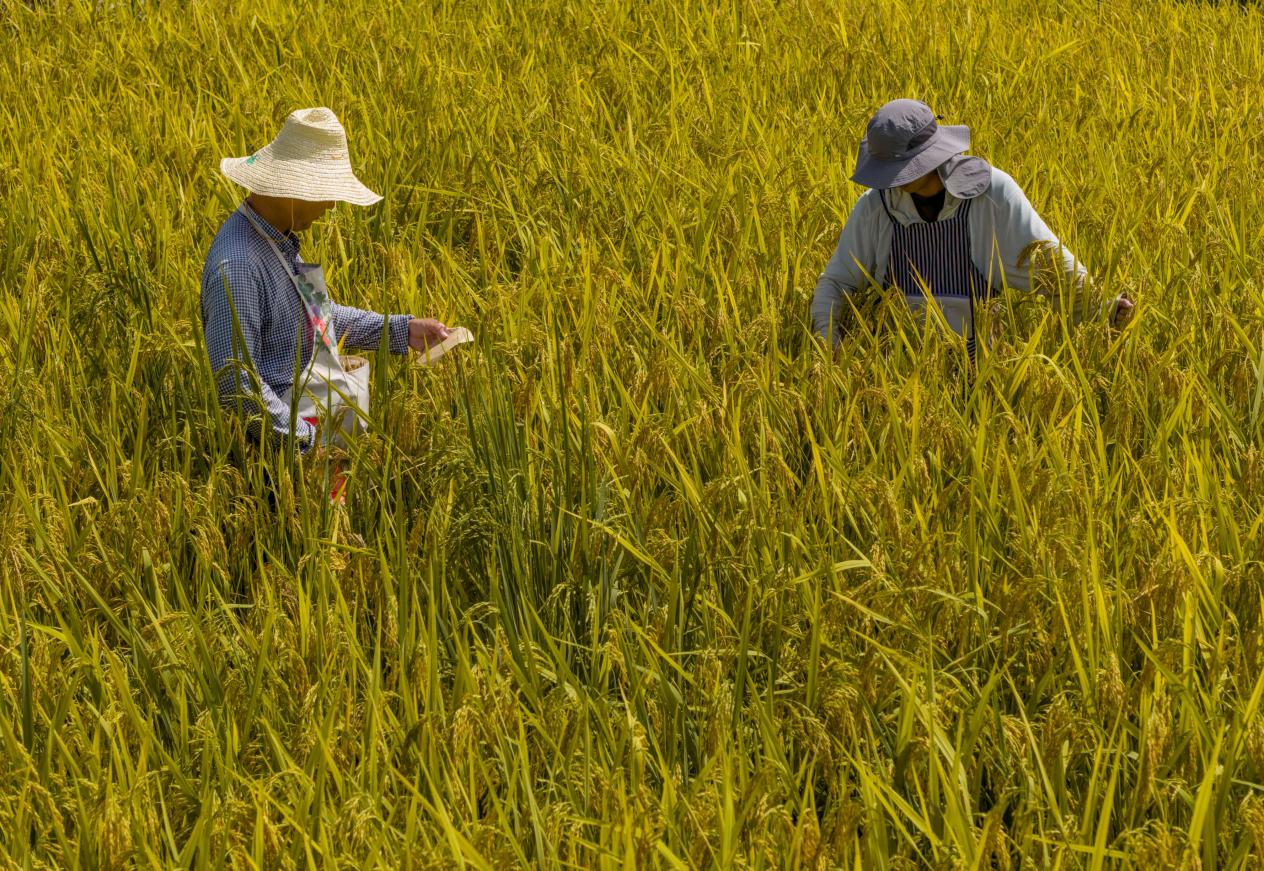
Researchers work in a research base for rice breeding of Sichuan Agricultural University, southwest China's Sichuan province. (Photo/Chen Xianlin)
"China is among the global leaders in terms of sci-tech innovation in the seed industry, meeting the goal of growing Chinese grain with Chinese seeds," said an official with China's Ministry of Agriculture and Rural Affairs.
In Yingchun village, Qinggang county, northeast China's Heilongjiang province, farmer Kou Jiuchun was loading golden ears of corn onto trucks bound for a grain purchasing station. This year's harvest was particularly strong, with yields reaching 1,050 kilograms per mu (approximately 667 square meters), and all the grain from his 100 mu was sold out.
This marked the second year Kou has cultivated the new maize variety "Bixiang 2158." Initially trialed on just over 40 mu, the variety delivered results that surpassed expectations. "It offers strong resistance, high yields, and better purchase prices, generating an additional 240 yuan ($33.98) per mu," he noted. Encouraged by the strong returns, he expanded his planting to 100 mu this year.
China has effectively established a tiered cultivation system for seed enterprises, fostering the broad adoption of new and improved varieties.
For instance, China National Seed Group currently offers more than 300 maize varieties; Guangdong Haid Group, a world-leading agricultural enterprise, ranks first worldwide in annual sales of aquatic seedlings; Xuerong Biotechnology based in Shanghai and Wanchen Biotechnology in Fujian province have developed multiple white enoki mushroom varieties, now accounting for nearly 30 percent of the domestic market; and Fujian Sunner Development Corporation has independently bred three new varieties of white-feather broiler chickens.
To accelerate the large-scale application of scientific and technological advances in agriculture, China's Ministry of Agriculture and Rural Affairs has released a national catalog of quality farm produce and recommended technologies for leading crop varieties.
By promoting the integrated use of high-quality farmland, improved seeds, advanced machinery, and modern farming practices, China is driving broad-based yield improvements in grain and oil crop production. An increasing number of superior new varieties are being rapidly transformed into productive capacity.
Experts said, however, that despite significant progress, gaps remain in China's seed industry when measured against the standards of high-quality development.
For example, although China possesses the world's largest collection of agricultural germplasm resources, the proportion of readily usable, high-quality genetic materials remains limited. Moreover, while China leads the world in academic publications in top-tier journals, the conversion of research into industrial applications remains insufficient.
Breeding innovation is now entering a new phase characterized by the integration of biotechnology and artificial intelligence, fundamentally reshaping breeding paradigms. Moving forward, China should strengthen the protection and utilization of germplasm resources, accelerate innovation breakthroughs, and focus innovative capacity within leading seed enterprises to ensure the continued emergence of high-yielding, high-quality, eco-friendly, cost-effective, and specialty crop varieties.
Photos


Related Stories
- Shanghai seed bank hits 100 million samples in biodiversity conservation push
- China sees notable improvement in seed supply capacity
- Trending in China | Sapium candles: transforming seeds into magic
- Vegetable, fruit, seed sectors thrive in Yuanmou, SW China's Yunnan
- People busy in field on day of Rain Water in Tianjin
- Chinese vice premier stresses speeding up sci-tech progress in seed industry
- China's top court pledges better IPR protection in seed sector
- China reports high level of crop germplasm resource preservation
- China's top legislator urges boosting seed industry through rule of law
- China, Thailand enhance seed cooperation to boost farmer incomes
Copyright © 2026 People's Daily Online. All Rights Reserved.
