



Wild fruit transforms into 10-billion-yuan industry in SW China's Guizhou
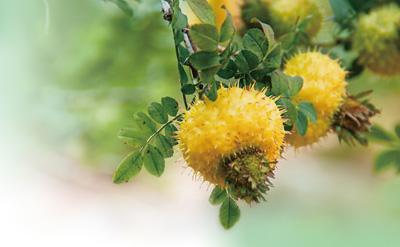
Photo shows Rosa roxburghii fruits in Shuicheng district, Liupanshui city, southwest China's Guizhou Province. (Photo courtesy of the Publicity Department of the Communist Party of China Shuicheng District Committee)
Rosa roxburghii, meaning "thorn pear" in Chinese, is a wild fruit species adorned with thorns in its natural state. This golden fruit is a hallmark product of the mountainous regions in southwest China's Guizhou Province.
In recent years, Rosa roxburghii has emerged as a commercial success story. Processed into beverages, pastries and other products, this once-overlooked fruit has grown into a 10-billion-yuan ($1.4 billion) industry in just a few years.
In Yezhong township, Shuicheng district, Liupanshui city, the karst landscape has long posed formidable challenges for farming. Tang Zhongguang, head of the township forestry station, recalled the frustration of watching crops fail repeatedly on the rocky, desertified land.
The local government had tried planting walnut trees and other economic crops, but the unique ecological conditions defeated most efforts. As confidence eroded, many villagers abandoned their plots and sought work elsewhere. Meanwhile, wild Rosa roxburghii continued thriving on the hillsides, unnoticed and unharvested.
The breakthrough came in autumn 2013, when Tang Fakai, Party chief of Yezhong village, spotted vendors selling dried Rosa roxburghii fruits in the provincial capital Guiyang at 40 yuan per kilogram.
Learning the product came from Longli county in the province's Qiannan Buyi and Miao Autonomous Prefecture, he organized a dozen villagers to visit during the following harvest season to study cultivation techniques. Their initiative aligned with Shuicheng district's plans for ecological restoration and agricultural restructuring. At the time, the district was conducting feasibility studies on developing the Rosa roxburghii industry.
Experts noted that Rosa roxburghii not only serves as an ideal species for combating rocky desertification but also produces highly nutritious fruits with strong commercial potential.
"We never imagined the wild fruit growing in mountainous areas affected by rocky desertification held such great potential," Tang Zhongguang said.
Starting in 2015, Shuicheng district prioritized Rosa roxburghii cultivation as a specialty industry to boost farmers' incomes. Riding this momentum, Yezhong village planted over 2,000 mu (133.33 hectares) of Rosa roxburghii.
The fruiting cycle of Rosa roxburghii spans three years. "We focused on selecting superior varieties and providing technical support throughout key stages," Tang Zhongguang said. To ensure successful cultivation, the district integrated research resources from forestry and agricultural departments at various levels, universities and enterprises, providing systematic training for farmers while dispatching technicians for on-site guidance.
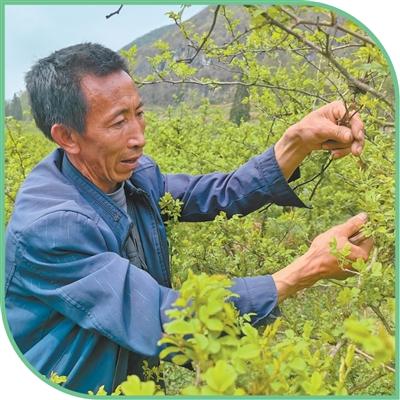
Villager Xu Tianyong prunes Rosa roxburghii trees in Yezhong township, Shuicheng district, Liupanshui city, southwest China's Guizhou Province. (People's Daily/Cheng Huan)
Villager Xu Tianyong has become an expert in Rosa roxburghii cultivation and is widely recognized by his fellow villagers. With patient guidance from technicians, Xu planted the fruit on all his more than 10 mu of land. From pruning and fertilizing to weeding and pest control, he gradually mastered key management skills. His dedication paid off with exceptionally vigorous growth.
As training programs expanded, more farmers like Xu mastered essential techniques. Shuicheng district organized these skilled growers and local experts to establish demonstration orchards and help farmers adopt standardized cultivation and management. The thriving Rosa roxburghii trees gradually turned bare hillsides green. Today, the district maintains a forest coverage rate of over 63.55 percent.
In 2018, the district established Guizhou Chuhao Agricultural Technology Development Co., Ltd., tasking it with guaranteeing the procurement of fresh Rosa roxburghii fruits across the district.
"We purchase at above-market prices, ensuring tangible benefits for local people," said Chen Xianjin, the company's production director.
Drawing on its own research center, the company partnered with institutions such as the Institute of Geochemistry of the Chinese Academy of Sciences, China Agricultural University and Guizhou University to jointly develop new products.
Wang Xinying, director of the company's research center, has led her team in developing more than 20 commercial products, ranging from Rosa roxburghii sparkling water to concentrated juice, beverages and lozenges, and has secured 26 patents.
"In 2024, we procured over 8,500 tonnes of fresh Rosa roxburghii fruits, generating more than 51 million yuan in additional income for farmers," Chen said. The company's Rosa roxburghii products now reach markets nationwide, and it is working to expand internationally.
Shuicheng district's experience represents a microcosm of Guizhou's Rosa roxburghii industry development. In 2019, Guizhou designated Rosa roxburghii among its 12 advantageous agricultural industries. In recent years, Guizhou has maintained 1.52 million mu of Rosa roxburghii under stable cultivation, forming four key industrial belts in the cities of Liupanshui, Anshun and Bijie, as well as in Qiannan Buyi and Miao Autonomous Prefecture.
Currently, Guizhou's Rosa roxburghii sector generates an annual output value exceeding 10 billion yuan.
Photos


Related Stories
- Guiyang brews new tourism appeal with coffee, craft beer and tea
- Renhuai in SW China's Guizhou boosts development of its baijiu industry
- Nature reserve witnesses peak season for migration of black-necked cranes in Guizhou
- New high-speed rail opens fresh pathways to tourism and growth in mountainous Guizhou
- World's highest bridge boosts local tourism in Guizhou
- 200 villagers carry 10-tonne wooden house to new site in SW China's Guizhou
- World's highest bridge brings local tourism to new heights
- China's mountainous Guizhou set to launch regular low-altitude drone logistics route
- SW China's Guizhou breathes new life into Tunpu heritage
- 'My Music Paradise' art exchange initiative strikes a chord between China and Europe
Copyright © 2026 People's Daily Online. All Rights Reserved.
