

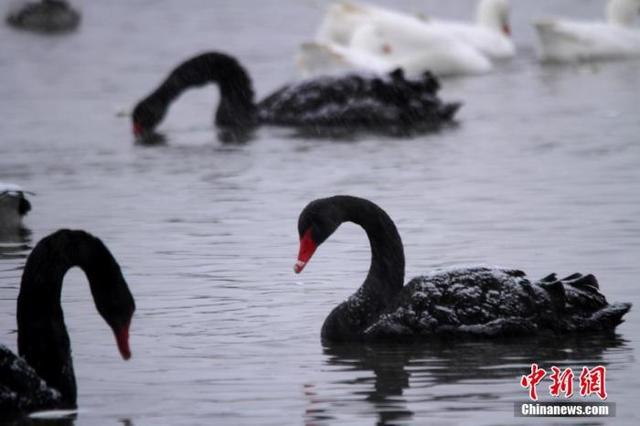
(Photo/China News Service)
The H5N8 bird flu in wild swans at Beijing's Old Summer Palace has been brought under control, local animal disease prevention and control department announced on Tuesday, dispelling the possibility that it could have a bigger area of infection.
"The disease currently only occurs partially and has been effectively controlled. No infection has been seen in other areas," the animal disease prevention and control department in Haidian district said.
There is no poultry farming within 5 kilometers of the park, it said, ruling out the possibility that it could infect domestically bred poultry.
The H5N8 bird flu caused the deaths of three black swans at the Old Summer Palace in the city's Haidian district from January 22 to 25.
Among the three deaths, two adult swans lived in the same flock and had been in poor physical condition, while the other was a 9-day-old juvenile with weak immunity. The cold winter weather also added to the risk of contracting the highly pathogenic avian influenza virus.
The announcement said the black swans were originally from Australia and had been living in Beijing's Old Summer Palace since February 2008.
The H5N8 bird flu is not known to have ever infected humans, the announcement said. The highly pathogenic avian influenza virus is mainly transmitted through physical contact with infected poultry, their secretions and excrement, and could also cause infection via respiratory and digestive tracts. Wild birds are easily cross-infected during migration.
The department has carried out a risk assessment of the epidemic which began to emerge last year, with H5N8 outbreaks occurring among wild and home-raised poultry in other parts of the world, including Europe, the Middle East, and East Asia.
This was the third place in China to report the highly pathogenic H5N8 bird flu in wild swans over the last three months, following North China's Shanxi, which reported an outbreak in November, and East China's Shandong Province, which reported an outbreak on January 19.
Disinfection work has been conducted at the surroundings, the authority said, and all the dead animals have been handled appropriately. All the 257 collected samples in wild bird habitats at the park came back negative for H5N8 bird flu.
To eliminate risks, the Old Summer Palace has sealed off the swans' living area and will disinfect all wild bird habitats and feeding venues three times a day. Each disinfection covers an area of 6,000 square meters.
China's Ministry of Agriculture on Monday said Beijing reported an outbreak of H5N8 bird flu in the Old Summer Palace that had caused the deaths of three wild birds, and three others have contracted the virus.
 Fire brigade in Shanghai holds group wedding
 Tourists enjoy ice sculptures in Datan Town, north China
 Sunset scenery of Dayan Pagoda in Xi'an
 Tourists have fun at scenic spot in Nanlong Town, NW China
 Harbin attracts tourists by making best use of ice in winter
 In pics: FIS Alpine Ski Women's World Cup Slalom
 Black-necked cranes rest at reservoir in Lhunzhub County, Lhasa
 China's FAST telescope will be available to foreign scientists in April
 "She power" plays indispensable role in poverty alleviation
 Top 10 world news events of People's Daily in 2020
 Top 10 China news events of People's Daily in 2020
 Top 10 media buzzwords of 2020
 Year-ender:10 major tourism stories of 2020
 No interference in Venezuelan issues
 Biz prepares for trade spat
 Broadcasting Continent
 Australia wins Chinese CEOs as US loses