

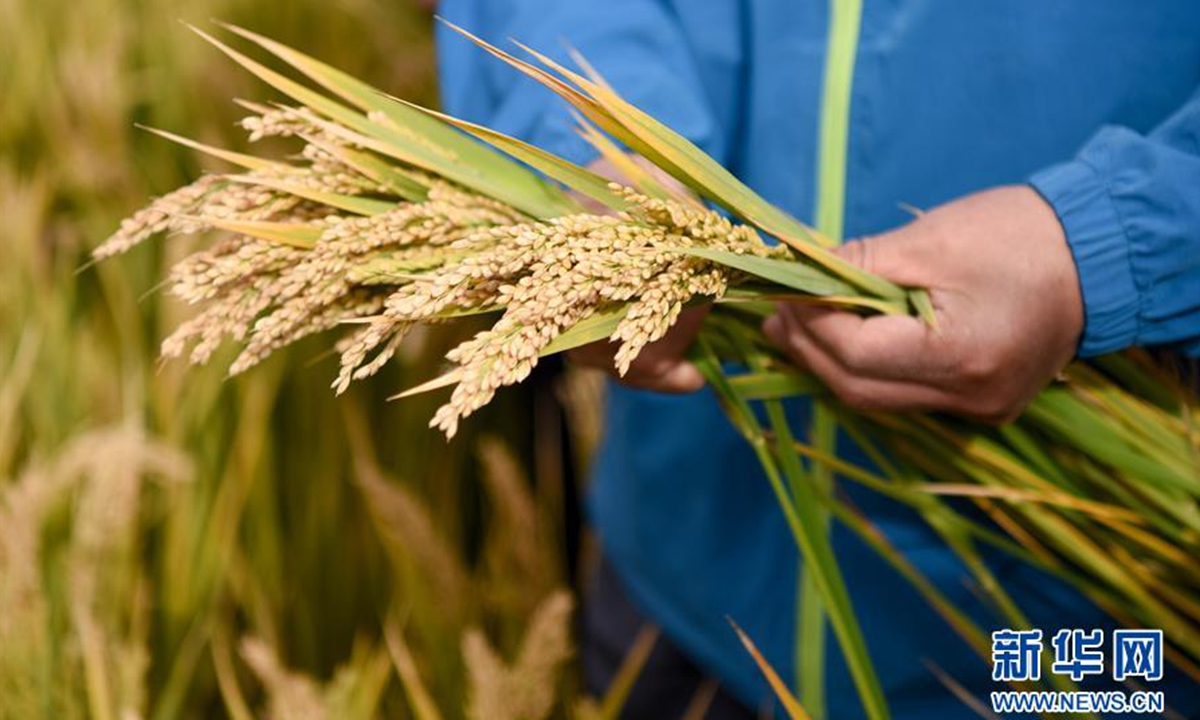
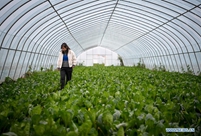
File Photo: Xinhua
The saltwater-tolerant rice made by the team of China's "father of hybrid rice" Yuan Longping has reportedly been planted on the Qaidam Basin of the Qinghai-Tibet Plateau for the first time, pumping up public confidence in food production amid security worries arising from the COVID-19 epidemic.
The Qingdao Saline-Alkali Tolerant Rice R & D Center told the Global Times that the team planted about 6.7 hectares (100 mu) of saltwater-tolerant rice at 2,800 meters in the Qinghai-Tibetan plateau.
It was the first time the team has conducted rice-planting experiments in high-altitude areas in hope of empowering Qinghai Province to fully utilize and expand arable land, Zhang Guodong, deputy director of the center, told the Global Times.
The team hopes to plant 6,667 hectares (100,000 mu) of the "sea rice" across the nation this year, with the first batch planted for the first time on the Qaidam Basin in Northwest China's Qinghai Province.
The Chinese-language hashtag "Yuan Longping team conducts 'sea rice' trial in Qaidam Basin" generated more than 140 million views as of press time on China's Twitter-like Sina Weibo social media.
Many web users officially thanked Yuan, saying the team was addressing public concerns about food.
Some countries and regions have begun to restrict grain exports out of epidemic food security concerns. Russia, Kazakhstan, Ukraine and Cambodia have restricted food and agricultural products exports, media has reported.
Most ordinary rice cannot survive in extreme cold, low air pressure and salty soil. The Qingdao team selected 17 kinds of saltwater-tolerant rice for the plateau and if the trial goes well, they will expand, Zhang said.
"We are aiming to increase the efficiency of arable land by exploiting the saline-alkali soil not only in China, but also for other countries, addressing hunger issues that confront all of humanity."
Through support from governments including Shandong Province and Inner Mongolia, the center had also carried out saline-alkali land reconstruction in 66,667 hectares (1 million mu), the team said.
Yuan, 90-year-old hybrid rice expert and academician at the Chinese Academy of Engineering in Beijing, has vowed to expand the planting of saltwater-tolerant rice to 6.7 million hectares (100 million mu) within a decade.
China has 100 million hectares (1.5 billion mu) of saline-alkali land providing an arable land reserve for the country.
The average yield could reach 400 kilograms per mu (0.06 hectares) this year, Zhang said. Some 100,000 mu (6,667 hectares) of saline-alkali soil can produce 40,000 tons of rice for the Chinese people, he said.
 Fire brigade in Shanghai holds group wedding
 Tourists enjoy ice sculptures in Datan Town, north China
 Sunset scenery of Dayan Pagoda in Xi'an
 Tourists have fun at scenic spot in Nanlong Town, NW China
 Harbin attracts tourists by making best use of ice in winter
 In pics: FIS Alpine Ski Women's World Cup Slalom
 Black-necked cranes rest at reservoir in Lhunzhub County, Lhasa
 China's FAST telescope will be available to foreign scientists in April
 "She power" plays indispensable role in poverty alleviation
 Top 10 world news events of People's Daily in 2020
 Top 10 China news events of People's Daily in 2020
 Top 10 media buzzwords of 2020
 Year-ender:10 major tourism stories of 2020
 No interference in Venezuelan issues
 Biz prepares for trade spat
 Broadcasting Continent
 Australia wins Chinese CEOs as US loses