BEIJING, June 8 (Xinhua) -- An international team of researchers has found evidence of a parasite-host relationship in 512-million-year-old fossils.
The team, led by researchers from Northwest University, analyzed a cluster of brachiopod fossils, discovered in southwest China's Yunnan Province. They found that some tube-like creatures are affixed to the exterior of the brachiopod's shells.
The creatures are positioned at the same level as the brachiopod's opening where it would take in food, and researchers believe the tube-like creatures stole food from the brachiopod. They also found evidence that brachiopods with encrusting, tube-like creatures didn't grow as large as those without tubes on them.
Parasite-host systems are pervasive in nature but are extremely difficult to identify in fossil records. Researchers believe this is the oldest known evidence of parasitic relationships found in fossil records.
The study reveals parasite-host animal systems in early Cambrian, and their emergence may have played a key role in driving the evolutionary and ecological innovations associated with Cambrian radiation, according to the research.
The research was published in the journal Nature Communications.
 Fire brigade in Shanghai holds group wedding
 Tourists enjoy ice sculptures in Datan Town, north China
 Sunset scenery of Dayan Pagoda in Xi'an
 Tourists have fun at scenic spot in Nanlong Town, NW China
 Harbin attracts tourists by making best use of ice in winter
 In pics: FIS Alpine Ski Women's World Cup Slalom
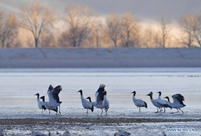 Black-necked cranes rest at reservoir in Lhunzhub County, Lhasa
 China's FAST telescope will be available to foreign scientists in April
 "She power" plays indispensable role in poverty alleviation
 Top 10 world news events of People's Daily in 2020
 Top 10 China news events of People's Daily in 2020
 Top 10 media buzzwords of 2020
 Year-ender:10 major tourism stories of 2020
 No interference in Venezuelan issues
 Biz prepares for trade spat
 Broadcasting Continent
 Australia wins Chinese CEOs as US loses