

In recent years, the U.S. government has placed unwarranted restrictions on Chinese media agencies and personnel in the U.S. out of Cold War mentality and ideological bias, and lately it just escalated its politically-motivated oppression on them.
The countermeasures taken by China are legitimate and justified self-defense. However, certain U.S. media outlets are still calling white black and pointing fingers at China’s counteractions while turning a blind eye to the escalating oppression of the U.S.
The clumsy performance further exposed the hypocrisy of the self-styled advocate of press freedom.
The U.S. made petty political moves to obstruct legitimate reporting of Chinese journalists. Chinese journalists can only get single-entry visas, so they have to reapply for visas after a home leave or a trip to a third country. Some cannot get back to the U.S. due to visa rejection.
Besides, the U.S. government also required them to submit extra documents for visa application, and arbitrarily extended visa approval, indefinitely delayed approval and even denied application of visa for Chinese journalists in name of administrative review.
Since 2018, the US denied visas for 29 Chinese journalists without any reason, including nine based in the U.S.
The U.S. has also restricted Chinese journalists from reporting in the U.S. for a variety of reasons. For instance, it denied some Chinese journalists applying for U.S. Congress press credentials, excluded them from small-scale reporting events, and even interrogated them during reporting. These actions have made it increasingly difficult for Chinese journalists to conduct interviews in the U.S., and severely violated the legitimate rights and interests of them to conduct reporting activities overseas.
The U.S. kept intensifying its suppression on Chinese media and for times restricted Chinese media agencies by political means.
In December 2018, the U.S. Department of Justice registered relevant Chinese media outlet as “foreign agents”, requesting the latter to report information about its finance and other activities in the U.S. on a regular basis.
On Feb. 18 this year, the U.S. State Department announced that five Chinese media agencies in the U.S. would be designated as “foreign missions” and required to submit information on their staff and real estate. It also ruled that these Chinese media outlets will have to gain approval for house renting or buying in the U.S.
On March 2, the U.S. State Department announced that starting March 13, the number of Chinese employees in the U.S. from the five Chinese media agencies would be cut by 60, or 40 percent, to 100, a move interpreted as expelling Chinese journalists from the U.S.
It is the U.S. who stirred up trouble by suppressing Chinese media agencies out of nothing; however, it lodged groundless accusations against the reciprocal measures China was forced to take and even hinted at revenge over China’s countermeasures. This exposed the double standards of the U.S.
The U.S. hypocrisy on “freedom of the press” has been seen through, and its political purposes of rudely oppressing Chinese media outlets are not a secret anymore. Its bullying practices conducted in the name of “freedom” will never be accepted and justified, and no country will tolerate that.
Media serves as a bridge and window of communication. For a long time, Chinese journalists in the U.S. have played an important role in deepening mutual understanding between the Chinese and Americans through their massive reports.
Regrettably, the U.S. political suppression on Chinese media organizations has become a stumbling block for the positive interaction between the two countries. The U.S. should see that arrogance and prejudice are not justice, and bullying will never succeed.
(Zhong Sheng is a pen name often used by People’s Daily to express its views on foreign policy.)
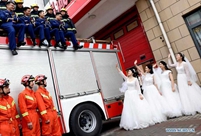 Fire brigade in Shanghai holds group wedding
 Tourists enjoy ice sculptures in Datan Town, north China
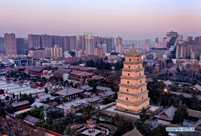 Sunset scenery of Dayan Pagoda in Xi'an
 Tourists have fun at scenic spot in Nanlong Town, NW China
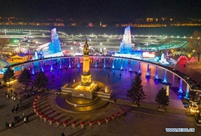 Harbin attracts tourists by making best use of ice in winter
 In pics: FIS Alpine Ski Women's World Cup Slalom
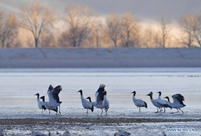 Black-necked cranes rest at reservoir in Lhunzhub County, Lhasa
 China's FAST telescope will be available to foreign scientists in April
 "She power" plays indispensable role in poverty alleviation
 Top 10 world news events of People's Daily in 2020
 Top 10 China news events of People's Daily in 2020
 Top 10 media buzzwords of 2020
 Year-ender:10 major tourism stories of 2020
 No interference in Venezuelan issues
 Biz prepares for trade spat
 Broadcasting Continent
 Australia wins Chinese CEOs as US loses