

Some foreign celebrities who attacked the Xinjiang Uygur autonomous region in social media were blinded by fake news cooked up by a few foreign reporters who listened to ill-intentioned lies from people with political agendas and then published irresponsible reports, a spokeswoman for the regional government said on Friday.
"Qurans are burned, mosques were closed down, Islamic theological schools, madrassas, were banned, religious scholars were killed one by one. Despite all this, Muslims stay quiet," Mesut Ozil, a soccer star of Arsenal, an English Premier League team, posted on Dec 13 on social media together with an image of the flag of so-called East Turkestan.
Gul Abulim, a spokeswoman for the regional government, pointed out at a news conference on Friday in the regional capital of Urumqi that "Xinjiang has never been called East Turkestan, and never has there been any so-called East Turkestan."
"I don't know if these celebrities have ever been to Xinjiang, but they seem to be blinded by fake news," she said.
Contrary to the accusation about demolishing mosques, local governments at all levels in Xinjiang have made continuous efforts to improve the quality of public services at mosques, she added.
Mosques in Xinjiang now have access to sewage systems, electricity, paved roads, natural gas for heating, telecommunication, broadcasting and TV signals. These services are all welcomed by followers, Gul said.
She said the regional government also noticed that some people recently launched a social media campaign tagged "China kills Muslims".
"This was clearly organized to smear the Chinese government's Xinjiang policy," Gul said.
The New York Times recently carried a report alleging that the Xinjiang government sends children to boarding schools, "separates" them by force from their parents, "replaces ethnic languages with Mandarin" and "brainwashes" them with patriotic education.
It is entirely up to students and their parents to decide whether or not someone should attend a boarding school, said Parhat Roz, a spokesman for the regional government, at the news conference. Because Xinjiang is a vast region, there are a significant number of students who live long distances from their schools. Many of them choose to live on campus. The same principle applies to all students in Xinjiang, regardless of their ethnic group, he said.
"Also, six languages are used in primary-to-secondary education in Xinjiang for courses in the national common language and in languages of their own ethnic groups," he said.
Despicably, Parhat said, The New York Times made irresponsible remarks about Xinjiang's patriotic education of primary school students, which is a common practice in countries all over the world, including the United States.
"Don't schools in the US conduct patriotic education? In fact, since the end of 19th century, it has been a tradition for American primary and secondary students to learn and recite the Pledge of Allegiance. But the patriotic education in schools in Xinjiang has been twisted as brainwashing," Parhat said.
Some foreign reporters have fabricated mendacious reports about Xinjiang and interviewees out of thin air, indiscriminately making up content in violation of press ethics, he added.
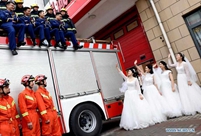 Fire brigade in Shanghai holds group wedding
 Tourists enjoy ice sculptures in Datan Town, north China
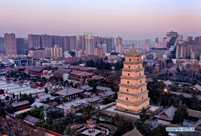 Sunset scenery of Dayan Pagoda in Xi'an
 Tourists have fun at scenic spot in Nanlong Town, NW China
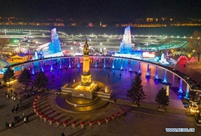 Harbin attracts tourists by making best use of ice in winter
 In pics: FIS Alpine Ski Women's World Cup Slalom
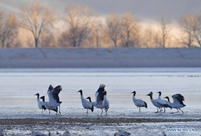 Black-necked cranes rest at reservoir in Lhunzhub County, Lhasa
 China's FAST telescope will be available to foreign scientists in April
 "She power" plays indispensable role in poverty alleviation
 Top 10 world news events of People's Daily in 2020
 Top 10 China news events of People's Daily in 2020
 Top 10 media buzzwords of 2020
 Year-ender:10 major tourism stories of 2020
 No interference in Venezuelan issues
 Biz prepares for trade spat
 Broadcasting Continent
 Australia wins Chinese CEOs as US loses