

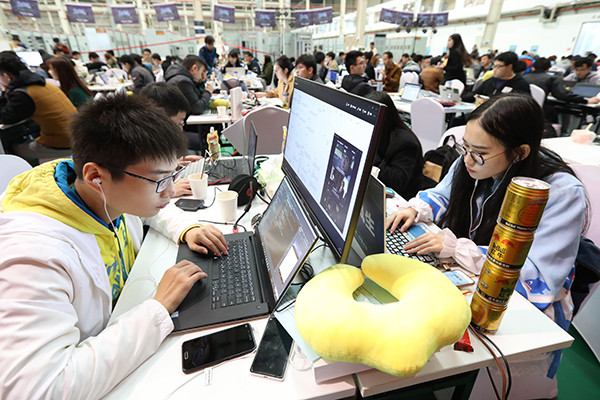
Programmers at a skills competition in Wuhan, Hubei province. The contest was aimed at stimulating the development of internet technology. [Photo/China Daily]
For Fang Xing, it was not an easy to start a business in the “niche” industry of cybersecurity. Yet the man has incubated three startup projects and won another prize with his latest.
Fang and his Quanzhi Tech team brought home the champion title at the startup competition during the 2019 Beijing Cyber Security Conference in August.
“I’m a cybersecurity engineer myself, and from what I’ve done with my last two entrepreneurial projects, my experience and projects have both proved my judgement correct and far-sighted. Within three minutes [during the presentation], it is critical to show you are forward-looking in strategy and technology,” Fang said.
Fang’s company aims to protect data security during data flow, while his peer competitors have set eyes on various other fields, from IoT and data privacy to supercomputing and even cybersecurity insurance.
“Different from my previous experience in starting a business in cybersecurity, this time I can feel the whole industry under spotlight and each day something new comes up in the industry. The development and reform is tremendous,” Fang told People’s Daily.
Like Innovation Sandbox at the RSA Conference in the US, startup competitions began to catch public attention in China since 2016. Over the years, a number of Chinese startups have taken off from such competitions.
“It’s delightful to see how each startup today has its own focus, and that they are increasingly focused on everyday services and data applications, which goes along with innovative security models,” said Wu Yunkun, president of Qi An Xin Group, who hosted the competition.
China’s cybersecurity market spending reached $7.35 billion in 2019 and experts estimate that the annual growth rate will be 25.1%, making it a leader in the global market. By 2023, the market volume will reach $17.9 billion, according to the latest IDC report.
The booming cybersecurity market is also consistent with the overall high-tech industry in the past years. With more enterprises aiming high for technology that is more cutting-edge and economic progress, the continuous investment in R&D and innovation also in turn expand the horizon of cybersecurity players, said Cai Jingjing, founder of Integrity Tech, a Beijing-based cybersecurity company.
There is also a rising demand for better cybersecurity products and services, as Chinese enterprises become more proactive in cyber defense, Cai told People’s Daily.
China has tightened its grip on national cybersecurity over the past years, especially after it announced the nation’s first Cyber Security Law in November 2016, which took effect one year later. The nation has hence picked up pace in cyber defense, repeating its pledge to become a major cyber security power.
“The cybersecurity industry is bound to take off and more startups will rise and gradually lead in the industry to safeguard the nation’s cybersecurity,” Fang said.
 Fire brigade in Shanghai holds group wedding
 Tourists enjoy ice sculptures in Datan Town, north China
 Sunset scenery of Dayan Pagoda in Xi'an
 Tourists have fun at scenic spot in Nanlong Town, NW China
 Harbin attracts tourists by making best use of ice in winter
 In pics: FIS Alpine Ski Women's World Cup Slalom
 Black-necked cranes rest at reservoir in Lhunzhub County, Lhasa
 China's FAST telescope will be available to foreign scientists in April
 "She power" plays indispensable role in poverty alleviation
 Top 10 world news events of People's Daily in 2020
 Top 10 China news events of People's Daily in 2020
 Top 10 media buzzwords of 2020
 Year-ender:10 major tourism stories of 2020
 No interference in Venezuelan issues
 Biz prepares for trade spat
 Broadcasting Continent
 Australia wins Chinese CEOs as US loses