

TOKYO, Aug. 29 -- A research team from Japan's Osaka University said Thursday that it has conducted the world's first transplant for corneal disease using induced pluripotent stem (iPS) cells.
The team conducted the surgery in July, allowing iPS corneal tissues to replace the current queuing for corneal donations, which have been insufficient in Japan.
The female patient in her 40s, who suffered from corneal epithelial stem cell deficiency, was discharged from the hospital last week. According to the researchers, so far no problems have occurred and her eyesight has improved.
Corneal disease is caused by losing cells in the eye that produce the cornea due to illness or injury. It results in worsening eyesight and loss of vision.
The researchers said they will continue to monitor the patient to observe the transplant's effectiveness and safety.
"We are just getting started with the first (patient) and we're at the stage where we will be looking very carefully," the team's leader Koji Nishida said at a press conference.
Nishida said he would like the surgery to be put into practical use as a common treatment within five years as his team plans to conduct its second transplant within the year.
In March, Japan's health ministry approved the clinical studies of the research team on four adult patients.
 Fire brigade in Shanghai holds group wedding
 Tourists enjoy ice sculptures in Datan Town, north China
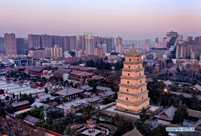 Sunset scenery of Dayan Pagoda in Xi'an
 Tourists have fun at scenic spot in Nanlong Town, NW China
 Harbin attracts tourists by making best use of ice in winter
 In pics: FIS Alpine Ski Women's World Cup Slalom
 Black-necked cranes rest at reservoir in Lhunzhub County, Lhasa
 China's FAST telescope will be available to foreign scientists in April
 "She power" plays indispensable role in poverty alleviation
 Top 10 world news events of People's Daily in 2020
 Top 10 China news events of People's Daily in 2020
 Top 10 media buzzwords of 2020
 Year-ender:10 major tourism stories of 2020
 No interference in Venezuelan issues
 Biz prepares for trade spat
 Broadcasting Continent
 Australia wins Chinese CEOs as US loses