

LOS ANGELES, June 17 (Xinhua) -- The Deep Space Atomic Clock, a new technology from NASA's Jet Propulsion Laboratory (JPL), will be launched on a SpaceX Falcon Heavy rocket into Earth's orbit for one year in late June, according to a latest release of JPL.
The clock, a toaster-size device, is the first GPS-like instrument small and stable enough to fly on a spacecraft.
Currently, navigators tell a spacecraft where to go by calculating its position from Earth and sending the location data to space in a two-way relay system that can take anywhere from minutes to hours to deliver directions.
The new technology of the clock enables a spacecraft to know where it is without needing to rely on that data from Earth, according to JPL.
After deploying the clock to Earth's orbit, engineers will test whether it can help spacecraft locate themselves in space.
If the clock's trial year in space goes well, it could pave the way for a future of one-way navigation in which astronauts are guided by a GPS-like system across the surface of the Moon or can safely fly their own missions to Mars and beyond, said JPL.
"Every spacecraft exploring deep space is steered by navigators here on Earth. Deep Space Atomic Clock will change that by enabling onboard autonomous navigation, or self-driving spacecraft," said mission Deputy Principal Investigator Jill Seubert.
 Fire brigade in Shanghai holds group wedding
 Tourists enjoy ice sculptures in Datan Town, north China
 Sunset scenery of Dayan Pagoda in Xi'an
 Tourists have fun at scenic spot in Nanlong Town, NW China
 Harbin attracts tourists by making best use of ice in winter
 In pics: FIS Alpine Ski Women's World Cup Slalom
 Black-necked cranes rest at reservoir in Lhunzhub County, Lhasa
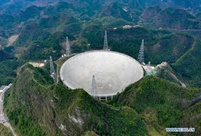 China's FAST telescope will be available to foreign scientists in April
 "She power" plays indispensable role in poverty alleviation
 Top 10 world news events of People's Daily in 2020
 Top 10 China news events of People's Daily in 2020
 Top 10 media buzzwords of 2020
 Year-ender:10 major tourism stories of 2020
 No interference in Venezuelan issues
 Biz prepares for trade spat
 Broadcasting Continent
 Australia wins Chinese CEOs as US loses