

After China established vocational education and training centers in northwest China's Xinjiang Uygur Autonomous Region, some western officials and media outlets constantly attacked China with groundless accusations. However, if they had paid attention to heated discussions about vocational education during China's two sessions in early March and interpreted China's moves from that perspective, their misunderstanding of China might be reduced.
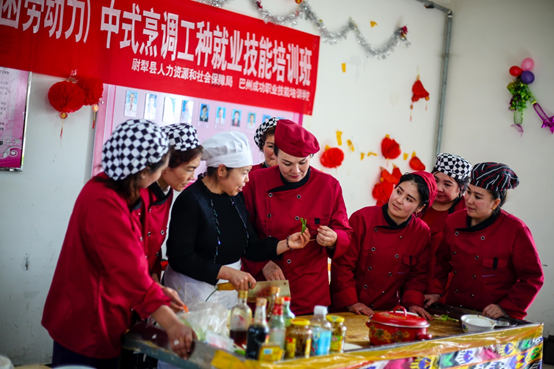
On February 23, 2019, the vocational training school teacher (third from left) explained the cooking knowledge to the students in the Tarim Village, northwest China's Xinjiang Uygur Autonomous Region. (Photo: Li Fei, People’s Daily Online)
The Chinese government is determined to stabilize and expand employment. "Stepping up the development of modern vocational education is a strategic move that will ease current employment pressure," reads the Government Work Report that Chinese Premier Li Keqiang delivered on March 5 to the second session of the 13th National People's Congress.
During China's rapid growth and current economic transition, technicians and skilled workers are urgently needed. There are about 280 million migrant workers in China who are the main workforce for the country's secondary and tertiary industries. Despite the huge number, highly skilled personnel are still in short supply as a majority of migrant workers don't have a good academic or technical background that enable them to be competent. However, China's industrial development is directly linked with workforce capability.
In addition, people without wanted skills could face unemployment and be gradually marginalized. Marginalization will breed antisocial emotions that affect the stability of a country and its development. This could happen in China or in any other country.
To prevent such destabilizing factors, vocational education and training centers have been established across China for migrant workers to improve themselves from big cities like Beijing and Shenzhen to smaller ones like Bincheng in East China's Shandong Province. The Chinese government will allocate 100 billion yuan ($14.9 billion) to provide training for more than 15 million people to help them upgrade their skills or switch jobs or industries. The vocational education and training centers in Xinjiang are along the same lines.
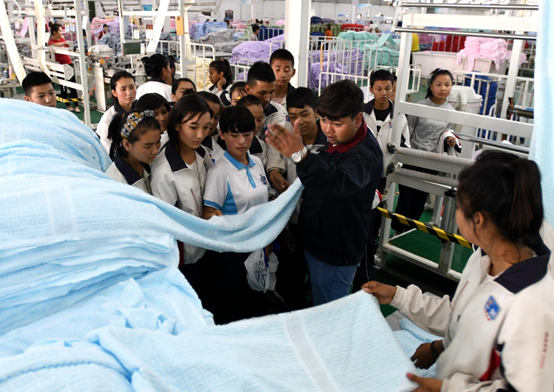
On May 11, 2018, students from the Alar Vocational and Technical School in Xinjiang Uygur Autonomous Region studied textile knowledge in a local textile enterprise workshop. (Photo: Wang Zhiqing, People’s Daily Online)
The underdeveloped education in the autonomous region has limited people from learning modern work skills. In addition, extremist thinking has forced some ethnic minority people away from the country's development achievements and made them feel it is hard to integrate into modern society. Vocational education will help fix these problems, maintain stability of employment and boost the development of China.
The training centers in Xinjiang are part of China's effort to prop up vocational education and enable more people to gain professional skills.

On December 13, 2018, Zhao Yanan (front left), a teacher from the Tacheng District Health School in Xinjiang Uygur Autonomous Region, taught students single-handed cardiopulmonary resuscitation. (Photo: Gao Bo, People’s Daily Online)
Since reform and opening-up, the Chinese government has realized the importance of the workforce and attached great importance to improving their capability in both academic and technical aspects.
Enhancing vocational education is in line with China's lessons learned from development in the past decades. As China aims to comprehensively develop its economy, skilled workers will play a key role that affects the speed and quality of growth.
 Fire brigade in Shanghai holds group wedding
 Tourists enjoy ice sculptures in Datan Town, north China
 Sunset scenery of Dayan Pagoda in Xi'an
 Tourists have fun at scenic spot in Nanlong Town, NW China
 Harbin attracts tourists by making best use of ice in winter
 In pics: FIS Alpine Ski Women's World Cup Slalom
 Black-necked cranes rest at reservoir in Lhunzhub County, Lhasa
 China's FAST telescope will be available to foreign scientists in April
 "She power" plays indispensable role in poverty alleviation
 Top 10 world news events of People's Daily in 2020
 Top 10 China news events of People's Daily in 2020
 Top 10 media buzzwords of 2020
 Year-ender:10 major tourism stories of 2020
 No interference in Venezuelan issues
 Biz prepares for trade spat
 Broadcasting Continent
 Australia wins Chinese CEOs as US loses