

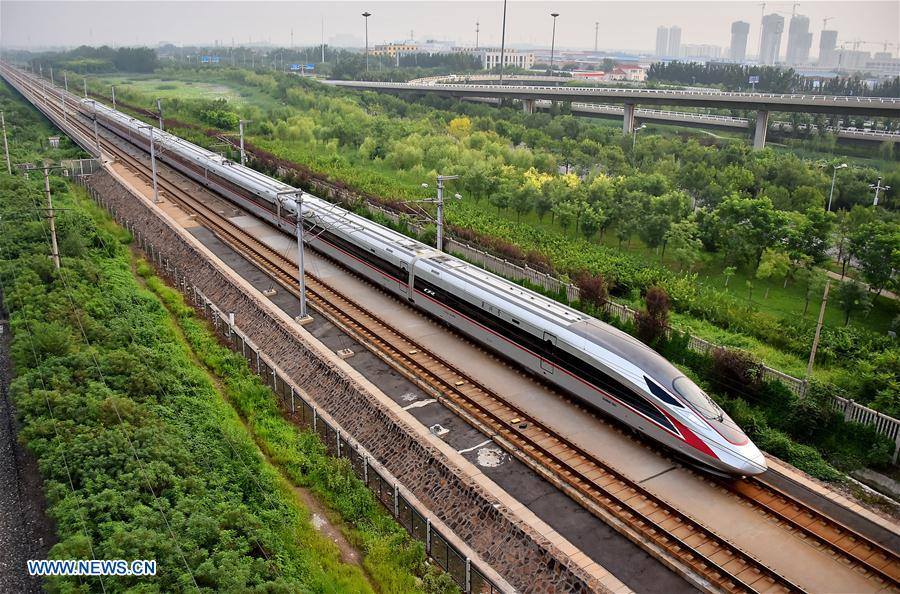
The current Fuxing train which runs on the Beijing-Shanghai line. (Photo/Xinhua)
A new set of longer Fuxing bullet trains will start running on the Beijing-Shanghai line on Jan. 5, according to China Railway Corporation.
Measuring 439.9 meters in length, the new 17-coach trains, which is one more coach longer than the 16-coach Fuxing trains currently running on Beijing-Shanghai line since March, are capable of carrying 1,283 passengers, a 7.5 percent increase in seating capacity.
Entirely designed and manufactured in China, Fuxing, or Rejuvenation in English, debuted on the Beijing-Shanghai line in June 2017. It takes a high-speed Fuxing train 4 hours and 28 minutes to travel between the country’s two largest cities.
The country has witnessed an expanding high-speed railway network over the years, which has reached a total length of 29,000 kilometers by the end of 2018, accounting for more than two-thirds of the world’s total high-speed railway, according to the country’s top railway operator, China Railway.
By the end of this year, China will see 850 Fuxing high-speed trains put into service while R&D efforts on Fuxing high-speed trains running at 350 km/h, 250 km/h, 200 km/h, and 160 km/h will be strengthened, according to the railway operator.
 Fire brigade in Shanghai holds group wedding
 Tourists enjoy ice sculptures in Datan Town, north China
 Sunset scenery of Dayan Pagoda in Xi'an
 Tourists have fun at scenic spot in Nanlong Town, NW China
 Harbin attracts tourists by making best use of ice in winter
 In pics: FIS Alpine Ski Women's World Cup Slalom
 Black-necked cranes rest at reservoir in Lhunzhub County, Lhasa
 China's FAST telescope will be available to foreign scientists in April
 "She power" plays indispensable role in poverty alleviation
 Top 10 world news events of People's Daily in 2020
 Top 10 China news events of People's Daily in 2020
 Top 10 media buzzwords of 2020
 Year-ender:10 major tourism stories of 2020
 No interference in Venezuelan issues
 Biz prepares for trade spat
 Broadcasting Continent
 Australia wins Chinese CEOs as US loses