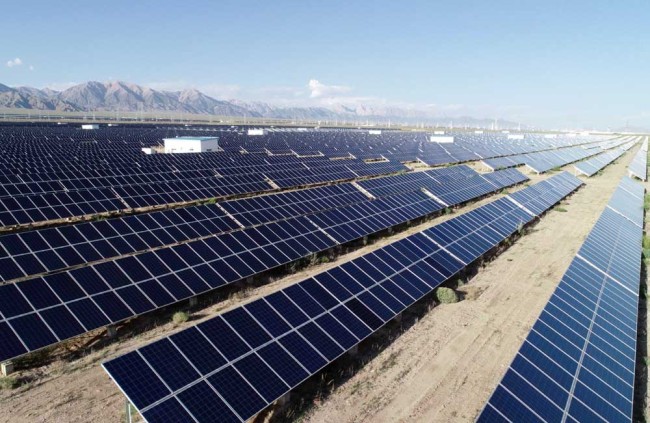
Two solar power bases in northwest China's Qinghai Province, with a total installed power generating capacity of 1 GW, were launched and connected to the grid Saturday.
Each of the two demonstration bases directly managed by the National Energy Administration in the cities Delingha and Golmud, the Mongolian-Tibetan Autonomous Prefecture of Haixi, has a generating capacity of 500 MW.
The Golmud base sells its electricity at 0.316 yuan (5 U.S. cents) per kWh, lower than the 0.325 yuan benchmark price of electricity generated by coal-fired power plants.
This is unprecedented nationwide for solar power plants, offering hope that solar power could be price competitive.
Chen Yuan, deputy director of the prefecture development and reform commission, said the two bases can generate 1.5 billion kWh of electricity each year, helping save 478,000 tonnes of standard coal.
This could help reduce annual emissions of dust by 6,494 tonnes and cut annual emissions of carbon dioxide and sulfur dioxide, said Chen.
To reduce greenhouse gas emissions and tackle air pollution, China has been trying to use more renewable energy.
But due to higher costs, poor grid connections and the grid's preference for more predictable coal-generated power, some of the new energy generating capacity could be left idle.
 Fire brigade in Shanghai holds group wedding
 Tourists enjoy ice sculptures in Datan Town, north China
 Sunset scenery of Dayan Pagoda in Xi'an
 Tourists have fun at scenic spot in Nanlong Town, NW China
 Harbin attracts tourists by making best use of ice in winter
 In pics: FIS Alpine Ski Women's World Cup Slalom
 Black-necked cranes rest at reservoir in Lhunzhub County, Lhasa
 China's FAST telescope will be available to foreign scientists in April
 "She power" plays indispensable role in poverty alleviation
 Top 10 world news events of People's Daily in 2020
 Top 10 China news events of People's Daily in 2020
 Top 10 media buzzwords of 2020
 Year-ender:10 major tourism stories of 2020
 No interference in Venezuelan issues
 Biz prepares for trade spat
 Broadcasting Continent
 Australia wins Chinese CEOs as US loses