

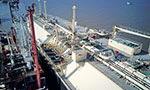
WASHINGTON, Dec. 10 (Xinhua) -- U.S. Energy Information Agency (EIA) said on Monday that liquefied natural gas (LNG) export capacity in the United States was expected to reach 8.9 billion cubic feet (about 252 million cubic meters) per day by the end of 2019.
This would make the United States the third largest LNG exporter in the world, right behind Australia and Qatar, said EIA.
EIA said that U.S. LNG export capacity stands at 3.6 billion cubic feet per day for now, and it is expected to reach 4.9 billion cubic feet per day at the end of this year, as two new liquefaction facilities become operational.
The two new liquefaction units, Sabine Pass Train 5 in the State of Louisiana and Corpus Christi LNG Train 1 in the State of Texas, both began LNG production this year ahead of schedule, said EIA.
The EIA also noted that these two facilities were expected to ship their first cargos within the next few weeks.
The United States began exporting LNG from the continental states area in February 2016, according to EIA.
EIA is an agency part of the U.S. Department of Energy. It is responsible for collecting, analyzing, and disseminating energy information in order to facilitate policy making process. EIA covers data on coal, petroleum, natural gas, electric, renewable and nuclear energy.
 Fire brigade in Shanghai holds group wedding
 Tourists enjoy ice sculptures in Datan Town, north China
 Sunset scenery of Dayan Pagoda in Xi'an
 Tourists have fun at scenic spot in Nanlong Town, NW China
 Harbin attracts tourists by making best use of ice in winter
 In pics: FIS Alpine Ski Women's World Cup Slalom
 Black-necked cranes rest at reservoir in Lhunzhub County, Lhasa
 China's FAST telescope will be available to foreign scientists in April
 "She power" plays indispensable role in poverty alleviation
 Top 10 world news events of People's Daily in 2020
 Top 10 China news events of People's Daily in 2020
 Top 10 media buzzwords of 2020
 Year-ender:10 major tourism stories of 2020
 No interference in Venezuelan issues
 Biz prepares for trade spat
 Broadcasting Continent
 Australia wins Chinese CEOs as US loses