China and Brazil will launch a new Earth resource satellite next year, according to an official with the China National Space Administration.
NEW SATELLITE
"The new satellite, the China-Brazil Earth Resource Satellite-4A, or CBERS-4A, will be launched in the second half of 2019," said Li Guoping, the secretary-general of the China National Space Administration, in a recent interview with Xinhua prior to a symposium held in Beijing Thursday, in commemoration of the 30th anniversary of China-Brazil space cooperation.
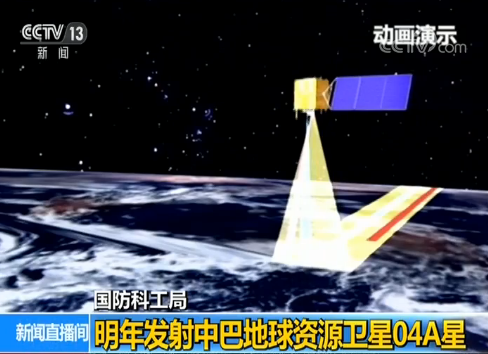
The CBERS satellites are Earth remote sensing satellites, specifically designed for Earth observation from orbit for non-military use, such as environment monitoring, meteorology and map making.
According to Li, CBERS-4A, the new satellite to be launched, is assembled and currently going through tests in Brazil. It is set to replace CBERS-4. CBERS-4, launched in December 2014, is currently in great condition although under extended service.
"The two countries will also start the final design and research of CBERS-5 and CBERS-6. The two satellites will be successors to CBERS-4A, which is designed to serve for five years," Li said.
China and Brazil inked the agreement establishing the joint research and production of the CBERS series in July 1988. The program has set a good example for cooperation among developing countries in the field of space technology, and has been praised as a model of "South-South cooperation."
OLD FRIENDS
In July 1988, China and Brazil inked the agreement establishing the joint research and production of the CBERS.
CBERS-1, the first satellite in the program was successfully launched in October 1999, giving each country their first transmission-type remote sensing satellite. It was rated one of the top 10 scientific and technological advances of the year in China.
It was the first satellite jointly developed by China and another country, and set a good example for cooperation among developing countries in the field of space technology, and was praised as a model of "South-South cooperation."
Meanwhile, data from the CBERS satellites, according to Li, are provided to a number of Asia-Pacific and Latin American countries for free.
FUTURE COOPERATION
"I think the cooperation between China and Brazil in space will last more than that. I hope it will last more than 100 years," said Jose Raimundo Coelho, president of the Brazilian Space Agency in an interview.
Both Raimundo and Li said that the two countries would continue to work together in order to consolidate and expand cooperation beyond the CBERS program.
In 2016, the space agencies of BRICS states announced plans to create a joint satellite constellation for Earth remote sensing. BRICS groups Brazil, Russia, India, China and South Africa.
Each country will provide one to two satellites to the constellation, and the project will mainly provide service to developing countries, according to Li.
The CBERS satellites would be included in the constellation program.
"Our satellites have to be useful for the humankind. I believe the CBERS brand will have its role enhanced worldwide. Even more than it already is," Raimundo said.
 Fire brigade in Shanghai holds group wedding
 Tourists enjoy ice sculptures in Datan Town, north China
 Sunset scenery of Dayan Pagoda in Xi'an
 Tourists have fun at scenic spot in Nanlong Town, NW China
 Harbin attracts tourists by making best use of ice in winter
 In pics: FIS Alpine Ski Women's World Cup Slalom
 Black-necked cranes rest at reservoir in Lhunzhub County, Lhasa
 China's FAST telescope will be available to foreign scientists in April
 "She power" plays indispensable role in poverty alleviation
 Top 10 world news events of People's Daily in 2020
 Top 10 China news events of People's Daily in 2020
 Top 10 media buzzwords of 2020
 Year-ender:10 major tourism stories of 2020
 No interference in Venezuelan issues
 Biz prepares for trade spat
 Broadcasting Continent
 Australia wins Chinese CEOs as US loses