

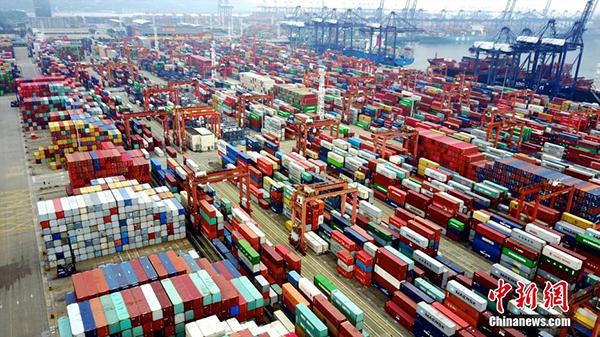
(File Photo)
BEIJING, Aug. 12 (Xinhua) -- China's foreign direct investment (FDI) has remained stable in scale and optimized in quality as the business environment has become more attractive, according to industry experts.
"Looking at the data for the first half of the year (H1), foreign investors maintained their enthusiasm in the Chinese market," said Huo Jianguo, vice chairman of the China Society for WTO Studies.
FDI into the Chinese mainland rose 4.1 percent year on year to 68.32 billion U.S. dollars in the first six months of 2018, according to the Ministry of Commerce.
In particular, the number of new overseas-funded companies established in the Chinese mainland during H1 surged 96.6 percent from a year earlier to 29,591.
In contrast, the overall situation of global direct investment was not rosy, said Sang Baichuan, a professor at the University of International Business and Economics.
Quoting data from the World Investment Report 2018 issued in June this year by the United Nations Conference on Trade and Development (UNCTAD), Sang said that global FDI flows fell by 23 percent in 2017 to 1.43 trillion U.S. dollars.
Foreign investors are investing in a wider range of industries, increasing cooperation, and choosing more varied channels, which shows that China remains an ideal place for investment, said Sang.
In H1, FDI in the high-tech manufacturing industry rose 25.3 percent year on year, led by investment growth in medical instruments, communications equipment, and computer and office equipment.
Bai Ming, a researcher with the Chinese Academy of International Trade and Economic Cooperation, attributed the stable FDI growth largely to a series of measures China has taken in opening up wider.
China has revised its negative lists for foreign investment, further widening market access in such areas as finance, transportation, energy, resources, and agriculture.
The nationwide negative list was cut to 48 items from 63 in the previous version, while the list for pilot free trade zones decreased from 95 to 45 items. Both lists came into effect at the end of July.
Zhan Xiaoning, an official in charge of investment and enterprises at UNCTAD, said he believed that FDI into the Chinese mainland would remain high thanks to the investment facilitation measures.
China is providing foreign investors with bigger market opportunities, wider investment ranges, and a better business environment, according to the experts.
A number of foreign-funded companies have unveiled their new investment plans in China. For example, Pepsi-Cola announced earlier this month that it will invest another 100 million U.S. dollars to expand and renovate its food plant in Shanghai, while BP announced in late July that it has decided to provide 10 million U.S. dollars in support for its Chinese partner's new energy vehicle business.
Despite progress, there is still much room for improvement in the business environment and services, said Sang.
 Fire brigade in Shanghai holds group wedding
 Tourists enjoy ice sculptures in Datan Town, north China
 Sunset scenery of Dayan Pagoda in Xi'an
 Tourists have fun at scenic spot in Nanlong Town, NW China
 Harbin attracts tourists by making best use of ice in winter
 In pics: FIS Alpine Ski Women's World Cup Slalom
 Black-necked cranes rest at reservoir in Lhunzhub County, Lhasa
 China's FAST telescope will be available to foreign scientists in April
 "She power" plays indispensable role in poverty alleviation
 Top 10 world news events of People's Daily in 2020
 Top 10 China news events of People's Daily in 2020
 Top 10 media buzzwords of 2020
 Year-ender:10 major tourism stories of 2020
 No interference in Venezuelan issues
 Biz prepares for trade spat
 Broadcasting Continent
 Australia wins Chinese CEOs as US loses