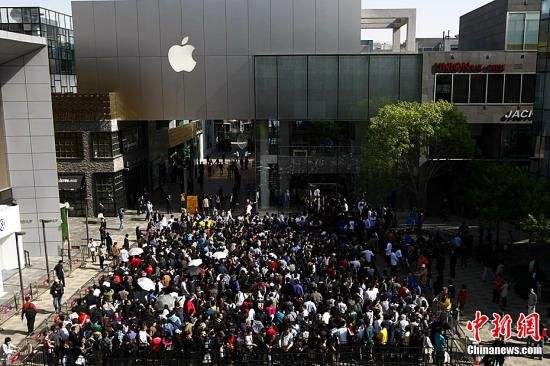
As Apple shares unexpectedly hit a record high, yielding a market capitalization of almost $1 trillion, the hard-earned achievement sparked some discussion: Why has the California-based company enjoyed remarkable success in China, while some Chinese companies have experienced big losses amid a growing trade conflict Washington brought on.
Apple recently reported financial results for its fiscal third quarter ended June 30, and sales to the greater China region gained 19 percent to $9.6 billion. Amid escalating trade friction, the company's better-than-expected quarterly result in China was a major reason for the surge in its shares.
However, the eye-catching success achieved in the Chinese market may provoke nationalist sentiment if US President Donald Trump's recently adopted protectionist measures hit Chinese companies hard.
China is by far the most important overseas market for the US-based Apple, leaving it exposed if Chinese people make it a target of anger and nationalist sentiment. China doesn't want to close its doors to Apple despite the trade conflict, but if the US company wants to earn good money in China, its needs to share its development dividends with the Chinese people.
In an increasingly interconnected world, Apple is a particularly good example of global manufacturing. China now serves as a key production and processing base for Apple. Many Chinese companies have been included in Apple's production chain to provide parts and components or assembly work. This has allowed Apple to benefit from China's ample supply of cheap labor.
In the case of the iPhone, some statistics show Chinese processors only get 1.8 percent of the total profits created by the device.
Apple's contribution to job creation in China is notable, but the company enjoys most of the profits created from its Chinese business. It is impractical and unreasonable to kick the company out of China, but if Apple wants to continue raking in enormous profits from the Chinese markets amid trade tensions, the company needs to do more to share the economic cake with local Chinese people.
The trade conflict initiated by Trump administration reminds China to re-examine China-US trade. It seems US companies doing business in China are the biggest winners from China-US trade. The Chinese market is vital for many top US brands, giving Beijing more leeway to play hardball in the trade conflict.
 Fire brigade in Shanghai holds group wedding
 Tourists enjoy ice sculptures in Datan Town, north China
 Sunset scenery of Dayan Pagoda in Xi'an
 Tourists have fun at scenic spot in Nanlong Town, NW China
 Harbin attracts tourists by making best use of ice in winter
 In pics: FIS Alpine Ski Women's World Cup Slalom
 Black-necked cranes rest at reservoir in Lhunzhub County, Lhasa
 China's FAST telescope will be available to foreign scientists in April
 "She power" plays indispensable role in poverty alleviation
 Top 10 world news events of People's Daily in 2020
 Top 10 China news events of People's Daily in 2020
 Top 10 media buzzwords of 2020
 Year-ender:10 major tourism stories of 2020
 No interference in Venezuelan issues
 Biz prepares for trade spat
 Broadcasting Continent
 Australia wins Chinese CEOs as US loses