

The Guangzhou Marine Geological Survey Bureau has announced that it successfully completed an expedition to explore an area in the South China Sea believed to be rich in deposits of gas hydrate, better known as flammable ice.
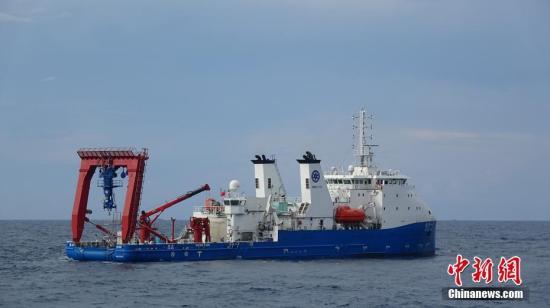
The Tansuo-1 submersibles support ship. [File photo: Chinanews.com]
Two oceanic research vessels, Ocean No. 6 and Tansuo-1, met at an area called Seahorse Cold Spring. This exploratory mission was conducted by two domestically-built submersibles, the remote-controlled Seahorse and the manned Deep Sea Warrior. It is the first time that China has employed two domestically-produced submersibles on a coordinated deep sea mission.
The Seahorse Cold Spring is the first large cold spring of its type discovered in China. China is one of only three countries in the world undertaking research into gas hydrate extraction, the other two being the United States and Japan. According to the U.S. Geological Survey, gas hydrate represents a vast untapped energy source that is estimated to hold more carbon than all the world's other fossil fuels combined.
 Fire brigade in Shanghai holds group wedding
 Tourists enjoy ice sculptures in Datan Town, north China
 Sunset scenery of Dayan Pagoda in Xi'an
 Tourists have fun at scenic spot in Nanlong Town, NW China
 Harbin attracts tourists by making best use of ice in winter
 In pics: FIS Alpine Ski Women's World Cup Slalom
 Black-necked cranes rest at reservoir in Lhunzhub County, Lhasa
 China's FAST telescope will be available to foreign scientists in April
 "She power" plays indispensable role in poverty alleviation
 Top 10 world news events of People's Daily in 2020
 Top 10 China news events of People's Daily in 2020
 Top 10 media buzzwords of 2020
 Year-ender:10 major tourism stories of 2020
 No interference in Venezuelan issues
 Biz prepares for trade spat
 Broadcasting Continent
 Australia wins Chinese CEOs as US loses