
China’s first testing center for autopilot technology is expected to be built in southern China’s Guangdong province.
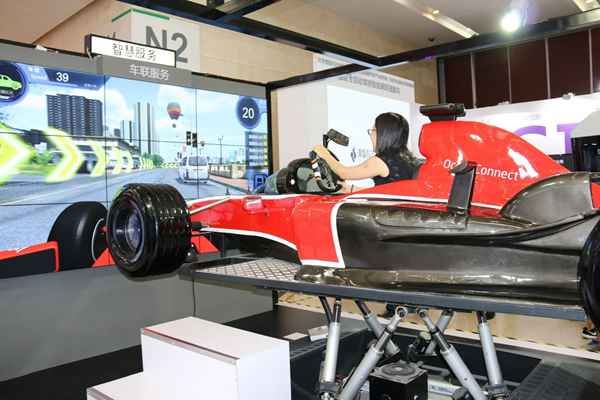
A woman experiences Internet of Vehicles on a simulated Formula-1 racing car at the ex-hibition area during the World Intelligence Congress held on June 29, 2017 in Tianjin. (Photo by Gong Xiangjuan from People’s Daily)
The Economic and Information Commission of Guangdong province recently disclosed that they have already started autopilot testing at local maker Guangzhou Automobile Group, in cooperation with tech giants Huawei, Alibaba and Tencent.
The decision came amid China’s rapid development in driverless technologies in recent years. Both automobile giants and tech forerunners are now exerting all-out efforts to win a place in the sector of unmanned vehicles.

Baidu tests autopilot car. (Photo from Baidu)
Robin Li, CEO of Chinese technology titan Baidu, said previously that the mass production of the unmanned mini-buses will begin in July, 2018 under its cooperation with the Chinese well-known bus manufacturer King Long.
More models of autopilot vehicles will be released by the company and its partners, he added on the annual Baidu World Conference on Nov. 16, 2017.
Though the autonomous driving technology is maturing, it still needs road tests to verify whether these innovative vehicles can deal with complex road and traffic conditions.
Beijing announced this January that its first enclosed testing field for self-driving vehicles will be established in its Yizhuang economic development zone. Other facilities will be added to the field to help autopilot vehicles recognize road and traffic signs.

The world’s first autopilot tramcar rolls off the production line of CRRC Qingdao Sifang Co., Ltd., on July 28, 2017. The tramcar would be put into trial operations in the southern Chinese city of Foshan. (Photo by People’s Daily)
Shanghai also issued regulation guideline on autopilot road tests this March, specifying application requirements for tests.
In addition, China is making laws to supervise autopilot road tests. The country’s Minister of Transport Li Xiaopeng disclosed on Feb. 7 that the ministry has been working on technical plans and specifications for autonomous driving.
The ministry will also build testing centers and work with other departments to formulate guiding policies, according to the minister.
Analysts believe that as both central and local authorities are giving priority to the driver-less technologies with an inclusive attitude and far-sighted horizon, a new engine driving economic growth will ultimately be fostered.

An autonomous driving vehicle transports tomatoes at a smart greenhouse in Beijing on Apr. 25, 2017. (Photo by He Yong from People’s Daily)
 Fire brigade in Shanghai holds group wedding
 Tourists enjoy ice sculptures in Datan Town, north China
 Sunset scenery of Dayan Pagoda in Xi'an
 Tourists have fun at scenic spot in Nanlong Town, NW China
 Harbin attracts tourists by making best use of ice in winter
 In pics: FIS Alpine Ski Women's World Cup Slalom
 Black-necked cranes rest at reservoir in Lhunzhub County, Lhasa
 China's FAST telescope will be available to foreign scientists in April
 "She power" plays indispensable role in poverty alleviation
 Top 10 world news events of People's Daily in 2020
 Top 10 China news events of People's Daily in 2020
 Top 10 media buzzwords of 2020
 Year-ender:10 major tourism stories of 2020
 No interference in Venezuelan issues
 Biz prepares for trade spat
 Broadcasting Continent
 Australia wins Chinese CEOs as US loses