Economic deleveraging, curbing financial risks to be top priorities for govt
China will likely maintain a steady growth rate of above 6.5 percent in two years, with economic deleveraging and preventing financial risks top priorities for the government, a report said on Tuesday.
The report, jointly released by Xiamen University and business newspaper Economic Information Daily, forecast that China will achieve a growth rate of 6.73 percent this year and will see slightly slower growth of 6.6 percent in 2019.
The country will also see mild growth in inflation with the consumer price index, a main gauge of inflation, reaching 2.13 percent. The policymakers are capable of keeping prices within a reasonable range and there is no major inflation risk in the country, the report said.
"China's economy will be transformed from old to new by involving innovation and supporting policies, by how structural transformation can be promoted in more places, how new technologies, industries and formats can be continuously conducted and changed in various sectors," said Zhang Yansheng, secretary-general of the academic committee of the National Development and Reform Commission.
"If we can manage to maintain high investment activities in innovation activities in 10 or 20 years and the stocks have accumulated to a certain extent, the world's top universities and more competitive industries will surely emerge here," he said.
China's economic growth beat forecasts to reach 6.9 percent year-on-year in 2017, marking the first acceleration since 2010 despite financial regulatory tightening and measures against pollution that affect growth.
Thanks to global economic recovery and rebounding demand for goods in 2017, the report predicted China's export volume would grow by 9.65 percent in 2018, about 1.75 percentage points higher from the previous year.
The report also urged the government to pay more attention to consumption that can result in investment, as well as boost sustainable industrial production.
"Consumption drives economic growth by leading investment. Economic growth can only be stimulated if consumption can be expanded to boost industrial production," said Wang Tongsan, an economist with the Chinese Academy of Social Sciences, a government think tank.
Li Jianfa, professor and vice-president of Xiamen University, said despite the steady growth of China's economy and benefits from rising foreign goods demand in 2017, the country still needs to resolve issues like falling growth rate of fixed assets, unbalanced investment structure and declining investment efficiency.
Even though the steady trend of industrial production can be maintained, Li said there has been no obvious increase in the growth rate of private investment. The government still has to rely on infrastructure investment and strengthen investment in State-owned enterprises at all levels in relevant monopolies.
 Fire brigade in Shanghai holds group wedding
 Tourists enjoy ice sculptures in Datan Town, north China
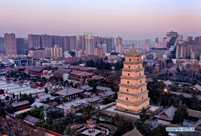 Sunset scenery of Dayan Pagoda in Xi'an
 Tourists have fun at scenic spot in Nanlong Town, NW China
 Harbin attracts tourists by making best use of ice in winter
 In pics: FIS Alpine Ski Women's World Cup Slalom
 Black-necked cranes rest at reservoir in Lhunzhub County, Lhasa
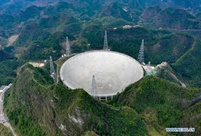 China's FAST telescope will be available to foreign scientists in April
 "She power" plays indispensable role in poverty alleviation
 Top 10 world news events of People's Daily in 2020
 Top 10 China news events of People's Daily in 2020
 Top 10 media buzzwords of 2020
 Year-ender:10 major tourism stories of 2020
 No interference in Venezuelan issues
 Biz prepares for trade spat
 Broadcasting Continent
 Australia wins Chinese CEOs as US loses