

○ Oil spill caused by foreign crude tanker collision in East China Sea continues to spread off the Chinese coastline
○ Serious long-term impact on local marine environment has been predicted by experts
○ China's major fishing hub is bracing for potential ecological and economic damage
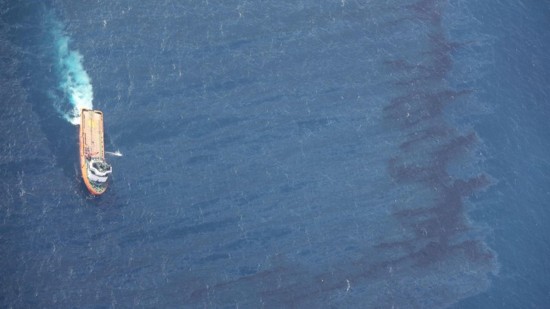
This picture from the Transport Ministry of China on January 15 shows offshore supply ship De Shenworking at an oil spill area off the coast of East China after the Sanchisank. Photo: VCG
As a massive oil spill caused by the crash of Iranian tanker Sanchiearlier this month continues to spread across the East China Sea, fishermen and sea farmers in China's largest fishing hub are worried about potential ecological damage.
The fully laden crude tanker, owned and operated by the National Iranian Tanker Company (NITC), suffered a major explosion and sank eight days after its collision with Hong Kong-flagged freighter CF Crystal.
The foreign tanker was carrying condensate, an ultra-refined, highly volatile form of ultra light oil used to make products such as jet fuel. Satellite images show that the spilt oil covered 332 square kilometers of water on Sunday, The Cover reported.
In the winter, low temperatures reduce evaporation speed, leaving massive condensate floating on the surface as waves spread. Experts warn of the serious immediate and long-term impact on the marine environment.
"The oil on the surface evolves to be highly concentrated, which hinders the respiration of marine life. Oily water containing sulphide can also poison and even kill sea creatures. Without professional treatment and scientific management, its harm will soon become obvious," Huang Weiqiu, a professor at Changzhou University Petroleum Engineering Department, interpreted.
The unpredictable expansion of the massive oil slick worries many fishermen in Zhoushan, Zhejiang Province, which is China's biggest and most important fishery hub.
Sun Yun (pseudonym), who farms mussels in the sea off Zhoushan, is one of them. After the crash, he was in a panic and rightly concerned about the potential ecological and economical effects on his livelihood. He recruited people to observe if there was oil floating near his sea area and purchased heavy metal test papers to prepare for subsequent risks.
Some other local residents remained relatively calm about the potential risks, counting on pure speculation. "The sea area is vast. I guess there would not be a serious problem as long as the wind blows strongly," a resident who lives in Zhoushan city was quoted by Chinese media jiemian.com as saying.

A sea farm for mussels in Zhoushan, Zhejiang Province. Photo: VCG
Local impact
Regarding the public's concern over seafood safety, Professor Huang said, "it will definitely have an impact on local fish spawning and nursery areas, which in turn will affect food safety." Now it is imperative to calculate the size of the involved area and analyze the specific composition and concentration, he said.
He advises local fishermen to stop their activities in the area, at least temporarily. "Fisheries must make a quick assessment about the severity of pollution via visual or osphresis (smelling) inspection," he added.
On January 18, China's Ministry of Agriculture launched an investigation of the impact of the Sanchi collision on Chinese fisheries. Two investigative ships departed from Zhoushan fishing port on the same day to the wreck.
Currently, rescue teams are working against the clock to clean up oil slicks. China's State Oceanic Administration (SOA) is preparing to use professional air-sea stereoscopic equipment to continuously carry out monitoring. They are paying increased attention to protecting the valuable marine ecosystem and find solutions to safeguard local residents' health and productivity.
On January 22, SOA China Marine surveillance team #2502and Xiangyanghong #06and #19patrolled and monitored the vicinity. Due to furious billows, there was no obvious oil pollution observed on the surface, Xinhua reported.
As jiemian.com reported, a local environmental group is also heading to coastal fishing villages along Zhoushan to learn more about the situation. He Li, founder of the group, told media that he is collecting more information on the dangers of pollution brought by this particular collision, in order to inform local fishermen.
"They have right to understand the impact on their future business," said He Li.
How to scientifically deal with the Sanchioil slick and avoid a "worst-case scenario" has become a top priority for Chinese maritime authorities.
On Thursday, maritime authorities with the Chinese mainland, Iran, Panama and the Hong Kong Special Administrative Region signed an agreement to launch a joint investigation into the collision between the Sanchiand the CF Crystal, the Ministry of Transportannounced.
Meanwhile, an innovative, new oil-absorbent material invented by Suzhou University has attracted the attention of the Shanghai Maritime Bureau, reported Chinese State media dyol.com.
The material, called "oil absorption treasure," was developed by Professor Lu Jianmei, vice president of Suzhou University, and her team. Its unique advantages include fast, large-volume absorption and cyclic utilization. It won second place in the National Prize for Progress in Science and Technology 2014 awards.
Soochow University Material and Chemistry Department said that relevant maritime sectors have loaded 15,000 square meters of this "oil absorption treasure" onto rescue vessels preparing to dispose the leaked condensate.
Lu told media that the concept of her research was a result of the Gulf War disaster. The war left many pipelines leaking crude oil into the sea, causing tremendous harm to sea life as well as mankind. This poignant memory impelled Lu to develop a high-efficiency oil absorption material to tackle future oil slicks.
"The magic is its innovative chemical structure," Lu said, explaining that similar products normally require four to six hours to complete a clean-up while their material takes only two to eleven seconds to "lock up oil."
Its quick reaction makes it especially suitable for large-scale emergencies like the Sanchispill. Reportedly, this "oil absorption treasure" has been used in previous oil crises including the Dalian Xingang oil pipeline explosion and the Deepwater Horizon oil spill in 2010.
 Fire brigade in Shanghai holds group wedding
 Tourists enjoy ice sculptures in Datan Town, north China
 Sunset scenery of Dayan Pagoda in Xi'an
 Tourists have fun at scenic spot in Nanlong Town, NW China
 Harbin attracts tourists by making best use of ice in winter
 In pics: FIS Alpine Ski Women's World Cup Slalom
 Black-necked cranes rest at reservoir in Lhunzhub County, Lhasa
 China's FAST telescope will be available to foreign scientists in April
 "She power" plays indispensable role in poverty alleviation
 Top 10 world news events of People's Daily in 2020
 Top 10 China news events of People's Daily in 2020
 Top 10 media buzzwords of 2020
 Year-ender:10 major tourism stories of 2020
 No interference in Venezuelan issues
 Biz prepares for trade spat
 Broadcasting Continent
 Australia wins Chinese CEOs as US loses