

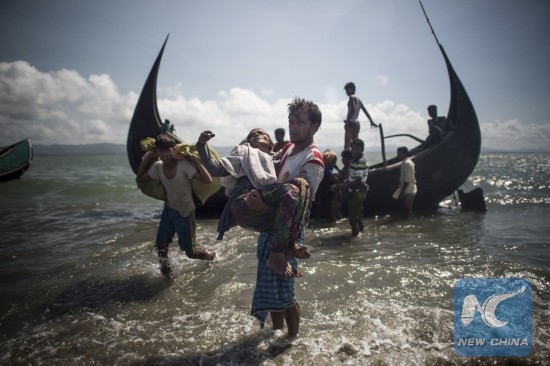
A Bangladeshi man helps Rohingya Muslim refugees to disembark from a boat on the Bangladeshi shoreline of the Naf river after crossing the border from Myanmar in Teknaf on September 30, 2017. (Xinhua/AFP)
UNITED NATIONS, Nov. 27 (Xinhua) -- The number of Rohingya refugees who have fled from Myanmar to Bangladesh since Aug. 25 has reached 624,000, said the UN Office for the Coordination of Humanitarian Affairs on Monday.
An average of 430 Rohingya refugees entered Bangladesh per day this past week, a slowdown compared to the previous week.
The Rohingyas fled their homes in northern Rakhine State of Myanmar into neighboring Bangladesh after deadly attacks staged by the rebel Arakan Rohingya Salvation Army on police posts on Aug. 25 allegedly touched off a wave of retribution by government and vigilante forces.
Rohingyas arriving in refugee camps -- some having traversed an inlet of the Bay of Bengal on makeshift rafts and boats -- reported widespread violence against them.
On reports of an agreement between Bangladesh and Myanmar on the repatriation of the refugees, UN spokesman Stephane Dujarric said it is important that people are able to return to the place they came from "in a safe, dignified and protected manner."
The ethnic Rohingyas are denied citizenship in the largely Buddhist nation.
 Fire brigade in Shanghai holds group wedding
 Tourists enjoy ice sculptures in Datan Town, north China
 Sunset scenery of Dayan Pagoda in Xi'an
 Tourists have fun at scenic spot in Nanlong Town, NW China
 Harbin attracts tourists by making best use of ice in winter
 In pics: FIS Alpine Ski Women's World Cup Slalom
 Black-necked cranes rest at reservoir in Lhunzhub County, Lhasa
 China's FAST telescope will be available to foreign scientists in April
 "She power" plays indispensable role in poverty alleviation
 Top 10 world news events of People's Daily in 2020
 Top 10 China news events of People's Daily in 2020
 Top 10 media buzzwords of 2020
 Year-ender:10 major tourism stories of 2020
 No interference in Venezuelan issues
 Biz prepares for trade spat
 Broadcasting Continent
 Australia wins Chinese CEOs as US loses