

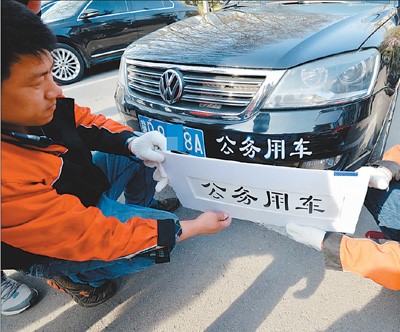
Handan, a city in north China's Hebei Province, launches car reforms by making a requirement to mark government vehicles with special stickers, in order to put the use of government cars under public oversight. (Photo by People’s Daily Online)
Thanks to China’s reform on use of government cars, a total of 3,868 official cars across 140 central government departments have been taken out of service over the past five years, accounting for over 60 percent of all government vehicles, said the latest data from the National Government Offices Administration.
Besides the central authorities, 29 provinces, autonomous regions and municipalities have almost completed the car reforms, and the focus has shifted to public institutions and state-owned enterprises, the administration added.
This crackdown on “corruption on wheels” has been part of China’s campaign to tighten party discipline since the 18th National Congress of the Communist Party of China (CPC).
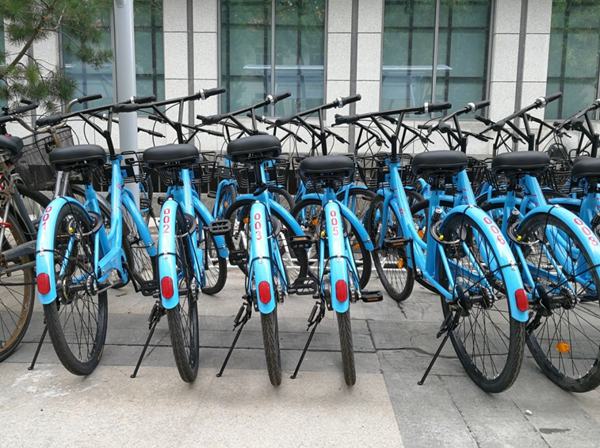
Some central authorities offer shared bikes for public servants after the launch of car reform. (Photo by Huan Xiang from People’s Daily)
By replacing the outdated management model with a new economic way, the reform has funda-mentally solved the difficulties in car management previously faced by government departments at all levels, the administration added.
The car reform called for government departments to scrap the use of vehicles for regular gov-ernment affairs and to keep only a few vehicles on hand for special uses, such as, emergency disposal, classified mail correspondence; technical supports and law enforcement.
The government is instead expected to allocate a "proper amount" of subsidies for public servants to allow them to choose their own means of transportation.
Those spared cars, after their legal documents are verified, have been auctioned.
In order to further prevent the government cars from use for private affairs, some authorities even put special stickers or signs to mark government vehicles, or installed GPS trackers.
So far, nearly 20 provinces have adopted the first method, while Guangdong, Gansu, Hunan, Si-chuan and some other provinces chose the latter, in a bid to tighten the supervision on misuse of official vehicles.
 Fire brigade in Shanghai holds group wedding
 Tourists enjoy ice sculptures in Datan Town, north China
 Sunset scenery of Dayan Pagoda in Xi'an
 Tourists have fun at scenic spot in Nanlong Town, NW China
 Harbin attracts tourists by making best use of ice in winter
 In pics: FIS Alpine Ski Women's World Cup Slalom
 Black-necked cranes rest at reservoir in Lhunzhub County, Lhasa
 China's FAST telescope will be available to foreign scientists in April
 "She power" plays indispensable role in poverty alleviation
 Top 10 world news events of People's Daily in 2020
 Top 10 China news events of People's Daily in 2020
 Top 10 media buzzwords of 2020
 Year-ender:10 major tourism stories of 2020
 No interference in Venezuelan issues
 Biz prepares for trade spat
 Broadcasting Continent
 Australia wins Chinese CEOs as US loses