

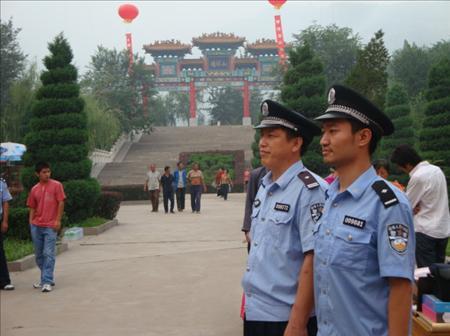
File photo
BEIJING, Oct. 5 (Xinhua) -- The ongoing combined National Day and Mid-Autumn Festival holiday period has been a busy time for a select group of Chinese police, known as "tourist police."
China's first tourist police unit was established in the city of Sanya in October 2015. This holiday period they have teamed up with inspectors from the city's industrial and commercial administration bureau to uncover tourism-related crime.
On Sept. 29, seafood restaurant Xiaoyanjing was fined 200,000 yuan, its business license was revoked and two men suspected of business fraud and bribery were detained.
As of September, China had established 131 tourist police units and 221 circuit courts specializing in tourism-related crime, according to the China Tourism News published on Wednesday.
At Tai'erzhuang, a town in Shandong Province with a history dating back to Qin Dynasty (221 BC -207 BC), tourist police officers monitor 1,000 fixed and six aerial cameras. If an emergency occurs, they must respond quickly to avoid damage or injuries.
"Personal safety is the baseline for tourism, especially during festivals or holiday periods," said Tan Yunzhou, police chief in Tai'erzhuang.
"If there is a disagreement between tourists and business operators or an argument amongst tourists, we must rush to the site, record evidence and control the situation as quickly as possible," he said.
In Beijing, a special tourist police unit has been established to prevent illegal agents, forced shopping and price fraud cases.
From Sept. 26 to Oct. 1, the unit had placed seven people in criminal detention and another 31 to administrative detention.
At the Badaling scenic area, a section of the Great Wall in the suburbs of Beijing, police have handled more than 200 tourist-related cases since early September.
Given that crime against tourists can hinder tourism and damage a location's image, many Chinese cities have realized the importance of having a specialist police unit for tourism-related issues.
Before the tourist police unit was established in Sanya, local restaurants were reportedly charging exorbitant prices after meals had been ordered, taxi drivers often made inconvenient detours to increase fares and local guides added compulsory shopping stops to earn extra commission.
To find out how best to rectify these issues, Sanya sent a police delegation to Russia to learn from their counterparts in Moscow.
Many countries with major tourism industries, such as Greece, Thailand and Egypt, also have specialist tourist police units. The officers are responsible for information inquiries, lost and found belongings, fraud complaints and other issues.
During the National holiday period, officer Zhu Hongguang and his colleagues in Tai'erzhuang take shifts patrolling around the clock. Each carries a first-aid kit in case tourists need emergency assistance or treatment.
"First-aid is the basic skill required of us," Zhu said.
 Fire brigade in Shanghai holds group wedding
 Tourists enjoy ice sculptures in Datan Town, north China
 Sunset scenery of Dayan Pagoda in Xi'an
 Tourists have fun at scenic spot in Nanlong Town, NW China
 Harbin attracts tourists by making best use of ice in winter
 In pics: FIS Alpine Ski Women's World Cup Slalom
 Black-necked cranes rest at reservoir in Lhunzhub County, Lhasa
 China's FAST telescope will be available to foreign scientists in April
 "She power" plays indispensable role in poverty alleviation
 Top 10 world news events of People's Daily in 2020
 Top 10 China news events of People's Daily in 2020
 Top 10 media buzzwords of 2020
 Year-ender:10 major tourism stories of 2020
 No interference in Venezuelan issues
 Biz prepares for trade spat
 Broadcasting Continent
 Australia wins Chinese CEOs as US loses