

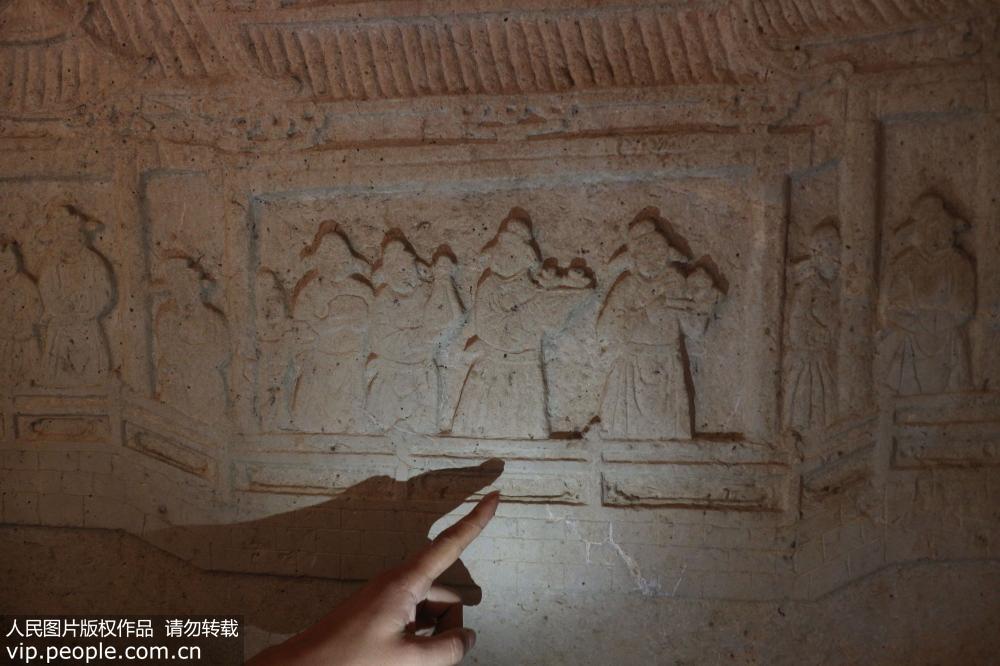
Archaeologists have discovered five more tombs belonging to the Tusi chieftains in southwest China's Guizhou Province.
The Tusi system was an ancient chieftain system adopted by feudal Chinese emperors to govern ethnic minorities in the southwest from the 13th to the early 20th century. "Tusi" refers to a tribal leader appointed as an imperial official by the central government.
The tombs were found in Zunyi City. Of the newly found tombs of the Yang family, three belong to Tusi chieftains of the Yuan Dynasty (1271-1368 A.D.). Nine Yang family tombs had already been discovered, according to the Guizhou Provincial Institute of Cultural Relics and Archaeology.
Zunyi was historically called Bozhou. The Yang family was one of the major four chieftain families in Guizhou. The family governed Bozhou for 725 years until 1601, when the last chieftain Yang Yinglong died in a failed rebellion.
The tombs will provide rich material for research about the Tusi chieftain system and culture, according to the institute.
 Fire brigade in Shanghai holds group wedding
 Tourists enjoy ice sculptures in Datan Town, north China
 Sunset scenery of Dayan Pagoda in Xi'an
 Tourists have fun at scenic spot in Nanlong Town, NW China
 Harbin attracts tourists by making best use of ice in winter
 In pics: FIS Alpine Ski Women's World Cup Slalom
 Black-necked cranes rest at reservoir in Lhunzhub County, Lhasa
 China's FAST telescope will be available to foreign scientists in April
 "She power" plays indispensable role in poverty alleviation
 Top 10 world news events of People's Daily in 2020
 Top 10 China news events of People's Daily in 2020
 Top 10 media buzzwords of 2020
 Year-ender:10 major tourism stories of 2020
 No interference in Venezuelan issues
 Biz prepares for trade spat
 Broadcasting Continent
 Australia wins Chinese CEOs as US loses