

 |
| File photo |
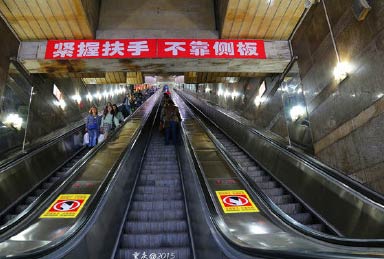
Southwest China's Chongqing Municipality is extending a subway station to more than 94 meters underground, the equivalent of 31 stories down, which will make it China's deepest station.
Hongtudi station, which opened on Line 6 years ago, was dubbed Chongqing's deepest station at 60 meters below ground. Now, it is being extended deeper to connect with Line 10, a new metro line to be opened by the end of 2017.
Chongqing is known as a "mountain city" in China. Because of the hilly terrain and to avoid damaging air-raid shelters and pile foundation of street buildings, the station has to be built deep underground.
It currently takes commuters more than three minutes to get from the platform of Line 6 to the street by taking elevators, longer if they choose to climb the 354 steps.
The station's 32 elevators will be increased to 91 when it becomes a transfer station.
In recent years, Chongqing is speeding up the construction of its subway system as the increasing number of vehicles on the road has caused traffic jams.
Like Chongqing, many Chinese cities are pushing forward the development of rail transit systems. Figures from the National Bureau of Statistics showed that China had 4,153 kilometers of urban rail networks in operation across 30 cities as of the end of 2016.
 Fire brigade in Shanghai holds group wedding
 Tourists enjoy ice sculptures in Datan Town, north China
 Sunset scenery of Dayan Pagoda in Xi'an
 Tourists have fun at scenic spot in Nanlong Town, NW China
 Harbin attracts tourists by making best use of ice in winter
 In pics: FIS Alpine Ski Women's World Cup Slalom
 Black-necked cranes rest at reservoir in Lhunzhub County, Lhasa
 China's FAST telescope will be available to foreign scientists in April
 "She power" plays indispensable role in poverty alleviation
 Top 10 world news events of People's Daily in 2020
 Top 10 China news events of People's Daily in 2020
 Top 10 media buzzwords of 2020
 Year-ender:10 major tourism stories of 2020
 No interference in Venezuelan issues
 Biz prepares for trade spat
 Broadcasting Continent
 Australia wins Chinese CEOs as US loses