
BEIJING, June 19 -- China's Tianzhou-1 cargo spacecraft completed its second docking with Tiangong-2 space lab at 2:55 p.m. Monday, after flying around the space lab.
Tianzhou-1 separated from Tiangong-2 on Monday morning and remained at distance of five kilometers behind the space lab for about 90 minutes.
Then, it was commanded to fly around Tiangong-2 from behind to a distance of five kilometers in front of the space lab. During the flight, both Tianzhou-1 and Tiangong-2 turned in a semicircle.
The experiments tested docking technology at different directions, which is of great importance to building a space station, according to the China Manned Space Engineering Office.
Tianzhou-1, China's first cargo spacecraft, was launched on April 20 from south China's Hainan Province, and it completed automated docking with the orbiting Tiangong-2 space lab on April 22.
The two spacecraft completed their first in-orbit refueling on April 27 and their second in-orbit refueling on June 15.
China is the third country, after Russia and the United States, to master refueling techniques in space, which is crucial in the building of a permanent space station.
As the International Space Station is set to retire in 2024, the Chinese space station will offer a promising alternative, and China will be the only country with a permanent space station.
 Fire brigade in Shanghai holds group wedding
 Tourists enjoy ice sculptures in Datan Town, north China
 Sunset scenery of Dayan Pagoda in Xi'an
 Tourists have fun at scenic spot in Nanlong Town, NW China
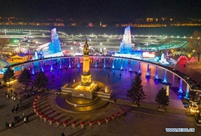 Harbin attracts tourists by making best use of ice in winter
 In pics: FIS Alpine Ski Women's World Cup Slalom
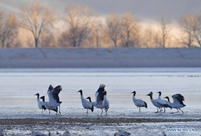 Black-necked cranes rest at reservoir in Lhunzhub County, Lhasa
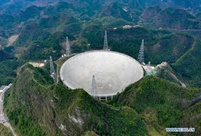 China's FAST telescope will be available to foreign scientists in April
 "She power" plays indispensable role in poverty alleviation
 Top 10 world news events of People's Daily in 2020
 Top 10 China news events of People's Daily in 2020
 Top 10 media buzzwords of 2020
 Year-ender:10 major tourism stories of 2020
 No interference in Venezuelan issues
 Biz prepares for trade spat
 Broadcasting Continent
 Australia wins Chinese CEOs as US loses