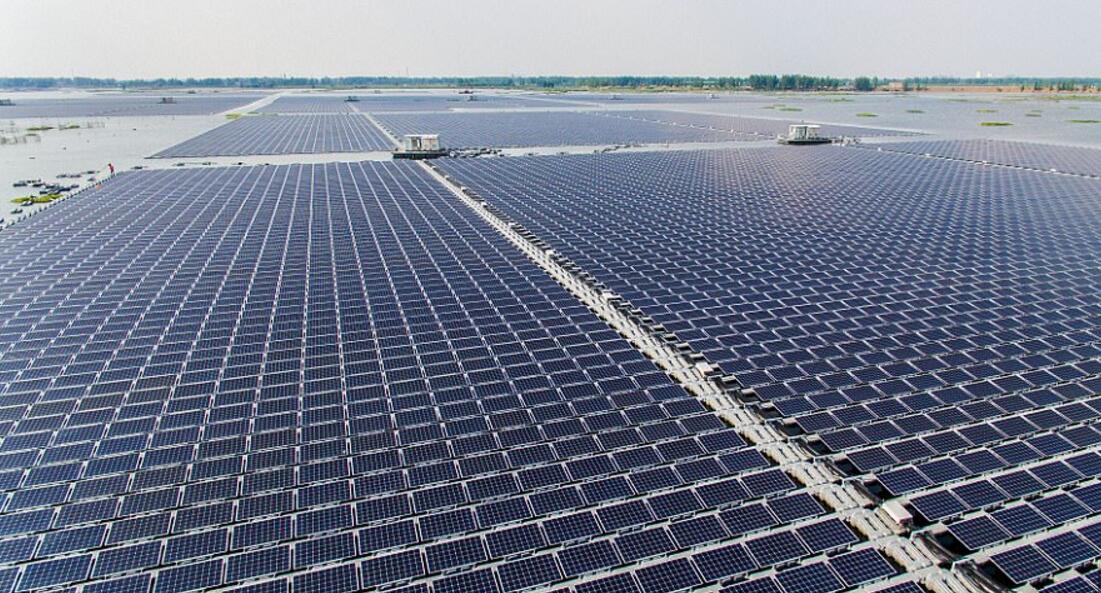
Located in eastern China, the plant has a capacity of 40 megawatts of energy - enough to power over 15,000 homes
Just as Donald Trump pulled the United States out of the Paris climate agreement, China flicked the switch on the world's largest floating solar energy plant.
The massive waterborne plant is expected to generate 40 megawatts at one time and could supply electricity for over 15,000 homes.
The pioneering project, located in eastern China, is thought to cement China's status as a top producer of solar energy in the world.
The plant has been built in Huainan city, Anhui Province, by Sungrow Power Supply, a Chinese company specialised in renewable energy.
The ambitious company has put the first phase of the project into use after connecting hundreds of solar panels to form the impressive power plant, according to its website.
In order to find a body of water large enough to hold the plant, workers filled an abandoned coal mine with water to create a reservoir.
The cool air near the surface of the water would help reduce the heat generated from the solar panels and lower the risk of battery malfunction, said Chinese news website Sohu.
In addition, building a solar plant on water could save land space, which puts China one step ahead of other countries in providing green energy, according to the same report.
The solar power plant is expected to generate 800 megawatts a year.
Last year, Britain built a similar floating solar plant on the Queen Elizabeth II reservoir in Walton-on-Thames, which is due to power 1,800 homes. The power station features 23,046 solar panels and measures 57,046 sq metres (618,925 square feet).
The floating plant in China is six times the size of the plant in Britain.
Donald Trump pulled the United States out of the Paris accord on climate change on June 1 - deriding it as bad for American jobs and bad for the environment.
The decision could accelerate China's unlikely ascent toward leadership in stemming global warming and promoting green technology, and on global matters far removed from the environment.
The world's largest emitter of man-made carbon dioxide, considered a top cause of climate change, is already making rapid progress toward its Paris goal of stopping emissions growth by 2030.
It has overtaken the U.S. in transitioning to renewable energy, generating a fifth of its electricity from renewable sources. The U.S. only sources about 13 per cent of its electricity from renewables.
 Fire brigade in Shanghai holds group wedding
 Tourists enjoy ice sculptures in Datan Town, north China
 Sunset scenery of Dayan Pagoda in Xi'an
 Tourists have fun at scenic spot in Nanlong Town, NW China
 Harbin attracts tourists by making best use of ice in winter
 In pics: FIS Alpine Ski Women's World Cup Slalom
 Black-necked cranes rest at reservoir in Lhunzhub County, Lhasa
 China's FAST telescope will be available to foreign scientists in April
 "She power" plays indispensable role in poverty alleviation
 Top 10 world news events of People's Daily in 2020
 Top 10 China news events of People's Daily in 2020
 Top 10 media buzzwords of 2020
 Year-ender:10 major tourism stories of 2020
 No interference in Venezuelan issues
 Biz prepares for trade spat
 Broadcasting Continent
 Australia wins Chinese CEOs as US loses